

CBD · Harvest Timing

Scientific Research
Trichome Biology and Cannabinoid Biosynthesis in Cannabis sativa
From Epidermal Glands to Bioactive Molecules: the Molecular Factory Inside Every Bud
March 2026
25 min read
Cannabis Science

Cannabis trichomes are the microscopic glandular structures responsible for virtually all cannabinoid biosynthesis in Cannabis sativa L. — the primary sites where THCA, CBDA, terpenes, and flavonoids accumulate to define each cultivar’s chemical fingerprint.[1] Although Cannabis sativa has been cultivated for millennia for its fiber and seed oil, it is precisely these epidermal glands that make it one of the most biochemically complex plants known. Furthermore, understanding cannabis trichomes at the cellular and molecular level is not merely an academic exercise: it is, in fact, the foundation for precision cultivation strategies, quality control in legal markets, and the development of AI-assisted monitoring platforms such as GrowBotiq.
In this article, we provide a rigorous scientific overview of cannabis trichome morphology and development, the enzymatic cascades that drive cannabinoid biosynthesis from simple acetyl-CoA precursors, and how real-time trichome monitoring translates this biochemistry into actionable grow-room intelligence.
Cannabis Trichome Morphology: Three Distinct Architectures
Cannabis sativa produces both non-glandular (cystolithic) and glandular trichomes. Non-glandular trichomes serve primarily as physical barriers against herbivory and UV radiation. Glandular cannabis trichomes, by contrast, synthesize and secrete a complex resin rich in cannabinoids and terpenes. Moreover, three glandular types are recognized, differing in stalk length, head cell number, and metabolite specialization:[1,2]
Bulbous Trichomes
The smallest type (~15–30 µm), scattered across all aerial surfaces. Consist of a single or pair of basal epidermal cells supporting a small head of 2–4 secretory cells. Their contribution to overall cannabinoid content is minimal, but they are present early in development and may have signaling roles.
Sessile (Capitate-Sessile) Trichomes
Intermediate size (~25–100 µm), distributed on leaves and floral bracts. Possess a short or absent stalk and a multicellular secretory head (8–16 cells). More metabolically active than bulbous trichomes; contain measurable cannabinoid and terpene levels.
Stalked (Capitate-Stalked) Trichomes
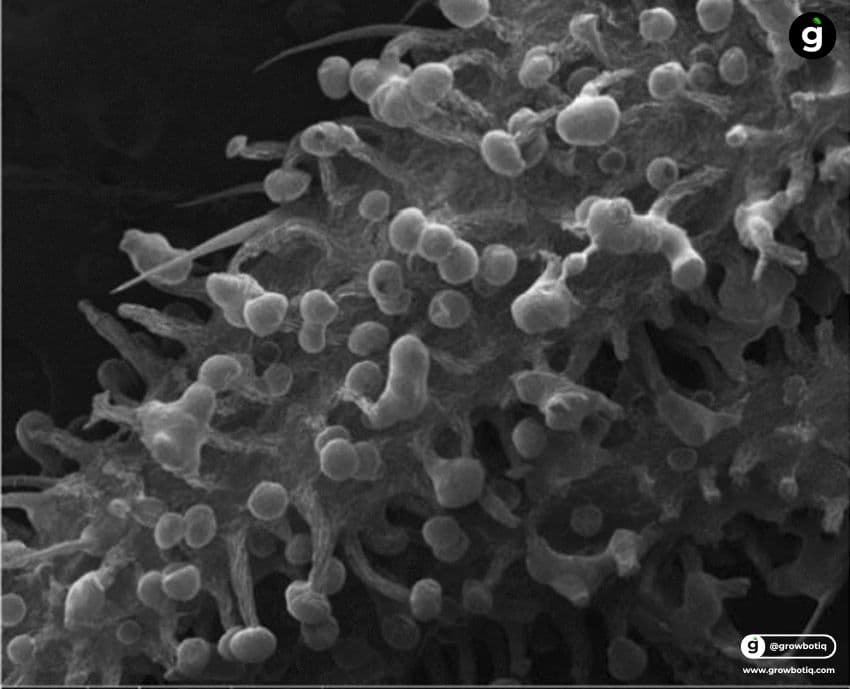
The largest and most pharmacologically relevant type (150–500 µm). A tall, multicellular stalk elevates a large secretory disc head (up to 16 secretory cells) capped by a cuticle-enclosed subcuticular space that stores the resin. These dominate inflorescences and account for the vast majority of THCA, CBDA, and terpene accumulation.[3]
🔬 Key Finding
Livingston et al. (2020) demonstrated using scanning electron microscopy and single-cell metabolomics that stalked capitate trichomes undergo a progressive morphological transition during flower maturation — from compact secretory discs with clear cytoplasm to electron-dense heads packed with resin — correlating with a three- to four-fold increase in THCA and monoterpene concentration over a six-week flowering window.[3]
Initiation and Development of Cannabis Trichomes
Trichome initiation is regulated by a conserved transcription factor network involving MYB, bHLH, and WD40 proteins — originally characterized in Arabidopsis thaliana but found to be active in Cannabis as well.[4] In Cannabis, trichome density and size are strongly modulated by several environmental and genetic factors:
Developmental Stage
Stalked trichome density peaks during mid-to-late florescence. Maturation of the secretory head — measurable by the opacity of the cuticle from clear to cloudy to amber — is the classical indicator of harvest timing.[3]
Genetics and Ploidy
Trichome density, head diameter, and metabolite ratios are heritable quantitative traits. Cultivar selection remains the most reliable lever for obtaining a specific chemotype (THC-dominant, CBD-dominant, balanced).[5]
Photoperiod and Light Quality
Short-day photoperiod (12:12 h) triggers the transition to florescence and accelerates trichome differentiation. UV-B radiation (280–315 nm) upregulates secondary metabolite biosynthesis, increasing terpene and cannabinoid titers.[6]
Temperature and VPD
Cooler night temperatures during late flowering reduce monoterpene evaporative losses and preserve resin integrity. High vapor-pressure deficit (VPD) stress can negatively impact secretory cell function and reduce metabolite output.[7]
At the subcellular level, the secretory cells of mature stalked cannabis trichomes are characterized by an abundant smooth endoplasmic reticulum (sER), numerous leucoplasts with prominent internal membranes, and mitochondria — organelles consistent with high biosynthetic flux through both the MEP (plastidial) and MVA (cytosolic) isoprenoid pathways.[8] In other words, these microscopic structures are genuine high-throughput biochemical factories.
Cannabinoid Biosynthesis Inside Cannabis Trichomes: The Enzymatic Cascade
Cannabinoids are a class of terpenophenolic compounds unique to Cannabis sativa. Their biosynthesis integrates two metabolic streams entirely localized within cannabis trichomes: a polyketide-derived phenolic acid (olivetolic acid) and a geranyl pyrophosphate (GPP) unit derived from the plastidial MEP pathway. The convergence point of this cannabinoid biosynthesis cascade is cannabigerolic acid (CBGA), the universal cannabinoid precursor.[9]
Cannabinoid Biosynthetic Pathway (Simplified)
Hexanoyl-CoA + 3× Malonyl-CoA
Acyl-activating enzyme (CsAAE1) + Olivetol synthase (OLS/CsPT4)
↓
Olivetolic Acid
Olivetolic acid cyclase (OAC)
↓
+ Geranyl Pyrophosphate (GPP) ← MEP pathway
CBGA synthase / Geranylpyrophosphate:olivetolate geranyltransferase (CsPT1)
↓
Cannabigerolic Acid (CBGA)
Universal cannabinoid precursor
↓
THC-dominant
THCA
THCA synthase (THCAS)
↓
Δ⁹-THC (decarboxylation)
CBD-dominant
CBDA
CBDA synthase (CBDAS)
↓
CBD (decarboxylation)
Minor pathway
CBCA
CBCA synthase (CBCAS)
↓
CBC (decarboxylation)
Terminal Oxidocyclases: One Precursor, Three Chemotypes
All three terminal oxidocyclases — THCAS, CBDAS, and CBCAS — are FAD-dependent enzymes belonging to the berberine bridge enzyme (BBE) superfamily. They are encoded by closely related genes and share ~84% amino acid identity, yet produce structurally distinct products through different cyclization mechanisms.[10,11] Consequently, the relative expression of these synthases within cannabis trichomes, combined with upstream flux through CBGA, ultimately determines the chemotypic ratio of the plant.
🔬 Scientific Insight
Sirikantaramas et al. (2004) were the first to clone and heterologously express THCAS in Pichia pastoris, confirming that a single gene product is sufficient to convert CBGA to THCA via an oxidative cyclization mechanism requiring molecular oxygen as the electron acceptor and producing H₂O₂ as a byproduct — a reactive oxygen species (ROS) that may itself trigger stress-responsive secondary metabolite cascades within the trichome.[10]
The Hexanoyl-CoA Precursor: A Critical Bottleneck in Cannabinoid Biosynthesis
The phenolic arm of cannabinoid biosynthesis begins with hexanoyl-CoA — a six-carbon acyl-CoA thioester. Its origin has been a subject of scientific debate: is it derived from fatty acid β-oxidation (shortening of longer-chain fatty acids) or from direct activation of hexanoic acid, a volatile short-chain fatty acid found in cannabis trichome exudates?
Stout et al. (2012) identified a trichome-specific acyl-activating enzyme (CsAAE1) capable of activating medium-chain fatty acids, including hexanoic acid, to their CoA thioesters.[12] Subcellular localization studies placed CsAAE1 in the peroxisome, suggesting that hexanoyl-CoA for cannabinoid biosynthesis may originate from peroxisomal fatty acid β-oxidation — providing a mechanistic link between lipid metabolism and cannabinoid production. As a result, fatty acid availability and peroxisomal function represent potential metabolic targets for optimizing cannabinoid yield through cultivation strategy.
Co-localized Terpene Biosynthesis in Cannabis Trichomes
Cannabis trichomes do not exclusively drive cannabinoid biosynthesis — they are equally the primary source of the plant’s terpene profile. Geranyl pyrophosphate (GPP), produced by the plastidial MEP pathway, is the direct substrate for monoterpene synthases (generating C10 terpenes such as myrcene, limonene, and pinene). GPP is also the building block, via farnesyl pyrophosphate (FPP), for sesquiterpene synthases (generating C15 terpenes such as β-caryophyllene and α-humulene).[13]
Critically, the same GPP pool feeds both the geranylation step of CBGA biosynthesis and monoterpene synthases, creating a direct metabolic competition between cannabinoid and terpene pathways. Therefore, environmental cues — temperature stress, UV-B exposure, and nitrogen availability — differentially regulate flux partitioning between these branches, explaining why certain growth conditions can shift the cannabinoid-to-terpene ratio without altering total metabolic output.[6,13]
MEP Pathway (Plastid)
Produces isopentenyl pyrophosphate (IPP) and DMAPP from pyruvate and glyceraldehyde-3-phosphate. Provides GPP for monoterpene synthases and the GPP arm of cannabinoid biosynthesis. Upregulated by light and elevated CO₂.
MVA Pathway (Cytosol)
Produces IPP from acetyl-CoA via mevalonate. Provides FPP for sesquiterpene synthases and triterpene biosynthesis. Regulated by carbon availability and stress signals. Cross-talk with MEP occurs via isoprene unit exchange across the plastid membrane.
From Cannabis Trichome Biology to Precision Cultivation: the GrowBotiq Perspective
The biochemical complexity described above — developmental timing, environmental sensitivity, and competing enzymatic pathways — means that cannabis trichome status is a real-time readout of the plant’s overall physiological and biosynthetic state. Traditional assessment relies on visual inspection under a loupe or basic digital microscope, a process that is subjective, slow, and often performed too infrequently to catch the narrow optimal harvest window.
GrowBotiq addresses this challenge by applying computer-vision and machine-learning pipelines to continuous macro-photographic streams of inflorescences. The system classifies trichome heads by optical state (transparent → cloudy → amber) and estimates density per unit area — two parameters that, as shown by Livingston et al., correlate strongly with the THCA/CBDA accumulation curve.[3] Moreover, by integrating cannabis trichome phenotyping with real-time environmental sensor data (light intensity, spectrum, temperature, VPD, CO₂), GrowBotiq creates a closed-loop feedback model capable of recommending micro-adjustments to maximize metabolite yield — translating decades of cannabinoid biosynthesis research into actionable grow-room intelligence.
Why Cannabis Trichome Monitoring Matters for Yield
Studies indicate that the peak THCA accumulation window in stalked trichomes spans as little as 5–10 days before enzymatic and photochemical degradation of THCA to CBN accelerates.[3] Missing this window in a commercial grow can mean a 10–25% reduction in potency-per-gram of final product. As a result, AI-assisted continuous trichome assessment is the most direct path to eliminating this variability.
Decarboxylation: Converting Acid Forms to Active Cannabinoids
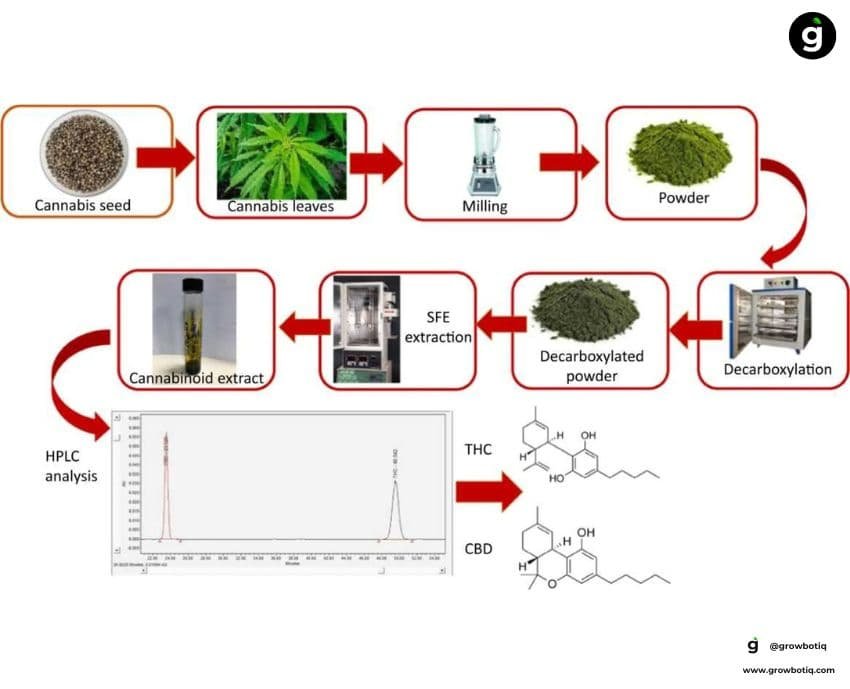
In the living plant, cannabinoids accumulate almost exclusively in their carboxylated acid forms (THCA, CBDA, CBGA, CBCA) inside cannabis trichomes. These acids carry a carboxyl group (–COOH) at the C-2 position of the resorcinol ring, which renders them largely non-psychoactive and modifies their pharmacological profile compared to their decarboxylated counterparts.[14]
Decarboxylation — loss of CO₂ — occurs slowly at ambient temperature (accelerated by light and oxygen exposure), and rapidly upon heating. In addition, the kinetics follow first-order Arrhenius behavior, which means that temperature control during post-harvest processing directly determines the final cannabinoid profile of any extract or product.[15]
⚗️ Decarboxylation Kinetics
Wang et al. (2016) modeled THCA decarboxylation as a first-order reaction with an activation energy of ~104 kJ/mol. At 110 °C (oven decarboxylation), complete conversion requires approximately 60 minutes; at 150 °C, however, the same conversion is achieved in ~7 minutes. Temperatures above 160 °C begin to volatilize and degrade the resulting Δ⁹-THC, reducing bioavailable yield. This places a precise thermal optimum window — critical information for both processing facilities and end-users — fully derivable from first-principles thermochemistry.[15]
Related Articles
Explore the full GrowBotIQ scientific library on Cannabis phytochemistry.
The Power of Trichomes
Flavonoids (Part 2)
Terpenes (Part 3)
References
-
[1]
Small E, Naraine SGU. (2016).
Size matters: evolution of large drug-secreting resin glands in elite pharmaceutical strains of Cannabis sativa L. (marijuana).
Genetic Resources and Crop Evolution, 63(2), 349–378.
doi:10.1007/s10722-015-0254-2 -
[2]
Turner JC, Hemphill JK, Mahlberg PG. (1978).
Cannabinoid content and gland distribution in developing plants of Cannabis sativa L. (Cannabaceae).
Bulletin on Narcotics, 30(4), 55–65. -
[3]
Livingston SJ, Quilichini TD, Booth JK, et al. (2020).
Cannabis glandular trichomes alter morphology and metabolite content during flower maturation.
The Plant Journal, 101(1), 37–56. PMID: 31454101.
PubMed -
[4]
Serna L, Martin C. (2006).
Trichomes: different regulatory networks lead to convergent structures.
Trends in Plant Science, 11(6), 274–280. PMID: 16677838.
PubMed -
[5]
Cascini F, Aiello C, Di Tanna G. (2012).
Increasing delta-9-tetrahydrocannabinol (Δ-9-THC) content in herbal cannabis over time: systematic review and meta-analysis.
Current Drug Abuse Reviews, 5(1), 32–40. PMID: 22150622.
PubMed -
[6]
Lydon J, Teramura AH, Coffman CB. (1987).
UV-B radiation effects on photosynthesis, growth and cannabinoid production of two Cannabis sativa chemotypes.
Photochemistry and Photobiology, 46(2), 201–206. PMID: 3628508.
PubMed -
[7]
Chandra S, Lata H, Khan IA, ElSohly MA. (2008).
Photosynthetic response of Cannabis sativa L. to variations in photosynthetic photon flux densities, temperature and CO₂ conditions.
Physiology and Molecular Biology of Plants, 14(4), 299–306. PMID: 23572148.
PubMed -
[8]
Happyana N, Kayser O. (2016).
Monitoring metabolite profiles of Cannabis sativa L. trichomes during flowering period using ¹H NMR-based metabolomics and real-time PCR.
Phytochemical Analysis, 27(2), 251–259. PMID: 26924560.
PubMed -
[9]
Andre CM, Hausman JF, Guerriero G. (2016).
Cannabis sativa: The Plant of the Thousand and One Molecules.
Frontiers in Plant Science, 7, 19. PMID: 26870049.
PubMed -
[10]
Sirikantaramas S, Morimoto S, Shoyama Y, et al. (2004).
The gene controlling marijuana psychoactivity: molecular cloning and heterologous expression of Δ1-tetrahydrocannabinolic acid synthase from Cannabis sativa L.
Journal of Biological Chemistry, 279(38), 39767–39774. PMID: 15234968.
PubMed -
[11]
Taura F, Sirikantaramas S, Shoyama Y, et al. (2009).
Characterization of olivetol synthase, a polyketide synthase putatively involved in cannabinoid biosynthetic pathway.
FEBS Letters, 583(12), 2061–2066. PMID: 19454282.
PubMed -
[12]
Stout JM, Boubakir Z, Ambrose SJ, et al. (2012).
The hexanoyl-CoA precursor for cannabinoid biosynthesis is formed by an acyl-activating enzyme in Cannabis sativa trichomes.
The Plant Journal, 71(3), 353–365. PMID: 22414025.
PubMed -
[13]
Booth JK, Bohlmann J. (2019).
Terpenes in Cannabis sativa — From plant genome to humans.
Plant Science, 284, 67–72. PMID: 31084954.
PubMed -
[14]
Hanuš LO, Meyer SM, Muñoz E, Taglialatela-Scafati O, Appendino G. (2016).
Phytocannabinoids: a unified critical inventory.
Natural Product Reports, 33(12), 1357–1392. PMID: 27722705.
PubMed -
[15]
Wang M, Wang YH, Avula B, et al. (2016).
Decarboxylation study of acidic cannabinoids: a novel approach using ultra-high-performance supercritical fluid chromatography/photodiode array-mass spectrometry.
Cannabis and Cannabinoid Research, 1(1), 262–271. PMID: 28861498.
PubMed