

Trichomes
Grower’s Guide
When to Harvest Cannabis: Reading Trichomes for Peak Potency
The Science Behind Trichome Maturity and How GrowBotiq Lab Tracks It Automatically on Your iPhone
April 2026
18 min read
Cultivation Guide
Knowing when to harvest cannabis is the single most impactful decision a grower makes at the end of every cycle. Harvest too early and you lose weeks of cannabinoid accumulation; harvest too late and THCA begins converting to CBN — the degradation product that reduces potency and shifts the effect profile toward sedation. Furthermore, terpenes, which define aroma and flavor, are among the most volatile compounds in the plant and degrade rapidly once past peak maturity. The difference between a good harvest and a great one often comes down to a window of just 5 to 10 days.[1]
The most reliable method to identify that window is reading cannabis trichomes — the glandular capitate-stalked trichomes on inflorescences that undergo a well-documented color transition as they mature: from transparent to milky-white to amber, each stage reflecting a distinct biochemical state of THCA and terpene accumulation.[2] In this guide, we break down each stage, explain the science behind it, and show how GrowBotiq Lab — running entirely on your iPhone — monitors trichomes, plant data, and environment automatically so you never miss the peak window again.
🔬
New to trichomes? Start with our deep-dive: The Power of Trichomes — covering trichome types, biology, and their role in cannabis biochemistry.
Why Trichomes Are the Best Harvest Indicator
Growers use several visual cues to estimate harvest readiness: pistil color, calyx swelling, and leaf fade. However, these are indirect proxies for what is actually happening at the biochemical level. Pistil color, for instance, is affected by temperature and humidity fluctuations, leading to false positives. By contrast, trichome color directly reflects the oxidative and enzymatic state of the cannabinoid pool inside each gland.[2,3]
Specifically, stalked capitate trichomes accumulate THCA in the subcuticular space between the secretory head cells and the cuticle. As the plant ages and resin production slows, the resin begins to oxidize, causing the optical shift from clear to cloudy to amber that growers observe under magnification.[1] Monitoring this shift continuously and objectively — not once a week with a loupe — is therefore the most direct path to a consistent, high-quality harvest.
🧬
For the full enzymatic pathway behind THCA and CBDA production inside trichomes, read: Trichome Biology and Cannabinoid Biosynthesis in Cannabis sativa.
The Three Trichome Maturity Stages Explained
When you examine cannabis trichomes under magnification, three distinct visual states are observed. Each corresponds to a specific phase of the cannabinoid biosynthesis and degradation timeline — and each is recognized and tracked in real time by GrowBotIQ Lab:
Clear / Transparent
The trichome head is glassy and transparent. Biosynthesis is still actively producing THCA — the gland is not yet full. Harvesting at this stage results in low potency and an underdeveloped terpene profile.
THC potential: 40–60% of maximum
Too Early
Cloudy / Milky White
The head appears opaque and white. THCA accumulation has peaked; the resin is dense and fully formed. Terpene concentrations are at their maximum. This is the optimal window for a cerebral, energetic effect profile.
THC potential: ~100% of maximum
Peak Window
Amber
The head darkens to amber/gold due to THCA oxidation and partial conversion to CBN. Terpenes degrade. A higher amber ratio shifts effects toward sedation. Ideal for certain therapeutic targets but marks declining potency.
THC potential: progressively declining
Past Peak
🔬 The Biochemistry Behind the Color Change
The optical shift from clear to cloudy results from the progressive densification of THCA resin inside the subcuticular space. The subsequent amber coloration is caused by oxidative degradation: THCA loses its carboxyl group and the resulting Δ⁹-THC further oxidizes to cannabinol (CBN) via a non-enzymatic pathway accelerated by light, heat, and oxygen exposure.[3,4] This is why post-harvest storage conditions — dark, cool, low-oxygen — are as important as harvest timing itself.
What Trichome Ratio Should You Harvest At?
The optimal cloudy-to-amber ratio depends on the desired effect profile, the cultivar, and the end product. Evidence-based guidelines from cultivation science provide a solid starting framework:[1,5]
Maximum THC / Cerebral Effect
Harvest when 70–90% of trichomes are cloudy, with minimal amber (0–10%). THCA content is at its highest; terpene profile is fully expressed. Best for sativa-dominant cultivars and daytime use.
Balanced / All-Round
Harvest at 50–70% cloudy, 20–30% amber. Some THCA has converted to CBN, softening the effect. Suitable for most indica and hybrid cultivars targeting relaxation without heavy sedation.
Sedative / Therapeutic
Harvest at 30–50% cloudy, 40–60% amber. Higher CBN content shifts the pharmacological profile toward sedation and pain relief. Often used in medical contexts.
CBD-Dominant Cultivars
For CBD-dominant genetics, harvest at 80–100% cloudy to maximize CBDA before degradation. The cloudy-to-amber ratio is less critical for psychoactivity but governs terpene integrity and overall profile.
⚠️ Common Mistake: Sampling the Wrong Trichomes
Trichomes on sugar leaves mature faster than those on the calyx and bracts. Always assess the capitate-stalked trichomes directly on the swollen calyx of the main cola for an accurate reading. GrowBotIQ Lab’s camera positioning guide helps you set up the correct framing automatically.
GrowBotiq Lab: Your Entire Grow in One iPhone App
Traditional trichome assessment requires cutting plant material, pointing a loupe or USB microscope at the sample, and making a subjective judgement call — once or twice a week if you are disciplined. The result is a fragmented, inconsistent picture of what is actually happening inside your grow. GrowBotiq Lab is built to replace that entirely.
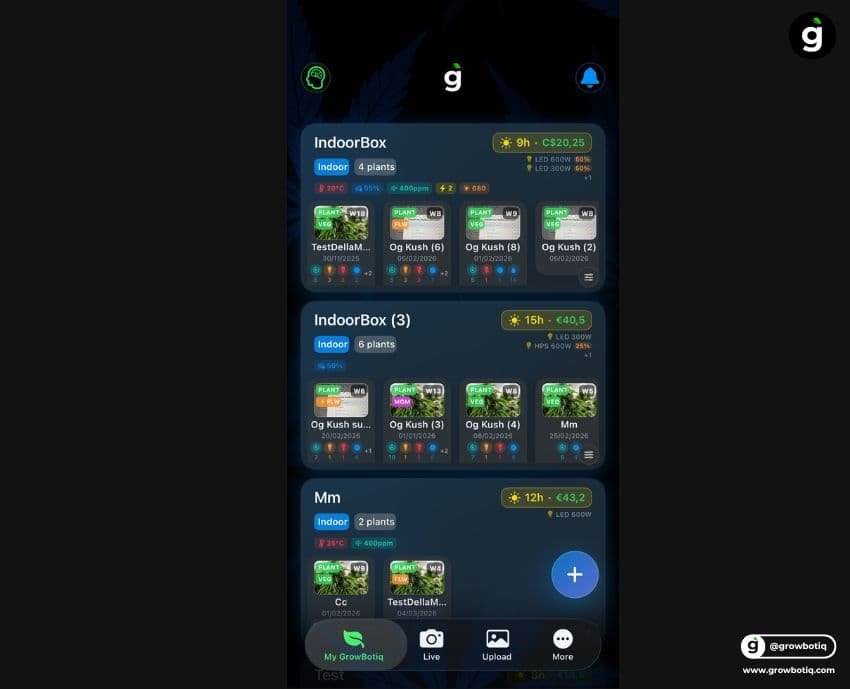
GrowBotiq Lab is an application that centralizes every aspect of plant management — from environmental monitoring to trichome analysis — in a single, connected interface. The AI pipeline runs entirely on-device, leveraging Apple’s Neural Engine directly on your iPhone: no data is sent to the cloud, no subscription to a remote server, no latency. Everything is processed locally, in real time, on the hardware you already have in your pocket.
What GrowBotiq Lab Manages
One app. Every variable that affects your harvest.
🌱
Plant Management
Track each plant individually — genetics, growth stage, notes, and full history from seed to harvest. Never lose context across cycles.
🌡️
Environment Monitoring
Log and visualize temperature, humidity, VPD, CO₂, and light data over time. Spot trends before they become problems.
📋
Grow Logs & Data
Structured daily logs for feeding, watering, training, and observations. All data is timestamped and tied to the specific plant and grow cycle.
🔬
AI Trichome Analysis
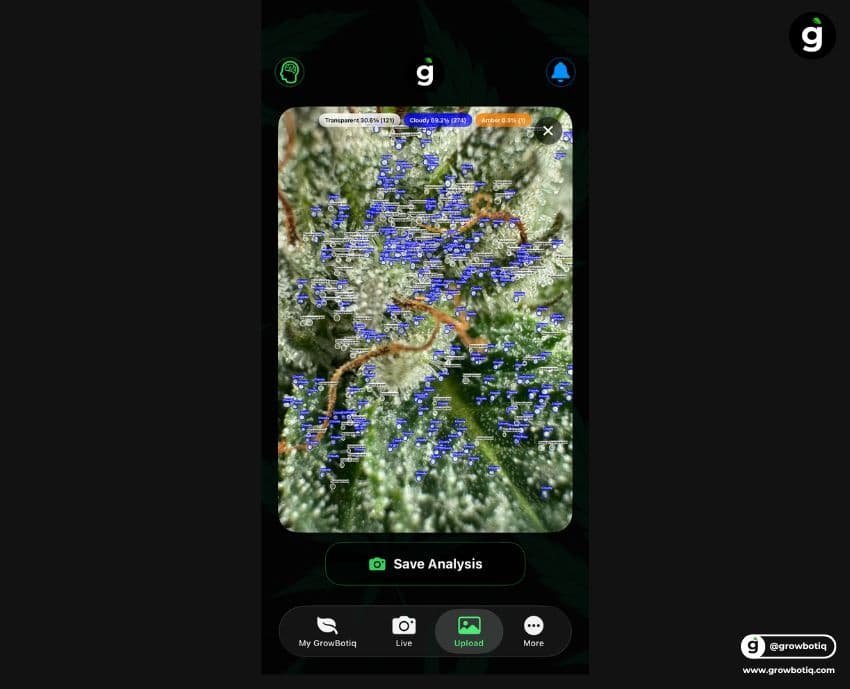
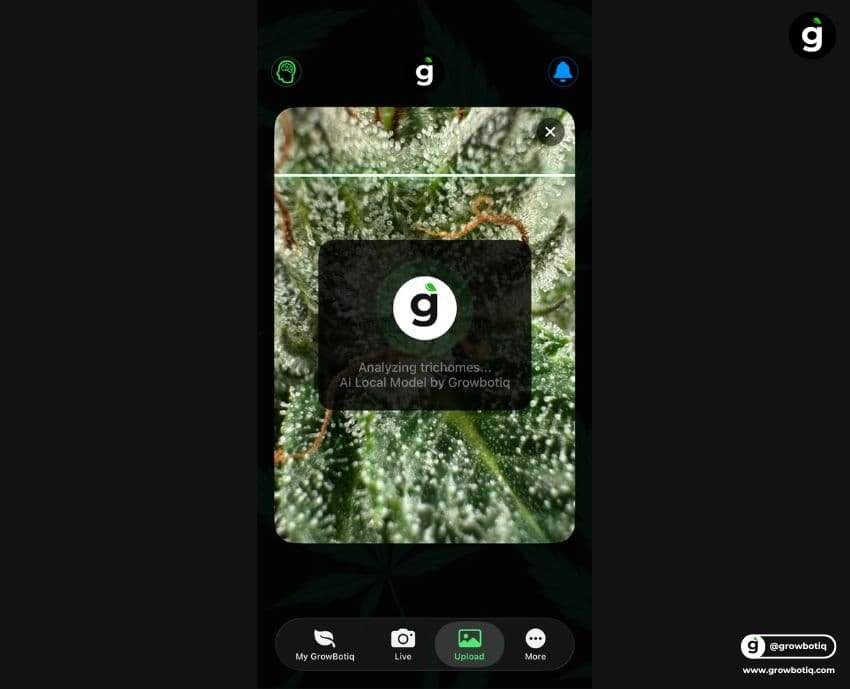
Point your iPhone camera at the inflorescence. The on-device model classifies trichome heads in real time — transparent, cloudy, amber — and outputs a maturity score instantly.
📈
Maturity Tracking
Trichome scores are logged over time to show the maturation curve of each plant. Watch cloudy percentage rise and get notified when the peak window opens.
🍎
Fully On-Device
The entire AI pipeline — model inference, image processing, classification — runs locally on your iPhone. No cloud, no subscription, no internet required in the grow room.
Runs entirely on-device · Apple Neural Engine · No cloud required
The 5–10 Day Problem — Solved
Research shows that the window between peak THCA accumulation and the onset of significant CBN formation spans as little as 5–10 days in most cultivars under standard indoor conditions.[1] A grower checking trichomes once a week — the industry norm — has a statistically high probability of missing this window. GrowBotIQ Lab closes that gap by giving you an objective maturity score every time you open the app, tied to the full environmental and plant log so you understand not just where the plant is, but why.
How Environment Affects Trichome Maturation Rate
The speed at which trichomes transition through the three stages is not fixed — it is modulated by the cultivation environment. GrowBotiq Lab’s environmental logging makes these correlations visible across cycles, turning each grow into data you can act on:
Temperature
High temperatures (>28 °C) accelerate terpene volatilization from trichome heads and speed up THCA oxidation to CBN. Maintaining night temperatures of 18–21 °C during late flowering preserves resin integrity and extends the harvest window.
VPD (Vapor Pressure Deficit)
Excessively high VPD in late flowering creates transpiration stress that can impair secretory cell function. GrowBotIQ Lab logs VPD over time, allowing you to correlate environmental spikes with changes in the trichome maturation curve.[6]
UV-B Exposure
UV-B radiation (280–315 nm) stimulates secondary metabolite production in trichomes. Supplemental UV-B during the last 2–3 weeks has been shown to increase resin density and terpene content.[7] Log your light schedule in the app to track its effect across runs.
Light Intensity (PPFD)
Adequate PPFD in late flower (600–900 µmol/m²/s) sustains the carbon supply needed for continued resin biosynthesis. Dropping intensity too early stalls cannabinoid production prematurely.[8]
💡
For a deep dive into how light spectrum and intensity shape cannabinoid and terpene profiles throughout the grow cycle: How Light Shapes Growth and Metabolite Profiles.
Frequently Asked Questions
Does GrowBotiq Lab work without internet in the grow room?
Yes — this is by design. The entire AI pipeline runs on-device using Apple’s Neural Engine. You do not need Wi-Fi or mobile data to run trichome analysis, log environmental data, or access your plant records. Everything is stored locally on your iPhone.
How does the app classify trichome stages?
GrowBotiq Lab uses a computer-vision model trained on a curated dataset of labeled trichome images captured at different maturity stages. When you point your iPhone camera at the inflorescence, the model processes each visible trichome head in real time, assigns it to a class (transparent, cloudy, or amber), and outputs a percentage breakdown — the maturity score — directly on screen. No cutting, no external hardware required.
Can I track multiple plants and grow cycles?
Yes. GrowBotiq Lab is built around a plant-centric data model: each plant has its own profile, grow log, environmental history, and trichome maturity timeline. You can manage multiple plants simultaneously and compare data across cycles to optimize your process over time.
How long does the cloudy trichome stage last?
Under standard indoor conditions, the peak cloudy window typically lasts 5–10 days before amber trichomes begin to predominate. Higher temperatures or light stress can shorten this window significantly. GrowBotiq Lab’s maturity tracking shows you the rate of change over time, so you can see not just the current score but whether it is accelerating.
Do I need any extra hardware or accessories?
No dedicated hardware is required. GrowBotiq Lab uses your iPhone’s existing camera. For best results, we recommend using the native camera in macro mode (available on iPhone 13 Pro and later) or a simple clip-on macro lens to maximize the number of trichome heads visible in the frame. The app provides framing guidance to help you get a consistent, analysis-ready shot.
What is CBN and why does it matter at harvest?
Cannabinol (CBN) is the oxidative degradation product of Δ⁹-THC. It is mildly sedative and has minimal psychoactivity compared to THC. High CBN content in finished product is a direct indicator that the plant was harvested past peak, or that the flower was improperly dried and stored. Monitoring trichome maturation with GrowBotIQ Lab and harvesting at peak cloudy is the primary strategy to minimize CBN formation.
Continue Reading
Explore the full GrowBotIQ scientific library on Cannabis phytochemistry and cultivation science.
The Power of Trichomes
Cannabinoid Biosynthesis
Light & Metabolite Profiles
Flavonoids (Part 2)
References
-
[1]
Livingston SJ, Quilichini TD, Booth JK, et al. (2020).
Cannabis glandular trichomes alter morphology and metabolite content during flower maturation.
The Plant Journal, 101(1), 37–56. PMID: 31469934.
PubMed -
[2]
Small E, Naraine SGU. (2016).
Size matters: evolution of large drug-secreting resin glands in elite pharmaceutical strains of Cannabis sativa L.
Genetic Resources and Crop Evolution, 63(2), 349–378.
doi:10.1007/s10722-015-0254-2 -
[3]
Hanuš LO, Meyer SM, Muñoz E, et al. (2016).
Phytocannabinoids: a unified critical inventory.
Natural Product Reports, 33(12), 1357–1392. PMID: 27722705.
PubMed -
[4]
Wang M, Wang YH, Avula B, et al. (2016).
Decarboxylation study of acidic cannabinoids: a novel approach using ultra-high-performance supercritical fluid chromatography/photodiode array-mass spectrometry.
Cannabis and Cannabinoid Research, 1(1), 262–271. PMID: 28861498.
PubMed -
[5]
Cascini F, Aiello C, Di Tanna G. (2012).
Increasing delta-9-tetrahydrocannabinol (Δ-9-THC) content in herbal cannabis over time: systematic review and meta-analysis.
Current Drug Abuse Reviews, 5(1), 32–40. PMID: 22150622.
PubMed -
[6]
Chandra S, Lata H, Khan IA, ElSohly MA. (2008).
Photosynthetic response of Cannabis sativa L. to variations in photosynthetic photon flux densities, temperature and CO₂ conditions.
Physiology and Molecular Biology of Plants, 14(4), 299–306. PMID: 23572895.
PubMed -
[7]
Lydon J, Teramura AH, Coffman CB. (1987).
UV-B radiation effects on photosynthesis, growth and cannabinoid production of two Cannabis sativa chemotypes.
Photochemistry and Photobiology, 46(2), 201–206. PMID: 3628508.
PubMed -
[8]
Booth JK, Bohlmann J. (2019).
Terpenes in Cannabis sativa — From plant genome to humans.
Plant Science, 284, 67–72. PMID: 31084880.
PubMed