
Pesticide Residues in Cannabis: Why Batches Fail Testing
In California, 2.3% of flower and 9.2% of extracts failed contaminant tests, most often for pesticides. Illegal Canadian flower nearly always carried them.
 GrowBotiq Research Team· 10 min read
In this article8
A failed pesticide test is one of the most expensive results a licensed grower can get. The batch cannot be sold, and in many markets it has to be destroyed. Yet the people who fail are rarely the ones spraying banned products on purpose.
This guide goes through what has been measured: how often legal cannabis fails, which pesticides turn up, why extracts fail more often than flower, how much of a residue reaches the person using it, and where residues come from when nobody sprayed. It also says plainly what has not been studied.
How often legal cannabis fails
The largest data set comes from California. Researchers mined a year of state compliance records, 5,654 samples of cured flower and 3,760 of extracts, about 6% of legal production. Regulated contaminants were detected in 141 flower and 423 extract samples, and insecticides and fungicides were the most common of them. 2.3% of flower failed, against 9.2% of extracts (Jameson et al., 2022). Those failures include solvents and other contaminants, not only pesticides.
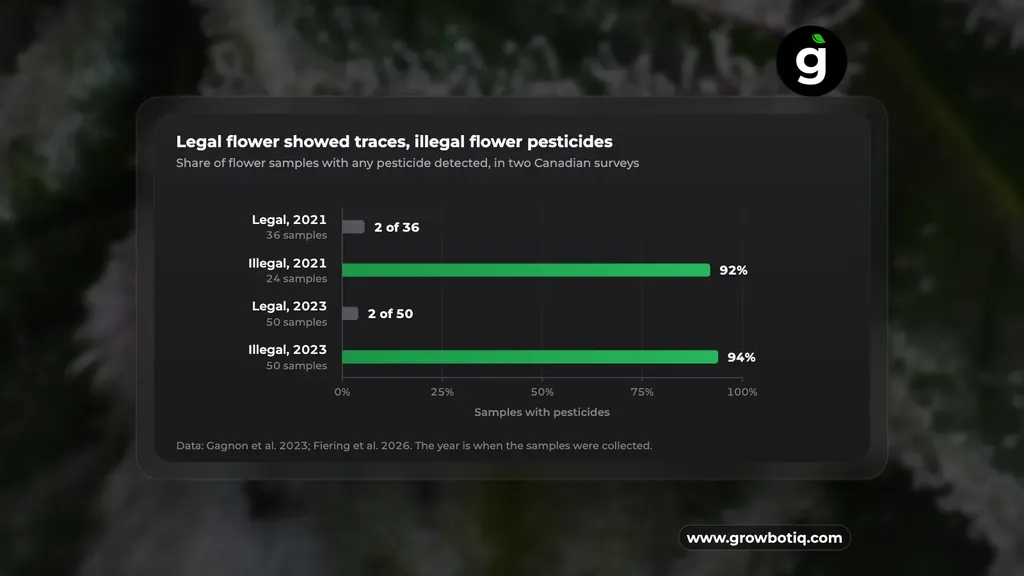
Canada shows how clean regulated flower can be. In a 2021 survey, 2 of 36 legal samples bought from the Ontario Cannabis Store carried a pesticide, each at 0.01 µg/g, the lowest level the method could measure. Of 24 illegal samples seized by police, 92% did, with 3.7 different pesticides per sample on average (Gagnon et al., 2023). A 2023 survey of 50 legal and 50 illegal samples found the same picture: traces in 2 legal samples, pesticides in 94% of the illegal ones, 3.4 per sample (Fiering et al., 2026). The authors think the legal traces were likely environmental or accidental contamination.
A third Canadian group found no detectable target pesticides in legal samples, while six samples from illegal storefronts were all positive, with up to 10 actives each (MacKenzie et al., 2025).
Which pesticides turn up
The same names come back across studies. In the 2023 Canadian survey, myclobutanil, a fungicide used against powdery mildew, was in 72% of illegal samples at up to 130 µg/g, and paclobutrazol, a growth regulator, in 60% (Fiering et al., 2026). Our article on plant growth regulators covers paclobutrazol in detail.
In California's extracts, the most frequent were boscalid in 60 samples, chlorfenapyr in 55, chlorpyrifos in 50, bifenazate in 44 and myclobutanil in 41. Insecticides and fungicides were the most common types (Jameson et al., 2022).
Illegal vape cartridges show the same fingerprint. In fluids recovered during the New York outbreak of vaping lung injuries, 79% of 202 cannabis cartridges contained pesticides, with up to 10 residues in one sample. Myclobutanil was in half of them (Lu et al., 2021). These were black-market products, and the study measured the liquid, not the vapour.
Why extracts fail more often
An extract keeps the resin and leaves most of the plant behind, so it is reasonable to expect residues that dissolve in resin to end up more concentrated. The California data fit that: extracts failed four times as often as flower, and 94 extract samples carried more than one contaminant, against only 3 flower samples (Jameson et al., 2022).
We found no peer-reviewed study that measured the same batch as flower and as extract and reported a concentration factor. What exists is work on cleaning extracts afterwards. In a chromatography model, 7 of 11 pesticides could be separated from the cannabinoids, but pyrethrins, permethrin and piperonyl butoxide overlapped with them (Cuchiaro et al., 2023). Another method separated 50 to 70% of the 59 pesticides on Oregon's list easily from CBD, while 13 to 22% were hard to separate (Luca et al., 2020). Removal is a lab process, and it does not work for every active.
What reaches the smoke
Burning does not destroy most of a residue. In a laboratory test, flower was spiked with four pesticides and smoked through different devices. With a glass pipe, 60 to 70% of each pesticide was recovered in the smoke. With an unfiltered water pipe, 42 to 60%. Cotton and carbon filters brought it down to about 10% for three of the four (Sullivan et al., 2013).
The spiking levels were far above real residues, and each device was run three times, so the exact numbers are a first estimate. The direction is clear: what is on the flower largely reaches the user.
A claim that circulates widely is that myclobutanil turns into hydrogen cyanide when burned. We found no peer-reviewed measurement of it in cannabis smoke. That does not make myclobutanil acceptable on a crop; it is simply not a number to quote.
Same pesticide, very different limits
Whether a batch passes depends on where it is sold. By May 2022, US jurisdictions together regulated 551 pesticides in cannabis, and action levels for the same compound differed by up to four orders of magnitude (Jameson et al., 2022). Across 20 states and Washington DC, the limits for azoxystrobin and chlorantraniliprole ranged from 0.01 to 40 ppm, a 4,000-fold spread, and the 50 most variable limits averaged 32 times the strictest US food tolerances (Pinkhasova et al., 2021).
Canada works differently. It lists 96 actives that are not authorised on cannabis and sets method detection limits rather than allowed residues, so any measurable amount fails (MacKenzie et al., 2025). Measuring them is not easy: in one validation, compounds extracted along with the cannabinoids were the main cause of signal distortion, and recovery of one insecticide fell to 29% in cannabis and 13% in hemp (MacKenzie et al., 2025). Ask your lab which limits of quantification it reaches for the compounds that matter to you.
Where residues come from when nobody sprayed
Licensed growers who fail often insist they never used the product found. The studies give several ways that can happen:
- The room itself. Wipe samples found 41 pesticides on surfaces in a non-certified production facility and 6 in a certified one (Craven et al., 2021). In illicit indoor grows in Belgium, 65.2% of 46 carbon-filter cloths carried pesticides, which points to residues travelling in the air (Cuypers et al., 2017).
- Inputs. In a test of 20 biopesticide products, 9 contained chemical pesticides that were not on the label (Chu et al., 2022). That study was not on cannabis products, but it shows that "biological" on a label is not a guarantee.
- Drift. In a wind tunnel, herbicide drift from corn and soybean sprays halved hemp biomass up to 8.7 m downwind with standard nozzles (Zaric et al., 2024). Residues on the plants were not measured.
- Equipment. A sprayer or backpack used on another crop, or with another product, can carry residues into the room. We found no cannabis study that measured it.
Hemp and CBD products are not spared. Of 202 CBD products bought online in the United States, 30 contained pesticides, 26 different actives found 55 times in all, and full-spectrum products carried them 2.12 times as often as isolates (Gidal et al., 2024).
Limits of the evidence
- Market surveys are small, except the California records, and they describe the years they cover.
- No peer-reviewed trial has followed a pesticide on cannabis or hemp flower from spray to harvest, so there is no measured pre-harvest interval for any active.
- We found no study of how drying or curing changes residues, and none that measured a concentration factor from flower to extract.
- Transfer into smoke was measured once, at very high spiking levels; transfer into vapour from flower has not been measured.
- Contamination from growing media, nutrients, irrigation water and shared equipment has not been measured in cannabis.
What to do with this
- Use only products allowed on cannabis where you sell, and keep the list current: limits and lists change.
- Record every application: date, room, product, lot number, dose and who applied it. When a test fails, that log is the only way back.
- Buy biological and botanical products from suppliers who provide a certificate of analysis, and keep it with the lot.
- Keep dedicated sprayers and tools for the cannabis rooms, and clean them on a schedule.
- If you grow near farmland, know what your neighbours spray and when, especially in greenhouses and outdoor plots.
- Test material before extraction, not only the finished product. A residue that passes in flower can fail in an extract.
- Ask your lab for its limits of quantification and for retests on a split sample when a result surprises you.
References
- Chu N, Shu X, Yuan L, Zhang X, Tang M, Yang J, et al. (2022). Determination of 52 hidden chemical pesticides in biopesticide products by GC-MS/MS and LC-MS/MS. Journal of Environmental Science and Health, Part B 57(6):504–515. doi:10.1080/03601234.2022.2072645
- Craven CB, Birjandi AP, Simons B, Jiang P, Li XF (2021). Determination of eighty-two pesticides and application to screening pesticides in cannabis growing facilities. Journal of Environmental Sciences 104:11–16. doi:10.1016/j.jes.2020.11.004
- Cuchiaro J, Baumgartner J, Reynolds MM (2023). Modeling a pesticide remediation strategy for preparative liquid chromatography using high-performance liquid chromatography. Journal of Cannabis Research 5:13. doi:10.1186/s42238-023-00172-1
- Cuypers E, Vanhove W, Gotink J, Bonneure A, Van Damme P, Tytgat J (2017). The use of pesticides in Belgian illicit indoor cannabis plantations. Forensic Science International 277:59–65. doi:10.1016/j.forsciint.2017.05.016
- Fiering Q, Mackey J, Kim H, Risha Y, Denkert R, Iuogovaz M, et al. (2026). Comparative analysis of metals, pesticides, mycotoxins, microbial contaminants and THC potency in illegal and regulated cannabis inflorescences in Canada. Journal of Cannabis Research 8:48. doi:10.1186/s42238-026-00414-y
- Gagnon M, McRitchie T, Montsion K, Tully J, Blais M, Snider N, Blais DR (2023). High levels of pesticides found in illicit cannabis inflorescence compared to licensed samples in Canadian study using expanded 327 pesticides multiresidue method. Journal of Cannabis Research 5:34. doi:10.1186/s42238-023-00200-0
- Gidal BE, Vandrey R, Wallin C, Callan S, Sutton A, Saurer TB, Triemstra JL (2024). Product labeling accuracy and contamination analysis of commercially available cannabidiol product samples. Frontiers in Pharmacology 15:1335441. doi:10.3389/fphar.2024.1335441
- Jameson LE, Conrow KD, Pinkhasova DV, Boulanger HL, Ha H, Jourabchian N, et al. (2022). Comparison of state-level regulations for cannabis contaminants and implications for public health. Environmental Health Perspectives 130(9):097001. doi:10.1289/EHP11206
- Lu S, Li L, Duffy BC, Dittmar MA, Durocher LA, Panawennage D, et al. (2021). Investigation of vaping fluids recovered from New York State e-cigarette or vaping product use-associated lung injury patients. Frontiers in Chemistry 9:748935. doi:10.3389/fchem.2021.748935
- Luca SV, Roehrer S, Kleigrewe K, Minceva M (2020). Approach for simultaneous cannabidiol isolation and pesticide removal from hemp extracts with liquid-liquid chromatography. Industrial Crops and Products 155:112726. doi:10.1016/j.indcrop.2020.112726
- MacKenzie DA, Anyanwu AM, McRae G, Melanson JE (2025). Quantitative determination and validation of 96 pesticides in cannabis by LC-MS/MS and GC-MS/MS. Analytical and Bioanalytical Chemistry 417(17):3959–3973. doi:10.1007/s00216-025-05918-9
- Pinkhasova DV, Jameson LE, Conrow KD, Simeone MP, Davis AP, Wiegers TC, et al. (2021). Regulatory status of pesticide residues in cannabis: implications to medical use in neurological diseases. Current Research in Toxicology 2:140–148. doi:10.1016/j.crtox.2021.02.007
- Sullivan N, Elzinga S, Raber JC (2013). Determination of pesticide residues in cannabis smoke. Journal of Toxicology 2013:1–6. doi:10.1155/2013/378168
- Zaric M, Canella Vieira B, Houston B, Sousa Alves G, Wortman SE, Peterson J, Kruger GR (2024). Industrial hemp biomass negatively affected by herbicide drift from corn and soybean herbicides. Scientific Reports 14:28148. doi:10.1038/s41598-024-78209-5