
Root Zone Temperature for Cannabis: Oxygen, Pythium and the Right Range
“Keep the reservoir at 18 to 20 °C” is repeated everywhere. No cannabis trial has tested it. The physics of oxygen and the biology of Pythium explain where the real risk lies.
 GrowBotiq Research Team· 5 min read

In this article4
Reservoir chillers are sold with a promise: keep the solution at 18 to 20 °C and the roots will be white and the yield higher. The number appears in almost every hydroponic guide. We looked for the cannabis study behind it and did not find one.
What exists is solid physics on how much oxygen water holds, good plant pathology on Pythium, and root zone trials on cannabis cuttings and on lettuce. Together they give a clearer picture than the folklore.
Oxygen in warm water
Warm water holds less dissolved oxygen. At saturation, fresh water holds 10.1 mg/L at 15 °C, 9.1 at 20 °C, 8.3 at 25 °C and 7.6 at 30 °C (Benson & Krause, 1984). From 20 to 30 °C that is a drop of about 17%.
Even at 30 °C, a saturated solution sits above the minimum of about 5 mg/L recommended for commercial hydroponics, and growth suppression in other crops was measured at 1 to 3 mg/L (Scott & Villouta, 2026). The real problem is demand: warm roots and the microbes around them breathe faster, so a warm, crowded reservoir or slab can fall far below saturation. Aeration and flow matter as much as temperature.
Pythium likes warmth, and sudden changes
Pythium species are the main root rot pathogens of hydroponic cannabis, together with Fusarium (Punja & Rodriguez, 2018). In hydroponic crops, P. aphanidermatum causes severe root rot when the root zone is moderate to warm, from about 23 to 27 °C upwards. Roots colonised by P. dissotocum stayed almost symptomless at 16 to 18 °C, then developed severe symptoms within hours when the solution warmed to 24 to 28 °C, and a brief warm spell before infection made roots more susceptible (Sutton et al., 2006).
There is no clean cut-off: disease kept increasing towards 30 to 32 °C in some crops, while one species was worse on spinach in cold winter solution (Sutton et al., 2006). The practical lesson is to avoid warm solutions and, above all, warm spikes, such as a reservoir heating up in a hot afternoon.
What the plant prefers
No study has tested root zone or solution temperature on flowering cannabis. The closest data:
- Cannabis cuttings produced better rooted plants with root zone heating at 27.8 °C (Cockson et al., 2019), and rooted best at air temperatures of 25 to 30 °C, with rooting inhibited at 15 °C (Kim et al., 2025).
- Lettuce in a plant factory, with oxygen kept at saturation, grew best with a root zone of about 28 °C; a 20 °C root zone gave the lowest dry weight (Carotti et al., 2021). In another trial, 25 °C beat both 15 and 35 °C (Levine et al., 2023).
So the plant itself does not seem to want cold roots. Cool solutions are a defence against Pythium and oxygen shortage, which is worth paying for in recirculating systems with high disease pressure, but not a growth booster. The large yield gains advertised for root-chilling products come from company press releases, not from published trials.
A practical root zone plan
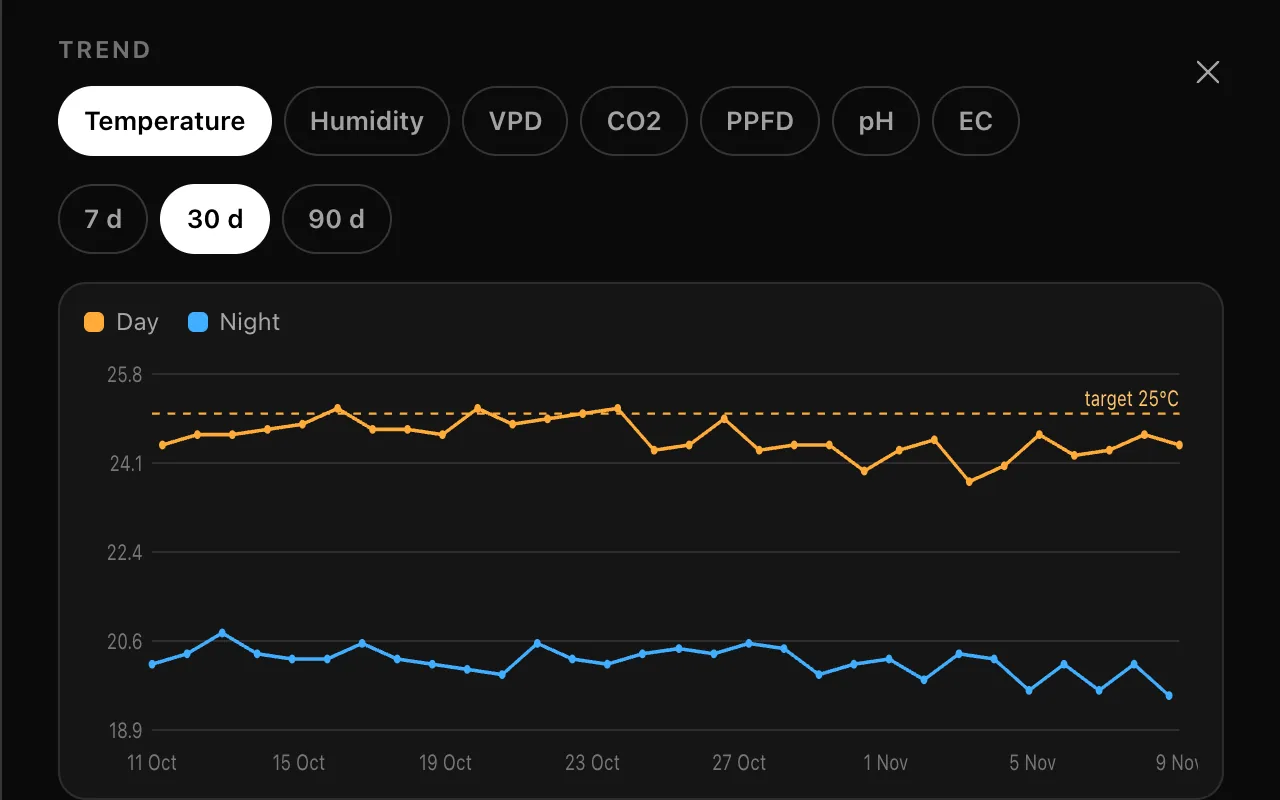
- Measure solution and slab temperature, not just air, especially in the afternoon.
- In recirculating hydroponics, keep the solution in the low 20s °C and avoid spikes above 26 °C.
- Aerate and keep the solution moving; aim for at least 5 to 6 mg/L of dissolved oxygen if you can measure it.
- In coco and rock wool, avoid letting slabs heat up under lamps or in sunlit greenhouses.
- Use 25 to 28 °C for rooting cuttings, as covered in our guide to irrigation and crop steering.
- Keep EC and pH in range, as described in our EC and pH guide, so roots stay healthy enough to resist infection.
References
- Benson BB, Krause D (1984). The concentration and isotopic fractionation of oxygen dissolved in freshwater and seawater in equilibrium with the atmosphere. Limnology and Oceanography 29(3):620–632. doi:10.4319/lo.1984.29.3.0620
- Carotti L, Graamans L, Puksic F, Butturini M, Meinen E, Heuvelink E, Stanghellini C (2021). Plant factories are heating up: hunting for the best combination of light intensity, air temperature and root-zone temperature in lettuce production. Frontiers in Plant Science 11:592171. doi:10.3389/fpls.2020.592171
- Cockson P, Barajas G, Whipker B (2019). Enhancing rooting of vegetatively propagated Cannabis sativa ‘BaOx’ cuttings. Journal of Agricultural Hemp Research 1(1). doi:10.61611/2688-5182.1000
- Kim B, Hahm S, Lee Y, Bok G, Park J (2025). Light, temperature, and relative humidity influence the adventitious rooting of cannabis stem cuttings. Horticultural Science and Technology 43(4):480–493. doi:10.7235/HORT.20250043
- Levine CP, Hayashi S, Ohmori Y, Kusano M, Kobayashi M, Nishizawa T, Kurimoto I, Kawabata S, et al. (2023). Controlling root zone temperature improves plant growth and pigments in hydroponic lettuce. Annals of Botany 132(3):455–470. doi:10.1093/aob/mcad127
- Punja ZK, Rodriguez G (2018). Fusarium and Pythium species infecting roots of hydroponically grown marijuana (Cannabis sativa L.) plants. Canadian Journal of Plant Pathology 40(4):498–513. doi:10.1080/07060661.2018.1535466
- Scott S, Villouta C (2026). Dissolved oxygen limitation and Pythium root rot in strawberry NFT systems: mechanisms, research gaps, and prospects for substrate-free production. Frontiers in Plant Science 17:1829367. doi:10.3389/fpls.2026.1829367
- Sutton JC, Sopher CR, Owen-Going TN, Liu W, Grodzinski B, Hall JC, Benchimol RL (2006). Etiology and epidemiology of Pythium root rot in hydroponic crops: current knowledge and perspectives. Summa Phytopathologica 32(4):307–321. doi:10.1590/S0100-54052006000400001