
Cannabis Temperature in Flower: Day, Night and What Heat Costs
Temperature advice for flowering rooms is full of rules borrowed from other crops. Five cannabis trials show where the plant works best, what heat costs and which night-time tricks backfire.
 GrowBotiq Research Team· 6 min read

In this article5
Flowering room temperatures are usually set by habit: 26 by day, a few degrees cooler at night, colder still in the last week for colour. Some of that advice comes from lilies and poinsettias, some from forums. This article goes through the cannabis trials that measured what temperature does to photosynthesis, flower weight, cannabinoids, terpenes and colour.
Where the leaves work best
In drug-type cannabis, photosynthesis peaked at 30 °C leaf temperature and 1,500 µmol m⁻² s⁻¹ of light, and the authors put the optimum at 25 to 30 °C; above 30 °C the stomata began to close (Chandra et al., 2008). Across seven drug and fibre varieties, the optimum ranged from 25 to 35 °C depending on the variety (Chandra et al., 2011). In fibre hemp, photosynthesis levelled off between 25 and 35 °C and fell above 35 (Tang et al., 2017).
These are leaf temperatures. Under strong LED light with low infrared, leaves can run cooler than the air, so the air setpoint that gives a 25 to 30 °C leaf depends on the lights and the humidity, as explained in our VPD chart. Extra CO₂ raises the optimum, covered in our guide to CO₂ enrichment.
What heat costs
A 2025 trial grew a THC and a CBD cultivar through nine weeks of flowering at 25/21 °C or 31/27 °C day/night, at three light levels. The warm treatment greatly reduced total cannabinoid concentration in both cultivars. Flower dry weight did not change in the THC cultivar, while the CBD cultivar tended to yield less and developed fox-tailing, new flower clusters on top of mature buds (Holweg et al., 2025).
Terpenes did not fall at 31/27 °C: total terpene concentration was unchanged in the THC cultivar and briefly higher in the CBD one. The idea that warm rooms “cook off” terpenes on the living plant is not supported by this trial; terpene losses happen mainly in drying and storage.
Short extreme heat is a different matter, but often misquoted. In young hemp flowers, a week at 45 to 50 °C barely changed CBGA; the large changes in CBG and CBD reported from the same study came from drought, not heat (Park et al., 2022).
Day and night: the DIF trial
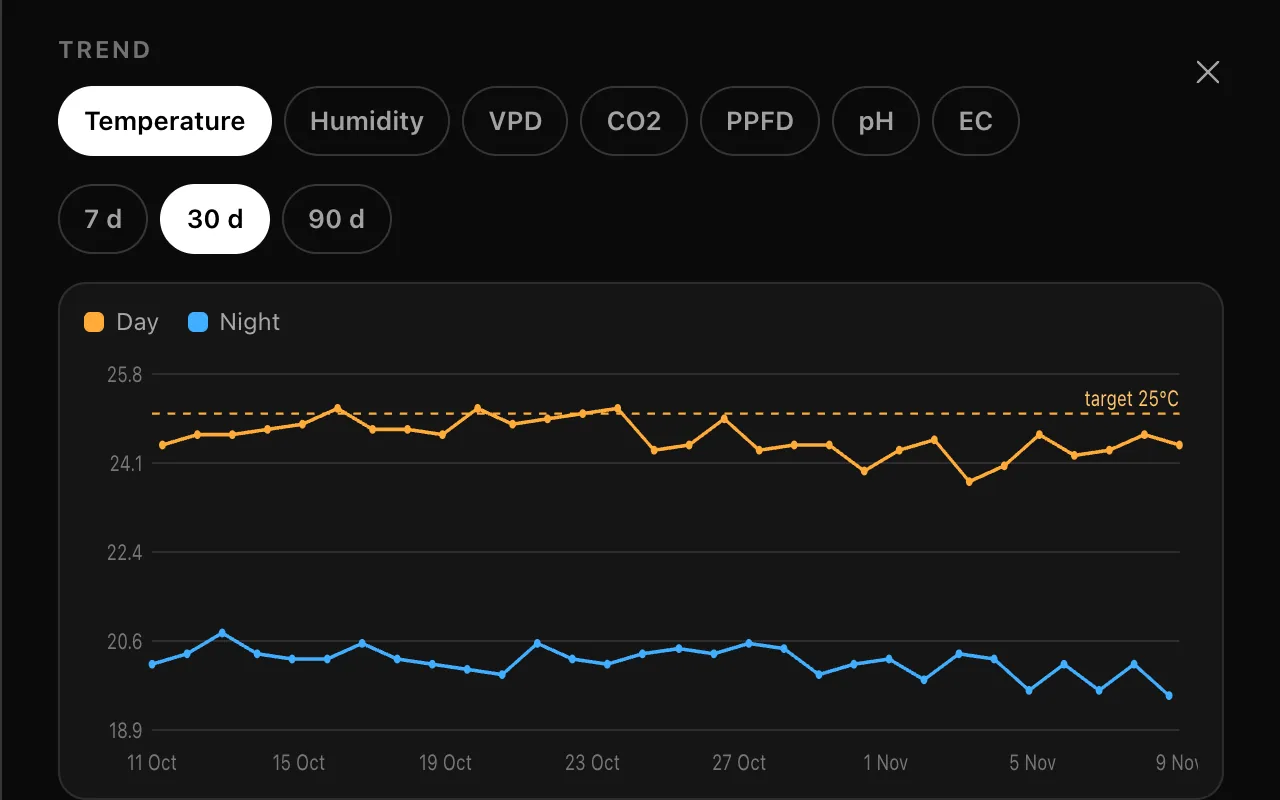
In many ornamental crops, a cooler day than night (negative DIF) shortens stems; in Easter lily, moving from −16 to +16 °C DIF increased plant height by 129% (Erwin et al., 1989). Growers have borrowed the idea to control stretch.
The only cannabis DIF trial found the opposite. Hemp grown at five day/night combinations, all averaging 24 °C, was tallest with warm nights (21/27 °C) and shortest with warm days (30/18 °C). Warm nights also nearly stopped flowering: 18/30 °C produced under 1 g of flowers per plant against 18 g at a constant 24 °C (Bok et al., 2023).
Cannabinoids peaked with a moderate positive difference: at 27/21 °C, CBDA was 29% and THCA 41% higher than at a constant 24 °C, with almost the same flower weight.
The trial used low-THC hemp in small chambers, at low light and ambient CO₂, so the exact numbers will not transfer to a commercial room. The direction is the useful part: keep nights cooler than days, and do not use warm nights to control stretch.
Cold nights and purple buds
Purple colour comes from anthocyanins, and many growers drop night temperatures in the last weeks to bring it out. In a CBD line bred for purple flowers, anthocyanin peaked at constant temperatures of 8 to 15 °C. Cycles of warm days and 4 °C nights produced less colour than constant cool temperatures, and flower weight and CBD rose with temperature up to 22 °C (Kim et al., 2025).
Those temperatures are far below any commercial room, and the line turned purple even at 25 to 30 °C because of its genetics. A late night drop is unlikely to change colour much in a cultivar that is not already disposed to purple, and nothing shows it raises potency.
Setpoints that follow the evidence
- Aim for a leaf temperature of about 25 to 28 °C in the light period; up to 30 °C with high light and CO₂.
- Avoid sustained 30 °C air or more: in the 31/27 °C trial, cannabinoids fell sharply.
- Keep nights 4 to 6 °C cooler than days; never warmer.
- Do not count on a cold last week for potency or colour unless the cultivar is known to respond.
- Watch for fox-tailing as a heat sign, and fix the climate rather than the plant.
- Check the root zone too: warm reservoirs bring their own risks.
References
- Bok G, Hahm S, Shin J, Park J (2023). Optimizing indoor hemp cultivation efficiency through differential day–night temperature treatment. Agronomy 13(10):2636. doi:10.3390/agronomy13102636
- Chandra S, Lata H, Khan IA, ElSohly MA (2008). Photosynthetic response of Cannabis sativa L. to variations in photosynthetic photon flux densities, temperature and CO2 conditions. Physiology and Molecular Biology of Plants 14(4):299–306. doi:10.1007/s12298-008-0027-x
- Chandra S, Lata H, Khan IA, ElSohly MA (2011). Temperature response of photosynthesis in different drug and fiber varieties of Cannabis sativa L. Physiology and Molecular Biology of Plants 17(3):297–303. doi:10.1007/s12298-011-0068-4
- Erwin JE, Heins RD, Karlsson MG (1989). Thermomorphogenesis in Lilium longiflorum. American Journal of Botany 76(1):47–52. doi:10.1002/j.1537-2197.1989.tb11283.x
- Holweg MMSF, Curren T, Cravino A, Kaiser E, Kappers IF, Heuvelink E, Marcelis LFM (2025). High air temperature reduces plant specialized metabolite yield in medical cannabis, and has genotype-specific effects on inflorescence dry matter production. Environmental and Experimental Botany 230:106085. doi:10.1016/j.envexpbot.2025.106085
- Kim SR, Basnet P, Kovaleski AP, Ellison SL (2025). Anthocyanin accumulation, inflorescence dry weight and total cannabidiol content have different temperature optima in Cannabis sativa. Journal of Cannabis Research 7:51. doi:10.1186/s42238-025-00311-w
- Park SH, Pauli CS, Gostin EL, Staples SK, Seifried D, Kinney C, Vanden Heuvel BD (2022). Effects of short-term environmental stresses on the onset of cannabinoid production in young immature flowers of industrial hemp (Cannabis sativa L.). Journal of Cannabis Research 4:1. doi:10.1186/s42238-021-00111-y
- Tang K, Struik PC, Amaducci S, Stomph T, Yin X (2017). Hemp (Cannabis sativa L.) leaf photosynthesis in relation to nitrogen content and temperature: implications for hemp as a bio-economically sustainable crop. GCB Bioenergy 9(10):1573–1587. doi:10.1111/gcbb.12451