
Rooting Cannabis Cuttings: What the Trials Say About Clones
Cloning advice is mostly passed from grower to grower. A handful of trials now test the details, and several popular habits, like trimming leaf tips, turn out to lower rooting.
 GrowBotiq Research Team· 5 min read
Almost every commercial cannabis crop starts as a cutting. The method looks simple, a stem in a cube under a dome, and the advice that comes with it is mostly tradition. A small group of studies has now tested the details on cannabis and hemp, and several common habits did not survive.
Leaves and stems
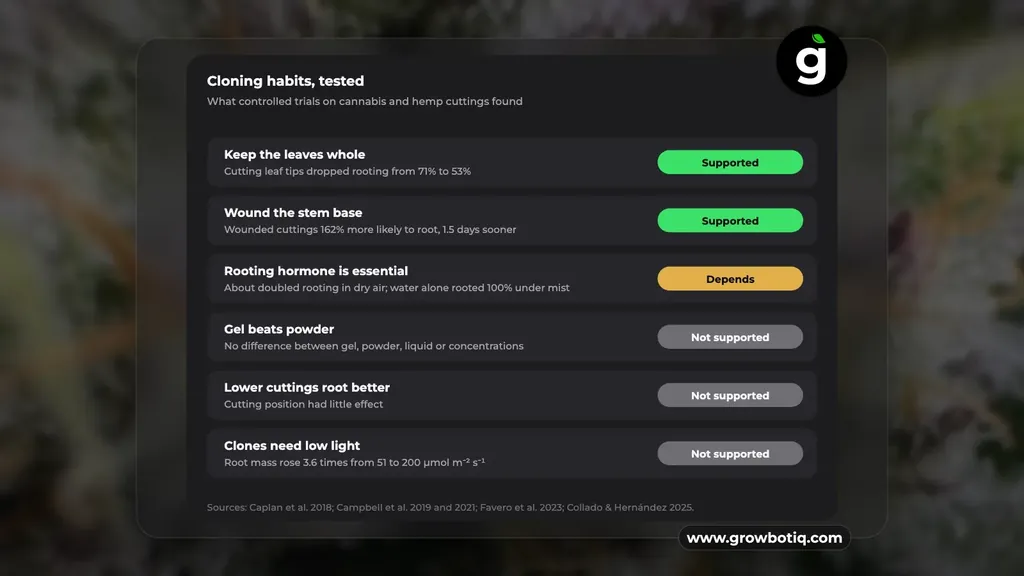
Many growers cut the leaf tips of clones to reduce water loss. In a controlled trial this lowered rooting from 71% to 53% without improving root quality; cuttings with three full leaves had better roots than those with two, and whether the cutting came from the top or the bottom of the mother made little difference (Caplan et al., 2018). Scraping or splitting the base of the stem made cuttings 162% more likely to root and about a day and a half faster (Campbell et al., 2019).
Bigger cuttings helped too. Stems 2.9 to 3.2 mm thick made better rooted plants (Cockson et al., 2019), and in one trial 20 cm cuttings rooted at 53% against 32 to 38% for shorter ones (Espósito et al., 2026).
Rooting hormone
An IBA gel gave twice the rooting success of a willow extract gel (Caplan et al., 2018). In a study of 960 hemp cuttings deliberately kept at low humidity, hormone treatments roughly doubled rooting compared with none, but there was no significant difference between powder, gel and liquid, or between 1,000 and 3,000 ppm IBA; the substrate mattered more, with rock wool rooting up to 80% (Campbell et al., 2021).
Under ideal humidity the hormone matters less. In an aeroponic propagator at near 100% humidity, cuttings of eight cultivars rooted 100% with water alone; a 100 mg/L IBA soak produced longer roots but slowed shoot growth (Favero et al., 2023). In a misted greenhouse, a 4,500 ppm IBA gel gave 2.6 times more root mass (Collado & Hernández, 2025).
Humidity, temperature and light
Humidity is the main driver. In hemp cuttings without hormone, one cultivar formed no roots at 30% humidity, and rooting levelled off from 70% to 90% (Kim et al., 2025). The same study found no roots at 15 °C, with rooting best between 20 and 30 °C; a root zone of 27.8 °C is recommended elsewhere (Cockson et al., 2019), as our guide to root zone temperature explains.
Light is often kept low for clones, but root mass increased steadily with light up to the highest level tested, from 22.5 mg at 51 µmol m⁻² s⁻¹ to 80.5 mg at 200, and extra CO₂ added about 20% more (Collado & Hernández, 2025).
Timing varies with the cultivar: in one production facility, clones rooted in anywhere from 5 to 35 days (Campbell et al., 2019).
A cloning checklist
- Take healthy, thick cuttings with at least three whole leaves; do not trim the tips.
- Wound the base and dip in an IBA gel, powder or liquid; the form does not matter.
- Use rock wool or another well-aerated cube, and keep humidity at 70–90%.
- Hold 24–28 °C at the root zone; avoid cool benches.
- Give more light than tradition says, up to about 200 µmol m⁻² s⁻¹ as roots form.
- Start from clean, tested mother plants, and record rooting by strain.
References
- Campbell LG, Naraine SGU, Dusfresne J (2019). Phenotypic plasticity influences the success of clonal propagation in industrial pharmaceutical Cannabis sativa. PLOS ONE 14(3):e0213434. doi:10.1371/journal.pone.0213434
- Campbell SM, Anderson SL, Brym ZT, Pearson BJ (2021). Evaluation of substrate composition and exogenous hormone application on vegetative propagule rooting success of essential oil hemp (Cannabis sativa L.). PLOS ONE 16(7):e0249160. doi:10.1371/journal.pone.0249160
- Caplan D, Stemeroff J, Dixon M, Zheng Y (2018). Vegetative propagation of cannabis by stem cuttings: effects of leaf number, cutting position, rooting hormone, and leaf tip removal. Canadian Journal of Plant Science 98(5):1126–1132. doi:10.1139/cjps-2018-0038
- Cockson P, Barajas G, Whipker B (2019). Enhancing rooting of vegetatively propagated Cannabis sativa ‘BaOx’ cuttings. Journal of Agricultural Hemp Research 1(1). doi:10.61611/2688-5182.1000
- Collado CE, Hernández R (2025). Effects of rooting hormone, light, and carbon dioxide enrichment on the rooting of Cannabis sativa cuttings. Acta Horticulturae 1426:51–58. doi:10.17660/ActaHortic.2025.1426.8
- Espósito LGA, Rodrigues C, Pereira P, Teixeira HM, Silva D (2026). Analysis of marijuana (Cannabis sativa L.) cuttings: morphological and colorimetric traits as predictors for optimization of vegetative reproduction. Plants 15(3):440. doi:10.3390/plants15030440
- Favero BT, Salomonsen JK, Lütken H (2023). Alternative rooting methods for medicinal cannabis cultivation in Denmark – preliminary results. Plants 12(11):2216. doi:10.3390/plants12112216
- Kim B, Hahm S, Lee Y, Bok G, Park J (2025). Light, temperature, and relative humidity influence the adventitious rooting of cannabis stem cuttings. Horticultural Science and Technology 43(4):480–493. doi:10.7235/HORT.20250043