
Spider Mites on Cannabis: Biology, Predators and Resistance
The spider mite is the pest indoor growers fear most and the one with the least cannabis-specific research. What is known, what comes from other crops, and how to keep it out of mother rooms.
 GrowBotiq Research Team· 5 min read

In this article6
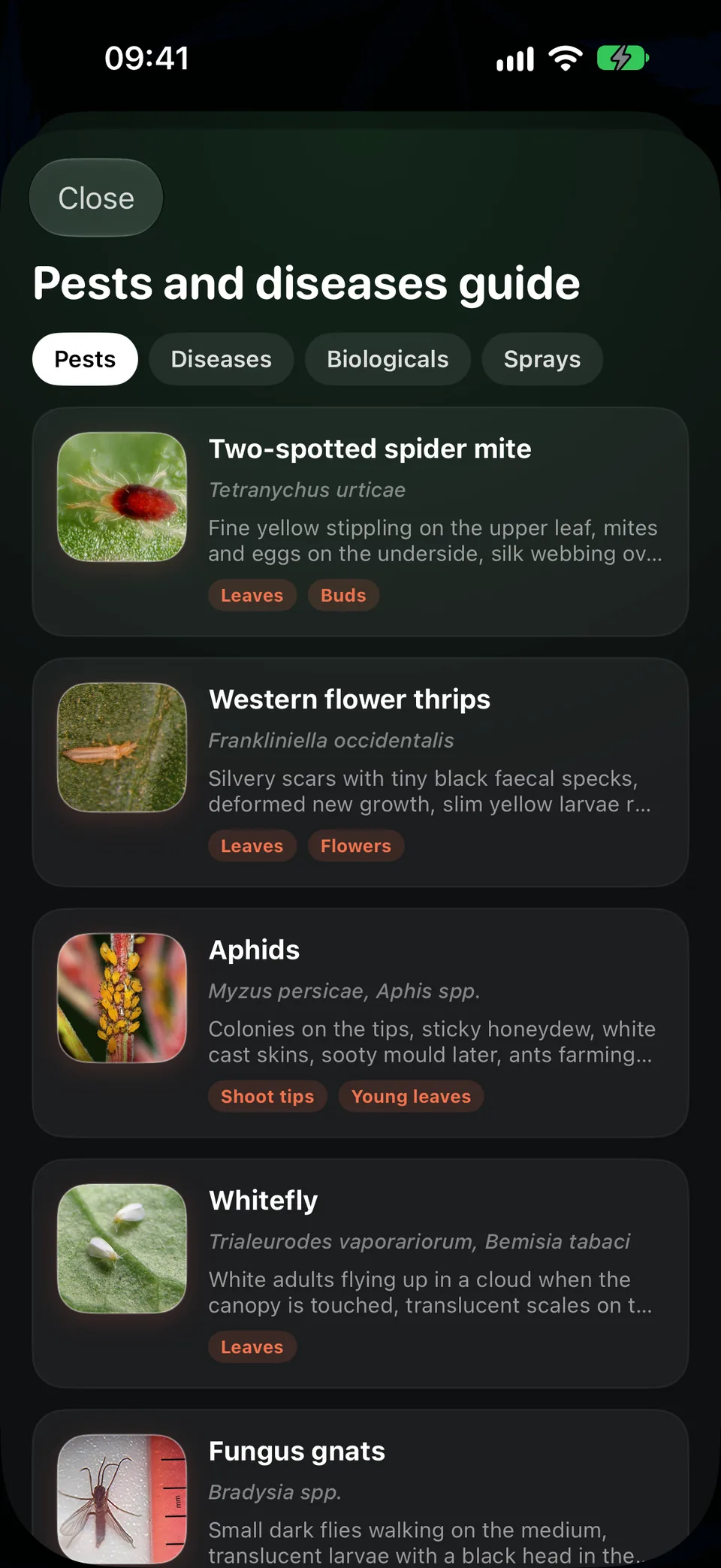
Fine yellow stippling on the top of the leaves, tiny moving dots underneath, then webbing over the tips. The two-spotted spider mite, Tetranychus urticae, is described as a key pest wherever cannabis has an indoor phase, especially on mother plants and clones (Cranshaw et al., 2019). It is also a pest with surprisingly little cannabis research: a 2022 review counted only six peer-reviewed papers on insect pests of indoor cannabis (Lemay et al., 2022).
This article separates what has been measured on cannabis from what is borrowed from other crops.
An indoor problem
In Colorado, spider mites were frequent in indoor production but high populations were not sustained once plants went to the field (Cranshaw et al., 2019). The pest thrives in the warm, sheltered conditions of grow rooms and propagation areas, and travels on cuttings. Clean mother plants are the first line of defence.
How fast they multiply
No life table has been measured on cannabis. On peach leaves, a population doubled in 4.7 days at 25 °C and 3.2 days at 27 °C; at 30 °C females lived shorter lives and laid fewer eggs, so growth slowed again, and no eggs hatched at 13 °C (Riahi et al., 2013). Claims of five-day generations and hundreds of eggs per female are not supported by the studies we checked.
Humidity matters less than often claimed. High humidity delays egg hatching, but the eggs keep developing and hatch within hours once the air dries (Ubara & Osakabe, 2015). No study we found shows that dry air speeds up spider mites, although dry air does hurt the eggs of the main predatory mite.
What they do to the crop
In greenhouse hemp infested three weeks into flowering, high mite densities slowed the build-up of THC and CBD, and cannabinoid levels fell as mite numbers rose (Pulkoski & Burrack, 2024). Another study reported that mites raised some terpenes and cannabinoids, so the effect on chemistry is not settled. No published study gives a yield loss figure or an action threshold for cannabis.
Biological control
Phytoseiulus persimilis, a specialist predator of spider mites, is the standard choice. On ivy geranium, releases of one predator for every four spider mites cut populations from as many as 30 per leaf to fewer than 0.6 within four weeks, while one in sixty was too few (Opit et al., 2004). On impatiens, releasing predators where the mites were clustered cleared them by day 9 (Alatawi et al., 2011). Above 28 °C, Amblyseius swirskii outperformed P. persimilis on strawberry, and the two together worked best across 25 to 32 °C (Mdallel et al., 2026).
Cannabis may be harder. Dense glandular trichomes slow predatory mites on other crops, and the review authors expect predators to be less effective at low pest densities on cannabis (Lemay et al., 2022). Release early, on mothers and clones, and release where the mites are.
Resistance
The two-spotted spider mite has developed resistance to more pesticide compounds than any other mite, helped by a short life cycle and many offspring (Van Leeuwen et al., 2010). In hop, the closest crop relative of cannabis, every population tested carried pyrethroid resistance mutations, 94% carried a mutation that defeats etoxazole and 69% one linked to bifenazate resistance (Kewedar et al., 2025).
Few products are allowed on cannabis, and the rules differ by country and state (Cranshaw et al., 2019). On hemp, citric acid and garlic oil killed 60 to 80% of spider mites within a day in a greenhouse test (Canon et al., 2025). Rotate modes of action and treat sprays as a support to biological control, not a substitute.
A spider mite plan
- Inspect every new cutting under a loupe and keep new plants apart for a week.
- Scout mothers and clones weekly, turning leaves over; mark hot spots.
- Release P. persimilis into hot spots early, at high predator-to-pest ratios; add A. swirskii in warm rooms.
- Avoid broad-spectrum sprays that kill predators.
- Rotate allowed products by mode of action and never spray flowers.
- Log every finding and release by room, as part of an IPM programme.
References
- Alatawi F, Nechols JR, Margolies DC (2011). Spatial distribution of predators and prey affect biological control of twospotted spider mites by Phytoseiulus persimilis in greenhouses. Biological Control 56(1):36–42. doi:10.1016/j.biocontrol.2010.09.006
- Canon MA, Ataide LMS, Villamarin P, De Giosa M, Osborne LS, Tabanca N, Lahiri S, Revynthi AM (2025). Sustainable management strategies for acarine pests of industrial hemp (Cannabis sativa subsp. sativa L.). Agronomy 15(12):2785. doi:10.3390/agronomy15122785
- Cranshaw W, Schreiner M, Britt K, Kuhar TP, McPartland J, Grant J (2019). Developing insect pest management systems for hemp in the United States: a work in progress. Journal of Integrated Pest Management 10(1):26. doi:10.1093/jipm/pmz023
- Kewedar S, Chen QR, Moural TW, Lo C, Umbel E, Forrence PJ, Walsh DB, Zhu F (2025). Acaricide resistance monitoring and structural insights for precision Tetranychus urticae management. Insects 16(5):440. doi:10.3390/insects16050440
- Lemay J, Zheng Y, Scott-Dupree C (2022). Factors influencing the efficacy of biological control agents used to manage insect pests in indoor cannabis (Cannabis sativa) cultivation. Frontiers in Agronomy 4:795989. doi:10.3389/fagro.2022.795989
- Mdallel LM, Mquiteb A, Guerban A, Sudayri BS, Al-Oudah S, Al-Eid SM (2026). Temperature effects on the efficacy of Phytoseiulus persimilis and Amblyseius swirskii against Tetranychus urticae in strawberry crops. Insects 17(4):366. doi:10.3390/insects17040366
- Opit GP, Nechols JR, Margolies DC (2004). Biological control of twospotted spider mites, Tetranychus urticae Koch, using Phytoseiulus persimilis Athias-Henriot on ivy geranium: assessment of predator release ratios. Biological Control 29(3):445–452. doi:10.1016/j.biocontrol.2003.08.007
- Pulkoski M, Burrack H (2024). Assessing the impact of piercing-sucking pests on greenhouse-grown industrial hemp (Cannabis sativa L.). Environmental Entomology 53(1):1–10. doi:10.1093/ee/nvad044
- Riahi E, Shishehbor P, Nemati AR, Saeidi Z (2013). Temperature effects on development and life table parameters of Tetranychus urticae (Acari: Tetranychidae). Journal of Agricultural Science and Technology 15(4):661–672. jast.modares.ac.ir
- Ubara M, Osakabe M (2015). Suspension of egg hatching caused by high humidity and submergence in spider mites. Environmental Entomology 44(4):1210–1219. doi:10.1093/ee/nvv080
- Van Leeuwen T, Vontas J, Tsagkarakou A, Dermauw W, Tirry L (2010). Acaricide resistance mechanisms in the two-spotted spider mite Tetranychus urticae and other important Acari: a review. Insect Biochemistry and Molecular Biology 40(8):563–572. doi:10.1016/j.ibmb.2010.05.008