
More Trichomes, More THC? What Gland Density Really Predicts
In controlled trials, gland counts and THC moved apart more than once. Head size separates hemp from drug strains, not a strong cultivar from a weaker one.
 GrowBotiq Research Team· 12 min read

In this article9
Ask growers or buyers how they spot a strong flower and many give the same answer: the frost. A bud that sparkles under the light, sticky to the touch, white with resin. It is a reasonable guess, because THC is made in those glands. It is also a guess that researchers have tested, and the answer is less simple than the look.
This guide goes through what has been measured: whether more glands mean more THC, whether bigger heads do, what changes gland numbers in a grow room, what is known about kief and hash, and how many heads come off before the flower reaches a jar.
What the frost is made of
Most of the sparkle comes from stalked glands: a stalk with a round resin head on top, crowded on the bracts of the flower. Their heads measure 40 to 110 µm across and their stalks reach about 1 mm. Smaller sessile glands sit flat on the surface, and tiny bulbous glands have heads of only 15 to 30 µm (Punja et al., 2023). Our guide to trichome types describes each one.
The glands are not equal. Stalked glands have 12 to 16 secretory cells against 8 in sessile ones (Livingston et al., 2020), and earlier work summarised by Punja and colleagues found up to 20 times more THC in stalked heads than in sessile ones (Punja et al., 2023). So what counts is not only how many glands a bud carries, but which kind, how big and how full.
Do more glands mean more THC?
Several trials counted glands and measured cannabinoids on the same plants. None found that more glands reliably meant more THC.
- Feeding. In the cultivar CBD Kush, plants given a low feed in the first half of growth had 4 to 5% fewer stalked glands on their bracts than plants on the recommended feed, and about 4% more on the calyx. Their THCA was 21.9% higher, a significant rise. The authors suggest each gland simply made more (Tanney et al., 2023).
- Ploidy. Tetraploid clones of a balanced THC/CBD strain carried 40% more glandular trichomes on their sugar leaves, 4.41 against 3.14 per mm², but THC did not rise significantly. The authors write that it is unclear why (Parsons et al., 2019).
- Sprays. In a medical cultivar sprayed with salicylic acid, methyl jasmonate or GABA, gland density did not differ from untreated plants, and its correlations with cannabinoid production were not significant (Garrido et al., 2022). In a hemp line, methyl jasmonate almost doubled cannabinoid content with no obvious change in trichome density or shape (Welling et al., 2023).
- Glands without cannabinoids. Hemp plants bred to make no cannabinoids at all carried as many sessile glands on their leaves as CBD- and CBG-dominant plants. Their glands looked collapsed (Stack et al., 2023).
Between cultivars the picture is less clear. Space Queen, sold at 16 to 18% THC, carried more glands per mm² of bract at every week of flower than Moby Dick at 10 to 12% (Punja et al., 2023). That fits the rule of thumb, but it is two cultivars, and their THC was the stated level, not measured in the study. A 2025 review of the field concluded that gland density does not consistently predict cannabinoid content across genotypes (Alberti et al., 2025).
Do bigger heads mean more THC?
Between hemp and drug strains, yes. Licensed medical strains had stalked gland heads 129 µm across on average, against 80 µm in low-THC hemp cultivars, more than four times the volume per head (Small & Naraine, 2016). A 2025 study found the same pattern between modern cultivars and landraces: larger trichomes with more secretory cells (Nolan et al., 2025).
Within drug cultivars it did not hold. At week 6 of flower, Moby Dick had heads of 90 µm and Space Queen of 75 µm, yet Space Queen is the stronger cultivar (Punja et al., 2023). Breeding for THC has made heads bigger overall. It does not follow that the biggest heads in your room belong to your strongest plant.
Why the eye gets it wrong
Potency is a concentration: milligrams of cannabinoid in a gram of flower. Frost is what you see on the surface. The studies point to several reasons why the two part ways:
- Glands differ in how much they hold, as the feeding trial showed.
- Stalked glands start out looking sessile and grow their stalk during flower, so the mix of gland types changes with age (Punja et al., 2023).
- Gland density on the bracts rose until about week 6. Heads began to drop off from about week 5 and collapsed by weeks 7 and 8 (Punja et al., 2023).
- Heads shrink after harvest, by about 15% of their diameter in the first month and 24% within a year (Small & Naraine, 2016).
- Glands crowd the bracts and sugar leaves, but potency is measured on the whole bud, including the parts with few glands.
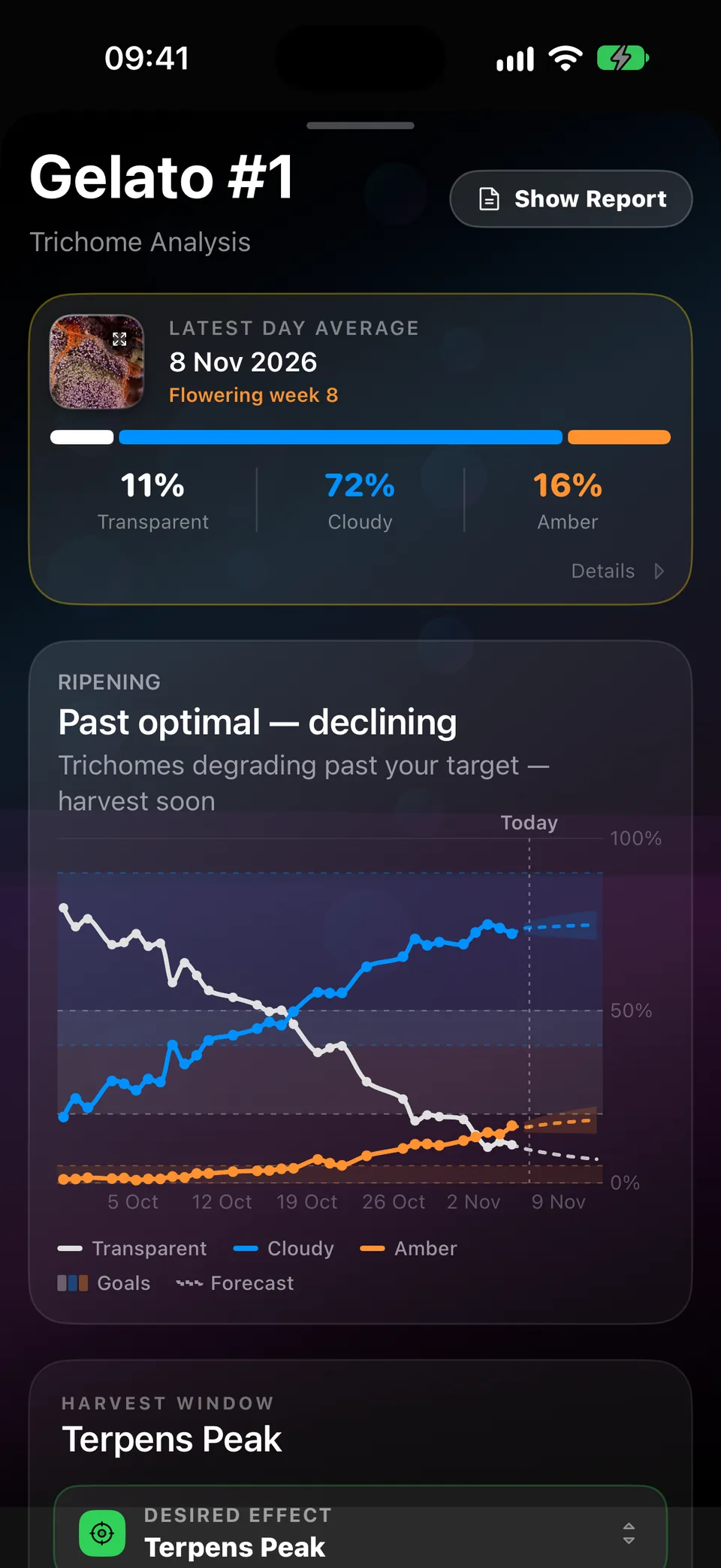
This is part of why lab results often surprise buyers who judge by eye, and why clear, cloudy and amber heads tell you about ripeness rather than strength. Our cloudy vs amber guide covers that reading.
What changes gland numbers
For a grower, the practical question is whether anything in the room raises gland numbers. The controlled evidence is thin.
- Flower age has the clearest effect: density on the bracts rose until about week 6 (Punja et al., 2023).
- Ploidy gave the largest change, 40% more trichomes (Parsons et al., 2019), but that is breeding, not cultivation.
- Feeding and root bacteria moved stalked gland density by about 4 to 10% in either direction (Tanney et al., 2023).
- Methyl jasmonate, a plant stress hormone sold in some elicitor products, gave no clear change in two greenhouse trials (Garrido et al., 2022; Welling et al., 2023). In a two-year field trial it had no overall effect in the first year, with responses that differed by cultivar, and a dose-dependent rise in trichomes in the second. Cannabinoid concentration did not change in either year (Da Cunha Leme Filho et al., 2026).
- UV and light spectrum: we found no peer-reviewed trial that counted glands. In one UV trial the authors had the impression of more trichomes on sugar leaves but did not count them, and cannabinoids in the flower did not change (Llewellyn et al., 2022). Our review of UV light and THC covers what was measured.
Kief and hash: what has been measured
For solventless extraction the glands are the crop itself, and head size decides which screen catches them. Here the published evidence is mostly about methods, not yields.
Sifting dried flower through a 250 µm mesh over a 74 µm mesh gave kief made of particles between 74 and 220 µm: gland heads, but also stalks, pistils and plant dust. Sieving alone reached a first-pass purity of about 40 to 60%. Adding an electrostatic separator raised it to 80 to 95% (MacGowan & Martynenko, 2025). That separator is the authors' own prototype.
In a laboratory ice-water wash of fresh Hindu Kush at week 6, the water was passed through bags of 200, 73 and 25 µm. The heads were recovered from the 25 µm bag, 99.8% pure, and the stalks from the 73 µm bag (Siazon et al., 2026). That study was isolating material for genetic analysis, so it reported purity, not yield.
The only yields we found come from one dry-ice method. Fresh flower was exposed to dry-ice vapour and then spun in a drum with 150 µm openings inside a freezer. The kief made up 0.1 to 6.96% of the fresh flower weight across four cultivars, against 0.08 to 1.33% for kief sifted from the same cultivars after drying. In one cultivar, total cannabinoids went from 24.8% in the flower to 60.7% in the kief (Russo et al., 2021).
Read those numbers as a first look. Each cultivar was run once, two of them with a much longer treatment, and the method is the authors' own, with a patent pending. They still show how far kief yield can differ between cultivars and methods.
We found no peer-reviewed study of ice-water hash or rosin yield, and none on which trichome traits make a cultivar wash well. Head size, how easily heads detach and resin texture are the obvious candidates, but none has been measured against yield.
Heads lost before the jar
A stalked gland is built to let go. The tip of the stalk narrows where it meets the head, and after a head detaches a ring-shaped separation zone is left behind. That narrow point let many heads come off, especially during drying and handling after harvest (Punja et al., 2023).
The same study compared hand and machine trimming of Pink Kush under the electron microscope. In hand-trimmed buds the heads were intact; in machine-trimmed buds many heads were detached or collapsed. Five days of drying at 21 to 24 °C and 50 to 55% relative humidity shrivelled the stalks but left most heads in place (Punja et al., 2023). Nobody has counted the share lost, so the size of the effect is unknown. Our comparison of wet and dry trimming covers the rest of that evidence.
Limits of the evidence
- Most trials used one or two cultivars, and several worked on CBD or hemp types rather than high-THC drug cultivars.
- The comparisons between cultivars rely on stated THC levels, not on THC measured in the same study.
- Gland counts were often made on small areas of a few bracts or leaves, from three plants per treatment in one trial.
- Kief yields come from single runs of a patent-pending method. There is no peer-reviewed data on ice-water hash or rosin yield.
- Losses from trimming and handling were seen under the microscope but never counted.
What to do with this
- Judge potency with a lab test on each batch, not by the frost. Two cultivars that look equally frosty can test far apart.
- When you compare cultivars, keep the test result next to photos taken in the same week of flower, so the look and the number can be checked against each other.
- For kief or hash, run a small sift or wash of each cultivar and record the yield. The literature cannot yet tell you which one washes best.
- Handle material for extraction gently. Hand trimming keeps more heads on than machine trimming.
- Read clear, cloudy and amber heads for ripeness, not for strength.
- Be sceptical of products that promise more trichomes. Sprays and stress gave mixed results, and more glands did not mean more THC.
- Keep the numbers for every batch: cultivar, flowering day, lab result and, if you extract, yield. That is the only way to learn what your own frost means.
References
- Alberti T, Didaran F, Sharma S, De Sarandy Raposo R, Diatta AA, Maraschin M, Da Cunha Leme Filho JF (2025). Bracts, buds, and biases: uncovering gaps in trichome density quantification and cannabinoid concentration in Cannabis sativa L. Plants 14(14):2220. doi:10.3390/plants14142220
- Da Cunha Leme Filho JF, Schuchman S, Shikanai A, Rauniyar K, Pinto Fonseca I, Diatta AA, Walters SA, Gage KL (2026). Influence of genotype and methyl jasmonate concentration on trichome development and yield traits in Cannabis sativa L. Journal of Cannabis Research, online ahead of print. doi:10.1186/s42238-026-00523-8
- Garrido J, Rico S, Corral C, Sánchez C, Vidal N, Martínez-Quesada JJ, Ferreiro-Vera C (2022). Exogenous application of stress-related signaling molecules affect growth and cannabinoid accumulation in medical cannabis (Cannabis sativa L.). Frontiers in Plant Science 13:1082554. doi:10.3389/fpls.2022.1082554
- Livingston SJ, Quilichini TD, Booth JK, Wong DCJ, Rensing KH, Laflamme-Yonkman J, Castellarin SD, Bohlmann J, Page JE, Samuels AL (2020). Cannabis glandular trichomes alter morphology and metabolite content during flower maturation. The Plant Journal 101(1):37–56. doi:10.1111/tpj.14516
- Llewellyn D, Golem S, Foley E, Dinka S, Jones AMP, Zheng Y (2022). Indoor grown cannabis yield increased proportionally with light intensity, but ultraviolet radiation did not affect yield or cannabinoid content. Frontiers in Plant Science 13:974018. doi:10.3389/fpls.2022.974018
- MacGowan C, Martynenko A (2025). Electrostatic separator of cannabis trichomes: an innovative approach to extraction. Journal of Cannabis Research 7(1):23. doi:10.1186/s42238-025-00281-z
- Nolan M, Guo Q, Garcia-de Heer L, Liu L, Dimopoulos N, Barkla BJ, Kretzschmar T (2025). Bigger is better: modern Cannabis trichomes are larger and more productive than their landrace ancestors. Plant and Cell Physiology 66(10):1477–1492. doi:10.1093/pcp/pcaf105
- Parsons JL, Martin SL, James T, Golenia G, Boudko EA, Hepworth SR (2019). Polyploidization for the genetic improvement of Cannabis sativa. Frontiers in Plant Science 10:476. doi:10.3389/fpls.2019.00476
- Punja ZK, Sutton DB, Kim T (2023). Glandular trichome development, morphology, and maturation are influenced by plant age and genotype in high THC-containing cannabis (Cannabis sativa L.) inflorescences. Journal of Cannabis Research 5:12. doi:10.1186/s42238-023-00178-9
- Russo EB, Plumb J, Whiteley VL (2021). Novel solventless extraction technique to preserve cannabinoid and terpenoid profiles of fresh cannabis inflorescence. Molecules 26(18):5496. doi:10.3390/molecules26185496
- Siazon PM, Nolan M, Guo Q, Perovich R, Kretzschmar T, Mieog JC (2026). Heads up: transcriptomics reveal functional roles of cannabis glandular trichome stalks. Plants 15(11):1624. doi:10.3390/plants15111624
- Small E, Naraine SGU (2016). Size matters: evolution of large drug-secreting resin glands in elite pharmaceutical strains of Cannabis sativa (marijuana). Genetic Resources and Crop Evolution 63(2):349–359. doi:10.1007/s10722-015-0254-2
- Stack GM, Snyder SI, Toth JA, Quade MA, Crawford JL, McKay JK, et al. (2023). Cannabinoids function in defense against chewing herbivores in Cannabis sativa L. Horticulture Research 10(11):uhad207. doi:10.1093/hr/uhad207
- Tanney CAS, Lyu D, Schwinghamer T, Geitmann A, Ruan ED, Smith DL (2023). Sub-optimal nutrient regime coupled with Bacillus and Pseudomonas sp. inoculation influences trichome density and cannabinoid profiles in drug-type Cannabis sativa. Frontiers in Plant Science 14:1131346. doi:10.3389/fpls.2023.1131346
- Welling MT, Deseo MA, O’Brien M, Clifton J, Bacic A, Doblin MS (2023). Metabolomic analysis of methyl jasmonate treatment on phytocannabinoid production in Cannabis sativa. Frontiers in Plant Science 14:1110144. doi:10.3389/fpls.2023.1110144