
Plant health · Nutrients & water
Pythium Root Rot in Cannabis: Species, Warning Signs and Control
Brown roots, wilting in a well-watered room, plants collapsing in flower. Surveys of licensed cannabis greenhouses identified the Pythium species behind it, and trials show what helps and what does not.
 GrowBotiq Research Team· 5 min read
In this article4
Plants that wilt in a room where the substrate is wet, roots that are brown instead of white, a soft, discoloured crown, and in bad cases sudden collapse in mid-flower. Pythium is a water mould, not a true fungus, and it thrives where roots sit warm, wet and short of oxygen.
Which species
A survey of 140 diseased plants from seven licensed greenhouses yielded 95 Pythium isolates. P. myriotylum accounted for 43 and P. dissotocum for 35, followed by P. catenulatum, P. aphanidermatum and Globisporangium ultimum. All caused crown and root rot, and wounded roots and long periods of saturation made the disease worse (Punja et al., 2022). In hydroponic cannabis, P. dissotocum and P. myriotylum caused root browning, loss of root mass and stunting, together with Fusarium, which was also found in the recirculating solution (Punja & Rodriguez, 2018).
The damage is substantial. In a Connecticut facility, disease incidence in coir and rock wool ranged from 7 to 100% and inoculated plants were at least 32% smaller (McGehee & Raudales, 2021). In Florida, 5 to 7% of 3,000 cuttings in one room showed damping-off and root rot (Brown et al., 2026). Pythium and Fusarium together can cause sudden death of flowering plants (Punja, 2021).
What favours it
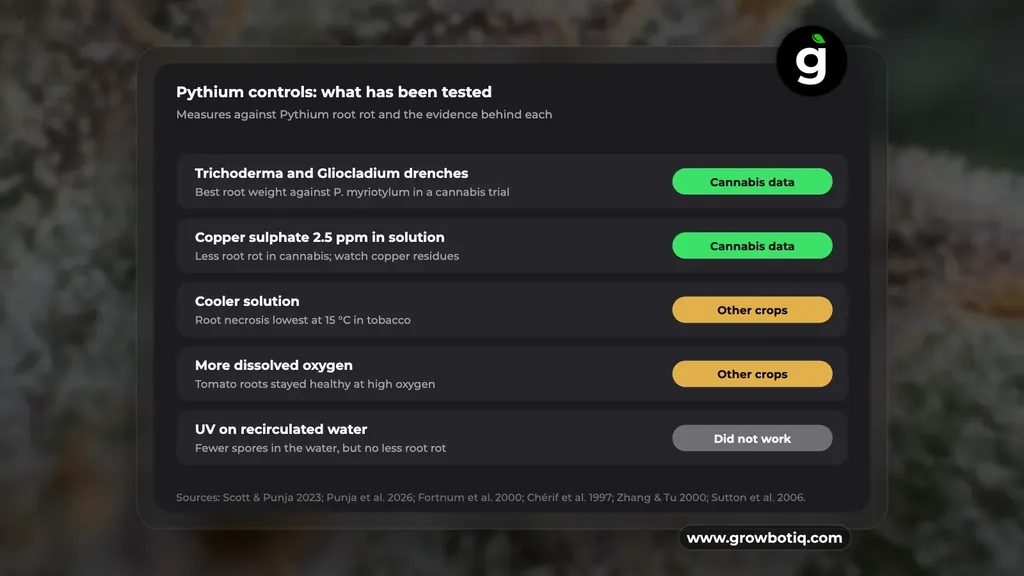
Most of the epidemiology comes from other hydroponic crops. P. aphanidermatum becomes severe at root zone temperatures of about 23 to 27 °C and above, roots colonised at 16 to 18 °C can develop severe symptoms within hours when the solution warms, and in tobacco float systems root necrosis from P. myriotylum was lowest at 15 °C and rose steadily towards 30 °C (Sutton et al., 2006; Fortnum et al., 2000). Oxygen matters as much: tomato roots in low-oxygen solutions showed symptoms within six days of inoculation, while plants kept at high oxygen stayed healthy (Chérif et al., 1997). Our guide to root zone temperature explains how warmth and oxygen interact.
What helps
No fungicide is registered for cannabis in most markets, so prevention and biological products carry the load. In a cannabis trial, drenches of Trichoderma (RootShield) and Gliocladium (Lalstop) products applied a week before inoculation gave the heaviest, healthiest roots against P. myriotylum; against Fusarium on cuttings, several biologicals cut disease by 30 to 56% (Scott & Punja, 2023). Copper sulphate at 2.5 ppm in hydroponic solution significantly reduced Pythium root rot and spore formation, and plants grew larger (Punja et al., 2026); copper applied to leaves raised residues in the flower, so keep doses low.
UV disinfection of recirculating water is widely sold but reduced Pythium in the water without reducing root rot or raising yield in tomato, and also killed beneficial bacteria (Zhang & Tu, 2000); similar results were reported in lettuce and chrysanthemum (Sutton et al., 2006).
Fungus gnat larvae can carry Pythium, but in potting mix they rarely transmit it, as explained in our article on fungus gnats.

A root rot prevention plan
- Start clean: test mothers for Pythium and Fusarium, and do not use unpasteurised coco.
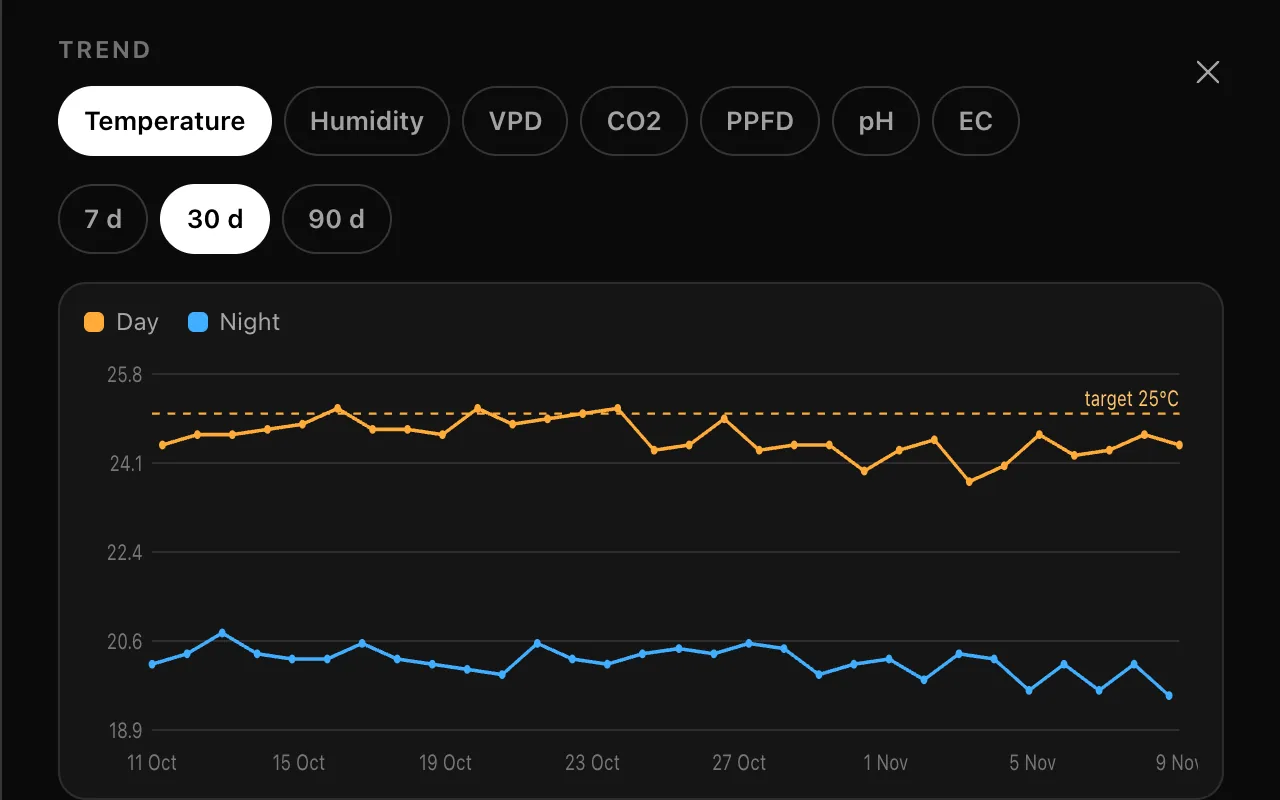
- Keep solution temperatures in the low 20s °C and avoid warm spikes.
- Keep oxygen high: aerate reservoirs, avoid saturated slabs, and let media drain; see crop steering.
- Apply Trichoderma or Gliocladium drenches preventively at transplant.
- Disinfect benches, tanks and lines between cycles; do not rely on UV alone.
- Pull wilting plants early, check their roots, and log where they were.
References
- Brown A, Blit E, Gerstenberg S, Say K, Philbrook R (2026). First report of Pythium myriotylum causing damping off and root rot in Cannabis sativa in Florida. Plant Disease 110(3):1026. doi:10.1094/PDIS-07-25-1413-PDN
- Chérif M, Tirilly Y, Bélanger RR (1997). Effect of oxygen concentration on plant growth, lipidperoxidation, and receptivity of tomato roots to Pythium F under hydroponic conditions. European Journal of Plant Pathology 103(3):255–264. doi:10.1023/A:1008691226213
- Fortnum BA, Rideout J, Martin SB, Gooden D (2000). Nutrient solution temperature affects Pythium root rot of tobacco in greenhouse float systems. Plant Disease 84(3):289–294. doi:10.1094/PDIS.2000.84.3.289
- McGehee CS, Raudales RE (2021). Pathogenicity and mefenoxam sensitivity of Pythium, Globisporangium, and Fusarium isolates from coconut coir and rockwool in marijuana (Cannabis sativa L.) production. Frontiers in Agronomy 3:706138. doi:10.3389/fagro.2021.706138
- Punja ZK (2021). Emerging diseases of Cannabis sativa and sustainable management. Pest Management Science 77(9):3857–3870. doi:10.1002/ps.6307
- Punja ZK, Ni L, Scott C (2026). Copper sulphate reduces Pythium root rot and powdery mildew development on greenhouse-grown cannabis (Cannabis sativa L., marijuana) plants. Canadian Journal of Plant Pathology, online ahead of print. doi:10.1080/07060661.2026.2716888
- Punja ZK, Rodriguez G (2018). Fusarium and Pythium species infecting roots of hydroponically grown marijuana (Cannabis sativa L.) plants. Canadian Journal of Plant Pathology 40(4):498–513. doi:10.1080/07060661.2018.1535466
- Punja ZK, Scott C, Chen S (2018). Root and crown rot pathogens causing wilt symptoms on field-grown marijuana (Cannabis sativa L.) plants. Canadian Journal of Plant Pathology 40(4):528–541. doi:10.1080/07060661.2018.1535470
- Punja ZK, Scott C, Lung S (2022). Several Pythium species cause crown and root rot on cannabis (Cannabis sativa L., marijuana) plants grown under commercial greenhouse conditions. Canadian Journal of Plant Pathology 44(1):66–81. doi:10.1080/07060661.2021.1954695
- Scott C, Punja ZK (2023). Biological control of Fusarium oxysporum causing damping-off and Pythium myriotylum causing root and crown rot on cannabis (Cannabis sativa L.) plants. Canadian Journal of Plant Pathology 45(3):238–252. doi:10.1080/07060661.2023.2172082
- Sutton JC, Sopher CR, Owen-Going TN, Liu W, Grodzinski B, Hall JC, Benchimol RL (2006). Etiology and epidemiology of Pythium root rot in hydroponic crops: current knowledge and perspectives. Summa Phytopathologica 32(4):307–321. doi:10.1590/S0100-54052006000400001
- Zhang W, Tu JC (2000). Effect of ultraviolet disinfection of hydroponic solutions on Pythium root rot and non-target bacteria. European Journal of Plant Pathology 106(5):415–421. doi:10.1023/A:1008798710325