
Fungus Gnats and Root Aphids in Cannabis: What Works and What’s Myth
Small black flies over the pots are the most common sight in a grow room. The larvae are the real concern, the disease-spreading story is overstated, and the root aphid that hides below them is easy to miss.
 GrowBotiq Research Team· 5 min read

In this article6
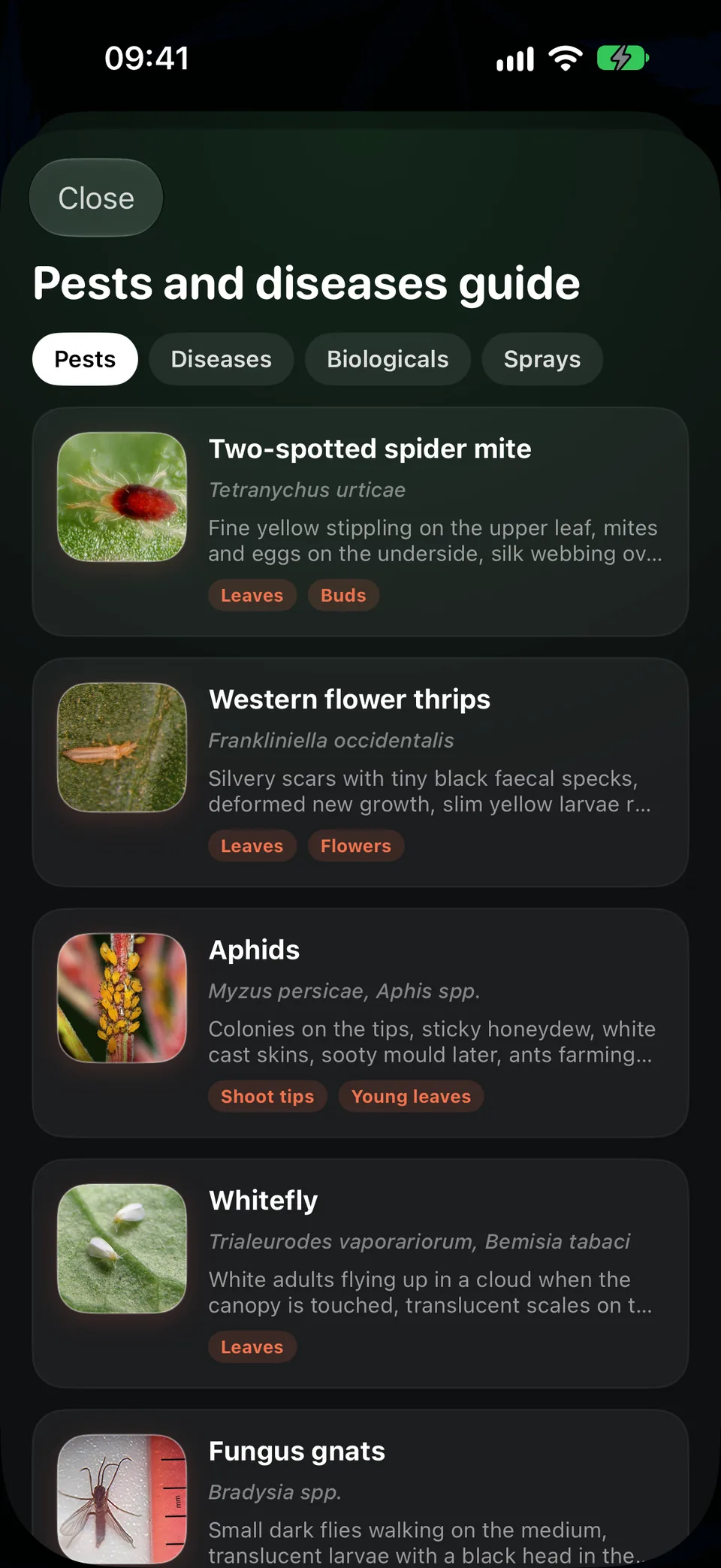
Tiny black flies running across the substrate and rising when a pot is moved: fungus gnats are in almost every indoor grow at some point. The adults are harmless nuisances; the larvae live in the top centimetres of the medium and feed on organic matter, fungi and young roots. They are often blamed for spreading root rot.
No controlled study of fungus gnats on cannabis has been published, so the numbers here come from ornamental and vegetable crops. They still answer the practical questions.
Life cycle
At about 24 °C a fungus gnat goes from egg to adult in roughly three weeks: four days as an egg, two weeks as a larva and three or four days as a pupa, and females lay around 75 eggs (Wilkinson & Daugherty, 1970). Cooler rooms slow them down markedly: development took 40 days at 15.6 °C, and all eggs died at 31.5 °C (Wang et al., 2026).
Do gnats spread root rot?
Larvae swallow Pythium spores, which pass through their gut alive. In a petri dish, larvae carried Pythium to seedlings in 65% of cases, but in plug cells filled with potting mix the rate fell below 6% (Braun et al., 2012). Adult gnats did not transmit any of three Pythium species, because the pathogen does not survive the change from pupa to adult (Braun et al., 2010). In one study, larval feeding even reduced seedling deaths from Pythium, possibly by triggering the plant’s defences (Braun et al., 2009).
Gnats and root rot often appear together because both thrive in wet, organic-rich media, not mainly because one carries the other (Cloyd, 2015). Our article on Pythium root rot covers the disease itself.
What controls them
- Bti, the larva-killing bacterium Bacillus thuringiensis israelensis, reduced survival to 8% against 84% in untreated media when present from the egg stage (Osborne et al., 1985), but it had no effect on second- and third-stage larvae (Cloyd & Dickinson, 2006). Apply it early and regularly, not as a rescue.
- Nematodes: Steinernema feltiae reduced larvae more than Bti and other products in floriculture (Harris et al., 1995); 125,000 to 500,000 infective juveniles per square metre worked, with lower efficacy in some media (Jagdale et al., 2004).
- Predatory soil mites (Stratiolaelaps, sold as Hypoaspis) gave lasting control at 55 or more mites per pot, living in the top centimetre and surviving weeks without prey (Chambers et al., 1993).
Two popular remedies did not hold up. Within a substrate, moisture level had no significant effect on gnat development, coco coir supported gnats as well as peat, and sand or diatomaceous earth top-dressings did not reduce egg-laying or emergence (Olson et al., 2002; Cloyd, 2015). Avoiding waterlogged, organic-rich media still helps.
Monitoring
Yellow sticky cards catch adults; slices of raw potato laid on the substrate attract larvae and proved a reliable way to count them (Harris et al., 1995). Check both weekly and log the counts.
Rice root aphids
Rice root aphids, Rhopalosiphum rufiabdominale, are now a common pest of indoor cannabis in North America. They live almost entirely on the roots, causing only a general decline, and are usually noticed when winged adults appear on sticky cards or stuck to leaf hairs as plants flower (Cranshaw & Wainwright-Evans, 2020). Reused soil with old roots favours them, and few biological controls have been proven; insect-killing fungi seem to work best. They can pick up hop latent viroid from infected plants, although transmission to healthy plants has not been shown (Ong et al., 2025).
A gnat and root aphid plan
- Use fresh or pasteurised media; never reuse substrate with old roots.
- Avoid overwatering and standing water, especially in propagation.
- Monitor with yellow cards and potato slices from day one; log weekly.
- Start Bti, nematodes or soil mites preventively in propagation and veg.
- Check cards for winged aphids in flower and inspect roots of declining plants.
- Treat gnats as a sign of wet media, and fix the water management first.
References
- Braun SE, Castrillo LA, Sanderson JP, Daughtrey ML, Wraight SP (2010). Transstadial transmission of Pythium in Bradysia impatiens and lack of adult vectoring capacity. Phytopathology 100(12):1307–1314. doi:10.1094/PHYTO-04-10-0117
- Braun SE, Sanderson JP, Nelson EB, Daughtrey ML, Wraight SP (2009). Fungus gnat feeding and mechanical wounding inhibit Pythium aphanidermatum infection of geranium seedlings. Phytopathology 99(12):1421–1428. doi:10.1094/PHYTO-99-12-1421
- Braun SE, Sanderson JP, Wraight SP (2012). Larval Bradysia impatiens (Diptera: Sciaridae) potential for vectoring Pythium root rot pathogens. Phytopathology 102(3):283–289. doi:10.1094/PHYTO-09-11-0262
- Chambers RJ, Wright EM, Lind RJ (1993). Biological control of glasshouse sciarid flies (Bradysia spp.) with the predatory mite, Hypoaspis miles, on cyclamen and poinsettia. Biocontrol Science and Technology 3(3):285–293. doi:10.1080/09583159309355283
- Cloyd RA (2015). Ecology of fungus gnats (Bradysia spp.) in greenhouse production systems associated with disease-interactions and alternative management strategies. Insects 6(2):325–332. doi:10.3390/insects6020325
- Cloyd RA, Dickinson A (2006). Effect of Bacillus thuringiensis subsp. israelensis and neonicotinoid insecticides on the fungus gnat Bradysia sp. nr. coprophila. Pest Management Science 62(2):171–177. doi:10.1002/ps.1143
- Cranshaw W, Wainwright-Evans S (2020). Cannabis sativa as a host of rice root aphid (Hemiptera: Aphididae) in North America. Journal of Integrated Pest Management 11(1):15. doi:10.1093/jipm/pmaa008
- Harris MA, Oetting RD, Gardner WA (1995). Use of entomopathogenic nematodes and a new monitoring technique for control of fungus gnats, Bradysia coprophila, in floriculture. Biological Control 5(3):412–418. doi:10.1006/bcon.1995.1049
- Jagdale GB, Casey ML, Grewal PS, Lindquist RK (2004). Application rate and timing, potting medium, and host plant effects on the efficacy of Steinernema feltiae against the fungus gnat, Bradysia coprophila, in floriculture. Biological Control 29(2):296–305. doi:10.1016/S1049-9644(03)00164-6
- Olson DL, Oetting RD, van Iersel MW (2002). Effect of soilless potting media and water management on development of fungus gnats and plant growth. HortScience 37(6):919–923. doi:10.21273/HORTSCI.37.6.919
- Ong M, Munz J, Feng A, Yaqub S, Buirs L, Gries G (2025). Acquisition of hop latent viroid from viroid-infected cannabis plants by rice root aphids and cannabis aphids. Archives of Virology 170(11):221. doi:10.1007/s00705-025-06422-2
- Osborne LS, Boucias DG, Lindquist RK (1985). Activity of Bacillus thuringiensis var. israelensis on Bradysia coprophila. Journal of Economic Entomology 78(4):922–925. doi:10.1093/jee/78.4.922
- Wilkinson JD, Daugherty DM (1970). The biology and immature stages of Bradysia impatiens (Diptera: Sciaridae). Annals of the Entomological Society of America 63(3):656–660. doi:10.1093/aesa/63.3.656
- Wang Q, Zhao L, Sun Y (2026). Identification, physiological time and reproductive potential of Bradysia impatiens (Diptera: Sciaridae) from Liuba, Shaanxi, with a review pertaining to its occurrences in China. Biology 15(19):1696. doi:10.3390/biology15191696