

Plant Health · Propagation
Hop Latent Viroid in Cannabis: Symptoms, Testing and Control
A 256-letter loop of RNA that shows nothing on the mother plant and ruins a flower room three months later. What the research says about spread, testing and control.
11 min read
Growers called it dudding before anyone knew the cause. A cultivar that had run well for years came out short and brittle, with small, loose flowers and little resin, while the plants next to it looked normal. In 2019 two groups in California traced it to hop latent viroid (Bektaş et al., 2019; Warren et al., 2019). Since then it has turned up wherever cannabis is propagated by cuttings.
This guide covers what the viroid is, what it does to the crop, how it moves through a facility, where and when to sample, what cleans a blade, and what a control programme looks like. It also separates the numbers that come from experiments from the ones that come from press releases.
What a viroid is
A viroid is the smallest pathogen known: a closed loop of RNA with no protein coat and no genes for proteins. Hop latent viroid, HLVd for short, has 256 nucleotides. It was first described in hops, where it was found worldwide and seemed to cause no symptoms, which is where the word latent comes from (Puchta et al., 1988).
In cannabis it is not harmless. When healthy plants were inoculated with a cloned copy of the viroid, they developed stunting and malformed, yellowing leaves and tested positive, and the mock-inoculated plants did not. That is the proof that the viroid causes the disease (Warren et al., 2019).
What it looks like
The difficulty is that it often looks like nothing. On mother plants the infection is mostly symptomless, with at most some curling or mottling of the youngest leaves. Symptoms that were missed in the vegetative room typically show one to three weeks after the move to flowering (Buirs and Punja, 2024).
- In propagation. Cuttings from infected plants root less reliably (Warren et al., 2019).
- In veg. Smaller leaves, shorter internodes, less vigour, sometimes nothing at all (Adkar-Purushothama et al., 2023).
- In flower. Stunted plants with brittle stems and branches that grow outwards, and small flowers with fewer trichomes (Bektaş et al., 2019).
- On the trichomes. Shorter stalks and smaller heads that shrivel when the flower dries (Punja et al., 2024a).
Not every cultivar reacts the same way. Some cultivars carry the viroid and show almost nothing, which makes them the most dangerous plants in a mother room.
What it costs
The best field data come from Canadian greenhouses. Infected plants had inflorescence stems, fresh weights and plant heights 12 to 42% below those of healthy plants, depending on the genotype, and THC and terpene levels in the diseased flowers were significantly lower (Punja et al., 2024a). In a side-by-side comparison of five genotypes, flower fresh weight was significantly reduced in three and unchanged in two (Punja et al., 2024b).
Hops give the only long-standing controlled figures: 35% less cone yield and 30% less alpha acids in one cultivar, and no significant yield loss with 15% less alpha acids in another (Barbara et al., 1990). The pattern is the same as in cannabis: the product suffers as well as the weight, and the cultivar decides how much.
The numbers quoted most often are weaker than they sound. The claims that 90% of Californian facilities are infected, that the industry loses 4 billion dollars a year and that THC falls by 50 to 70% come from a nursery’s own client testing and from trade press, not from published studies; a widely cited review gives news articles as their source (Adkar-Purushothama et al., 2023). The largest published survey found the viroid in 25.6% of 15,947 samples from nine Canadian provinces between 2020 and 2023, from 5.3% to 92% depending on province and year (Punja et al., 2024a). Those were samples growers chose to submit, so it is not a prevalence either, but it is a real count.
How it spreads
The researchers who have studied transmission in cannabis rank the routes this way: infected cuttings first, then infected roots and recirculated water (Punja et al., 2025).
- Cuttings. Clones taken from infected mothers carried the viroid at rates of up to 100% within four weeks. One infected mother is a production line for infected plants.
- Roots and water. A healthy cutting sharing an aeroponic cloner with an infected one for two weeks became infected. So did healthy plants at the far end of a flood tray. Bench surfaces under infected plants carried the viroid as well.
- Wounds. Sap from an infected plant on a fresh cut reached the roots within two to three weeks and the leaves within four to six; symptoms followed at about ten weeks. In hops, cutting stems transmitted the viroid more effectively than plants rubbing against each other (Adams et al., 1996).
- Seed and pollen. In hemp, 58 to 84% of seedlings from crosses with one infected parent were positive (Atallah et al., 2024). In two tests on cannabis seed, 14 of 16 and 16 of 16 seeds were positive (Punja et al., 2024b; Punja et al., 2025). Seed is not a clean start by definition.
- Insects. Aphids feeding on infected plants picked the viroid up, but did not pass it to healthy plants in the one trial that tested it (Ong et al., 2025).
The viroid also seems to move faster once plants flower: in a small test, its levels under 12 hours of light were higher in every tissue than under continuous light, and highest of all in the flowers (Punja et al., 2025). A plant that tested clean in veg can test positive in flower.
Testing: where and when to sample
Laboratories detect the viroid’s RNA by RT-PCR, RT-qPCR or RT-LAMP. A good RT-qPCR assay finds about ten copies (Punja et al., 2025). The weak point is not the assay but the sample, because the viroid is spread unevenly through the plant.
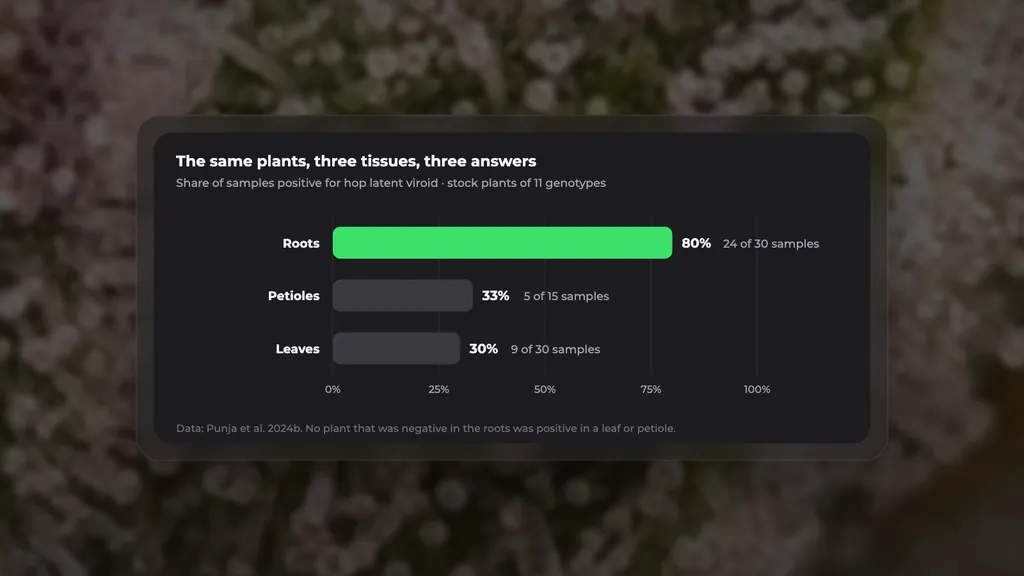
In stock plants of 11 genotypes, 24 of 30 root samples were positive, against 9 of 30 leaf samples and 5 of 15 petiole samples. No plant that was negative in the roots was positive in a leaf or petiole, while many that were positive in the roots were negative above ground (Punja et al., 2024b).
A second study reached the opposite conclusion, with leaves as good as roots, but it started from plants already known to be positive in a leaf test, so it could not find the plants that a leaf test misses. It did show that the viroid builds up with age: the signal in leaves roughly doubled to tripled between weeks five and ten, and one plant that was negative at five to six weeks was positive two weeks later (Fernandez i Marti et al., 2023).
- Sample roots where you can, or several tissues from the same plant. One leaf says little.
- Test more than once. A negative result on a young plant is not a clean result. The earliest detection was in the roots of two-week-old rooted cuttings.
- Test mothers on a schedule and every new genetic before it enters the mother room.
- Do not trust the eye. Most infected mothers look healthy, and infrared imaging did not pick them out either (Buirs and Punja, 2024).

Cleaning tools and surfaces
Viroid RNA is tough. In sap it was still detectable after a week, in dried leaves and roots after four weeks, and after heating at up to 90 °C for half an hour (Punja et al., 2025). The same study tested the products growers use on blades and benches.
Bleach worked: a 10% dilution of an 8.25% product, about 0.8% sodium hypochlorite, broke the RNA down in two minutes, and hypochlorous acid at 1,000 ppm did it in one. Seventy per cent ethanol did nothing in ten minutes, and neither did Virkon or a peroxide product in one. None of the products worked on pieces of root or leaf in two minutes, so debris has to come off first.
Two cautions. This test measures whether the RNA can still be detected, not whether it can still infect a plant. And for a related viroid in tomato, where infection itself was measured, both a 10% bleach dilution and 2% Virkon stopped transmission within ten seconds (Li et al., 2015), so the Virkon result is not settled. Bleach is the one product that passes both kinds of test. Mix it fresh, wipe the blade clean, dip between plants, and rinse and oil the tools afterwards, because bleach corrodes steel.
Can an infected cultivar be saved?
Sometimes. The growing tip of a shoot often stays ahead of the viroid, and a plant regenerated from a meristem of about 0.4 mm can be clean. In eight cannabis genotypes, 37 of 91 meristems gave viroid-free plants, and the result ran from none to all of them depending on the genotype (Punja et al., 2025). The plants were followed by RT-qPCR for six months before they were called clean.
Heat or cold before the culture can help. In hops, months of cold storage followed by meristem culture gave 28 clean plants out of 77 (Adams et al., 1996), and two weeks at 35 °C lowered viroid levels by 70 to 90% without eliminating them (Matoušek et al., 1995). In cannabis, heat treatment combined with meristem culture cleared the viroid from 5 of 13 cultivars (Torres et al., 2025). It is laboratory work that takes months, worth it for a cultivar that cannot be replaced and not for one that can be bought again clean.
A control programme
There is no spray and no cure in the room. Control is finding infected plants and taking them out before they are multiplied. One greenhouse facility tested its stock plants every week and destroyed every positive: over six months the share of infected stock plants fell from 22% to 1% (Buirs and Punja, 2024).
- Start clean. Buy tested stock, and quarantine and test every new cultivar, seeds included.
- Protect the mothers. Their own tools, their own gloves, and no shared irrigation with production plants.
- Test and remove. Roots, on a schedule, and again before cuttings are taken. A positive mother goes, with everything cut from her.
- Disinfect between plants. Bleach on clean blades, fresh gloves or a dip between mothers.
- Mind the water. Recirculating systems and shared trays connect every root in them. Remove dead roots and debris, and disinfect trays and benches between batches.
- Keep the family tree. Record which mother every batch came from, so that one positive test tells you which other plants to check.
An HLVd checklist
- Test every mother plant, from roots, and repeat on a fixed schedule.
- Quarantine new genetics and test them twice, a few weeks apart, before they join the mothers.
- Remove positive plants and the cuttings taken from them.
- Give the mother room its own tools and disinfect them with fresh bleach between plants.
- Do not share cloners, trays or recirculated water between tested and untested plants.
- Label every batch with its mother and its cutting date.
- Walk the flower rooms in weeks two to four and test any plant that falls behind its neighbours.
References
- Adams AN, Barbara DJ, Morton A, Darby P (1996). The experimental transmission of hop latent viroid and its elimination by low temperature treatment and meristem culture. Annals of Applied Biology 128(1):37–44.
- Adkar-Purushothama CR, Sano T, Perreault J-P (2023). Hop latent viroid: a hidden threat to the cannabis industry. Viruses 15(3):681.
- Atallah OO, Yassin SM, Verchot J (2024). New insights into hop latent viroid detection, infectivity, host range, and transmission. Viruses 16(1):30.
- Barbara DJ, Morton A, Adams AN, Green CP (1990). Some effects of hop latent viroid on two cultivars of hop (Humulus lupulus) in the UK. Annals of Applied Biology 117(2):359–366.
- Bektaş A, Hardwick KM, Waterman K, Kristof J (2019). Occurrence of hop latent viroid in Cannabis sativa with symptoms of cannabis stunting disease in California. Plant Disease 103(10):2699.
- Buirs L, Punja ZK (2024). Integrated management of pathogens and microbes in Cannabis sativa L. (cannabis) under greenhouse conditions. Plants 13(6):786.
- Fernandez i Marti A, Parungao M, Hollin J, Selimotic B, Farrar G, Seyler T, Anand A, Ahmad R (2023). A novel, precise and high-throughput technology for viroid detection in cannabis (MFDetect™). Viruses 15(7):1487.
- Li R, Baysal-Gurel F, Abdo Z, Miller SA, Ling K-S (2015). Evaluation of disinfectants to prevent mechanical transmission of viruses and a viroid in greenhouse tomato production. Virology Journal 12:5.
- Matoušek J, Trněná L, Svoboda P, Oriniaková P, Lichtenstein CP (1995). The gradual reduction of viroid levels in hop mericlones following heat therapy: a possible role for a nuclease degrading dsRNA. Biological Chemistry Hoppe-Seyler 376(12):715–721.
- Ong M, Munz J, Feng A, Yaqub S, Buirs L, Gries G (2025). Acquisition of hop latent viroid from viroid-infected cannabis plants by rice root aphids and cannabis aphids. Archives of Virology 170(11):221.
- Puchta H, Ramm K, Sänger HL (1988). The molecular structure of hop latent viroid (HLV), a new viroid occurring worldwide in hops. Nucleic Acids Research 16(10):4197–4216.
- Punja ZK, Wang K, Lung S, Buirs L (2024a). Symptomology, prevalence, and impact of Hop latent viroid on greenhouse-grown cannabis (Cannabis sativa L.) plants in Canada. Canadian Journal of Plant Pathology 46(2):174–197.
- Punja ZK, Kahl D, Reade R, Xiang Y, Munz J, Nachappa P (2024b). Challenges to Cannabis sativa production from pathogens and microbes: the role of molecular diagnostics and bioinformatics. International Journal of Molecular Sciences 25(1):14.
- Punja ZK, Scott C, Tso HH, Munz J, Buirs L (2025). Transmission, spread, longevity and management of hop latent viroid, a widespread and destructive pathogen affecting cannabis (Cannabis sativa L.) plants in North America. Plants 14(5):830.
- Torres A, Pauli C, Sarmiento C, Zalewski C, Gaudino R (2025). Differential gene expression analysis of Cannabis sativa following hop latent viroid (HLVd) eradication therapy in micropropagation tissue culture. Plant Cell, Tissue and Organ Culture 161(3):66.
- Warren JG, Mercado J, Grace D (2019). Occurrence of hop latent viroid causing disease in Cannabis sativa in California. Plant Disease 103(10):2699.