
Autoflowering Cannabis: Genetics, Light Schedule and Yield
Autoflowers bloom on their own clock, whatever the day length. Genome studies have now found the gene behind it, and the first trials have measured what that costs in yield.
 GrowBotiq Research Team· 9 min read
In this article8
Most cannabis is a short-day plant: it grows leaves while the nights are short and builds flowers once the dark period passes a threshold. Indoors that threshold is crossed on purpose, by switching the lights from 18 to 12 hours. An autoflower skips the switch. It flowers a few weeks after sprouting under any schedule, which is why it can be grown under one light cycle from seed to harvest. Popular plant categories do not always survive a genetic test, as our guide to indica vs sativa shows.
Seed catalogues explain this with the wild Cannabis ruderalis and recommend 18, 20 or 24 hours of light. Since 2022, genome studies have found the gene behind autoflowering, and a handful of trials have measured how autoflowers compare with photoperiod plants. This guide sums up what they found, and where the evidence stops. Flowering type also changes how long a hemp crop stays above the THC limit, as our guide to why hemp goes hot explains.
How a photoperiod plant decides to flower
In a study of hemp cultivars under eleven day lengths from 12 to 18 hours, the shortest critical day length was 13 h 45 min to 14 h, and a difference of just 15 minutes delayed flowering by 5 to 13 days in most cultivars (Zhang et al., 2021). Single flowers at the nodes, the "pre-flowers", appear regardless of day length; a real, condensed inflorescence needed at least three consecutive short days, and plants moved back to long days took it apart again (Alter et al., 2024). Under continuous light, photoperiod cultivars do not flower at all.
The gene: Autoflower1
At Cornell, two second-generation populations from crosses between an autoflower and a photoperiod plant were grown under 16-hour days. In each, about a quarter of the plants flowered, 28 and 24 of 88, the ratio of a single recessive gene. The trait mapped to one region of chromosome 1, named Autoflower1, and all 11 commercial autoflowers tested carried two copies (Toth et al., 2022).
A Canadian group then narrowed the region with 872 plants from seven families and found the likely cause: a single-letter change at a splice site of CsPRR37, a gene of the plant's internal clock. It was present in all 12 autoflowers sequenced and in none of 17 photoperiod plants, and it produced faulty, shortened versions of the protein (Leckie et al., 2024). The authors propose that the working gene holds back the flowering signal FT under long days, as its counterpart does in rice; with the brake broken, flowering goes ahead regardless of day length. A pangenome study places the region inside a 19.5 Mb inversion on chromosome 1, a block of about 1,200 genes that is rarely broken up by crossing over (Lynch et al., 2025).
Not one gene everywhere
The grain hemp FINOLA also flowers under any day length, but not because of Autoflower1. Its trait mapped to chromosome 8, to a duplicated copy of the flowering gene FT, named Autoflower2, and it behaves as a dominant gene: in one cross 77% of the plants flowered under continuous light (Dowling et al., 2024). Further loci have been reported in Iranian landraces (Babaei et al., 2026) and in a cross with the day-neutral Bubble Kush (Tang et al., 2026).
Autoflower1 is not perfectly recessive either. Plants with one copy flowered earlier and stayed smaller than plants with none (Toth et al., 2022), and in triploid plants each extra autoflower copy brought flowering forward; plants with two of three copies flowered 32 to 40 days earlier in the field than photoperiod plants (Kurtz et al., 2023). That is a plausible basis for seed lines that flower early outdoors without being true autoflowers.
Is it really ruderalis?
Not on current evidence. "Ruderalis" is used loosely for plants with roughly equal THC and CBD, a wild look or early flowering (McPartland, 2018), and the most detailed genomic studies do not support it as a separate group (Toth et al., 2022). A study of 110 genomes found that the feral plants sampled were escapes from domesticated forms, not wild types (Ren et al., 2021). No study we found traces the Autoflower1 mutation to a defined wild population.
What day length does to an autoflower
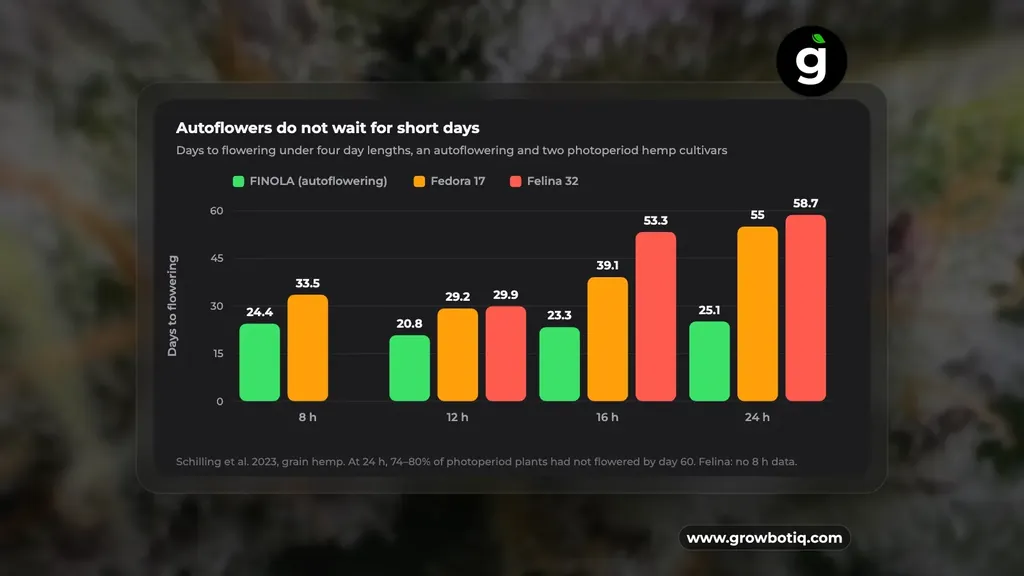
In a speed-breeding study, FINOLA flowered after 21 to 25 days whether it got 8, 12, 16 or 24 hours of light, with no significant difference between them, while two photoperiod cultivars were delayed by long days and mostly failed to flower under continuous light (Schilling et al., 2023). In the field, a two-hour night break raised cannabinoids by 23 to 76% in three photoperiod varieties and left the two autoflowering ones unchanged (Duringer et al., 2026).
That settles one point: an autoflower does not need short days, and long days do not stop it. It does not settle the question growers ask most. We found no peer-reviewed trial comparing 18/6, 20/4 and 24/0 on autoflower yield, potency or time to harvest, and no light-intensity trial on autoflowers at all. The one indoor yield figure with a stated schedule is about 19 g of dried buds per plant at 20 hours and about 17 mol/m²/day, in 2.3 litre pots (Pojmann-Ezeonyilo et al., 2024).
What is known comes from photoperiod plants: flower yield rises with the total light a plant receives per day, its daily light integral (see our guide to PPFD and DLI). For an autoflower, the hours are therefore a way of delivering light, not a flowering switch. The same daily light can come from 18 hours at higher intensity or 24 hours at lower intensity. Which gives more flower per kilowatt-hour on an autoflower has not been measured.
Autoflower or photoperiod?
A commercial greenhouse in New York recorded both. Its autoflowers spent 60 days in the ground against 80 for photoperiod plants from clones, with a quarter of the wet plant mass and about 9.9% THC against 15 to 18%. Even at five cycles a year against four, the autoflowers lost $1.48 per square foot while the photoperiod plants returned $7.18 (Vergara and Ruterbories, 2026). Seasons, cultivars and propagation differed, so it is a farm record, not a controlled trial.
The controlled comparisons are smaller. In hydroponics, two autoflowering CBD varieties gave 38 to 40 g of flower and leaf per plant against 46 to 49 g for two photoperiod ones, and only one pair differed significantly; CBD did not differ (Marabesi et al., 2023). In field hemp, photoperiod cultivars out-yielded day-neutral ones in both years, and day-neutral yields fell with later planting (Coolong et al., 2023), and the two autoflowering varieties of the night-break study had lower cannabinoid concentrations (Duringer et al., 2026).
Is low potency built into the gene? A study of a CBD hemp cross found that cannabinoids did not segregate with flowering type (Sreewongchai et al., 2026). The paper that found CsPRR37 suggests that the large block of genes inherited with it drags other, less useful traits along, but it gives no cannabinoid data for the claim (Leckie et al., 2024). Whether today's best autoflowers still carry a potency penalty has not been tested.
What has not been tested
- 18/6 against 20/4 against 24/0, or any light intensity, on autoflower yield and potency.
- A randomised, same-season indoor comparison of autoflower and photoperiod yield per square metre and per year.
- Pot size, transplanting, plant density or feeding level for autoflowers.
- Whether the two candidate genes named in chromosome 1 studies, PRR37 and PRR3, are the same gene.
What to do with autoflowers
- Treat the light schedule as a light budget: decide the daily light you want and the electricity you can pay, then pick the hours.
- Give autoflowers full light from early on; they cannot be held in veg to catch up.
- Expect smaller plants. More plants per square metre is the logical answer, but density has not been tested on autoflowers, so trial it on one bench first.
- Compare genetics by dry grams and lab results per cycle and per year, not per plant.
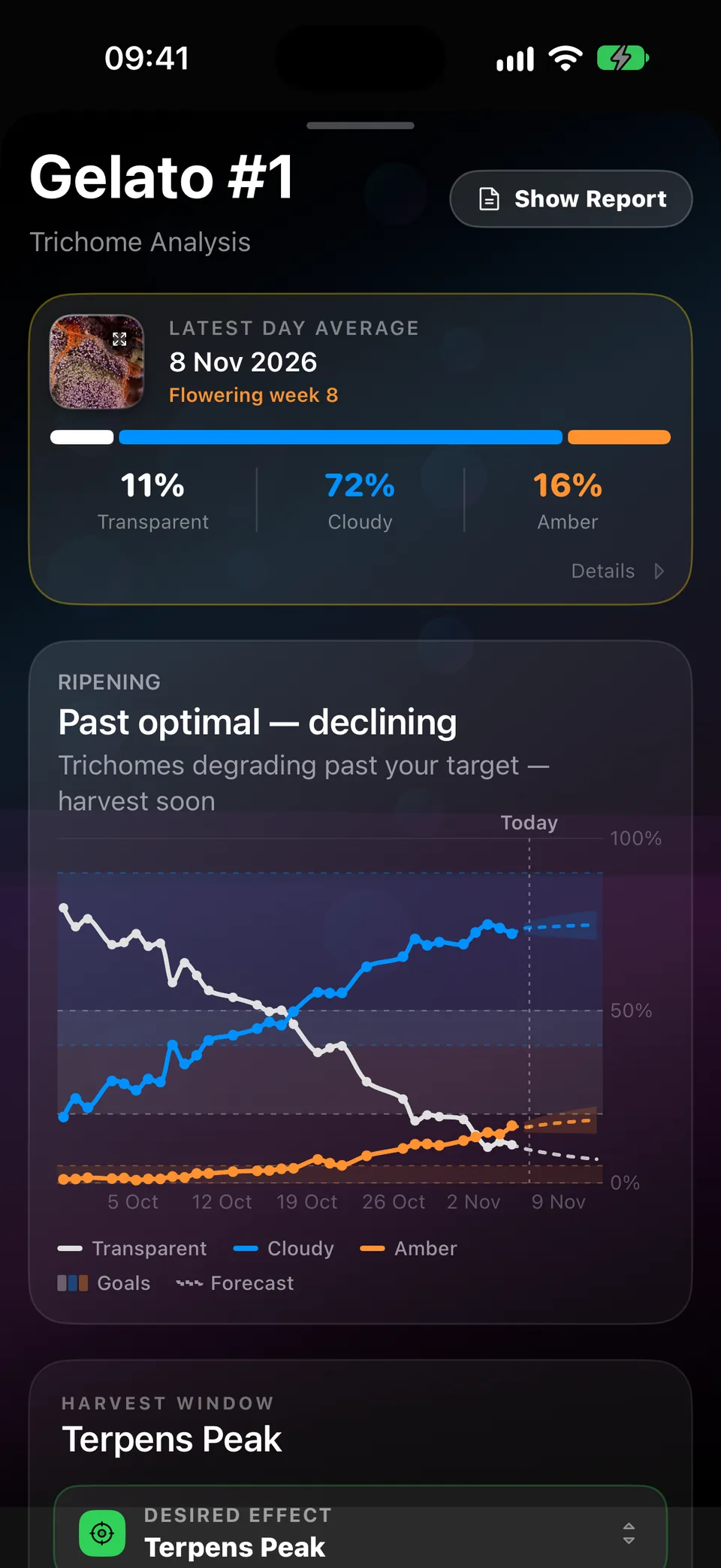
- Harvest by trichomes, not by the days on the packet; see our guide to autoflower harvest time.
References
- Alter H, Sade Y, Sood A, Carmeli-Weissberg M, Shaya F, Kamenetsky-Goldstein R, Bernstein N, Spitzer-Rimon B (2024). Inflorescence development in female cannabis plants is mediated by photoperiod and gibberellin. Horticulture Research 11(11):uhae245. doi:10.1093/hr/uhae245
- Babaei M, Nemati H, Arouiee H, Torkamaneh D (2026). Integrating temporal morphophysiological and genomic markers for precise classification of flowering time in cannabis. Scientific Reports 16:23150. doi:10.1038/s41598-026-53686-y
- Coolong T, Cassity-Duffey K, Joy N (2023). Role of planting date on yield and cannabinoid content of day-neutral and photoperiod-sensitive hemp in Georgia, USA. HortTechnology 33(1):138–145. doi:10.21273/HORTTECH05151-22
- Dowling CA, Shi J, Toth JA, Quade MA, Smart LB, McCabe PF, Schilling S, Melzer R (2024). A FLOWERING LOCUS T ortholog is associated with photoperiod-insensitive flowering in hemp (Cannabis sativa L.). The Plant Journal 119(1):383–403. doi:10.1111/tpj.16769
- Duringer JM, Saindon A, Irawan A, Ates S, Brownstein KJ, Gude KM, Ringo C, Kinney CA, Berhow M, Steiner J (2026). Nutritive value and cannabinoid potency of diverse hemp (Cannabis sativa L.) varieties grown under different light conditions and harvested across multiple time points as a possible feed source for livestock. Journal of Agricultural and Food Chemistry 74(18):14297–14310. doi:10.1021/acs.jafc.5c16989
- Kurtz LE, Brand MH, Lubell-Brand JD (2023). Gene dosage at the autoflowering locus effects flowering timing and plant height in triploid cannabis. Journal of the American Society for Horticultural Science 148(2):83–88. doi:10.21273/JASHS05293-23
- Leckie KM, Sawler J, Kapos P, MacKenzie JO, Giles I, Baynes K, Lo J, Baute GJ, Celedon JM (2024). Loss of daylength sensitivity by splice site mutation in Cannabis pseudo-response regulator. The Plant Journal 118(6):2020–2036. doi:10.1111/tpj.16726
- Lynch RC, Padgitt-Cobb LK, Garfinkel AR, Knaus BJ, et al., Michael TP (2025). Domesticated cannabinoid synthases amid a wild mosaic cannabis pangenome. Nature 643:1001–1010. doi:10.1038/s41586-025-09065-0
- Marabesi AO, Lessl JT, Coolong TW (2023). Cadmium bioconcentration and translocation potential in day neutral and photoperiod sensitive hemp grown hydroponically for the medicinal market. Water 15(12):2176. doi:10.3390/w15122176
- McPartland JM (2018). Cannabis systematics at the levels of family, genus, and species. Cannabis and Cannabinoid Research 3(1):203–212. doi:10.1089/can.2018.0039
- Pojmann-Ezeonyilo E, Langenhoven P, Ingwell LL (2024). Evaluating the impact of light quality on plant–herbivore interactions using hemp as the model system. Environmental Entomology 53(1):40–49. doi:10.1093/ee/nvad127
- Ren G, Zhang X, Li Y, Ridout K, et al. (2021). Large-scale whole-genome resequencing unravels the domestication history of Cannabis sativa. Science Advances 7(29):eabg2286. doi:10.1126/sciadv.abg2286
- Schilling S, Melzer R, Dowling CA, Shi J, Muldoon S, McCabe PF (2023). A protocol for rapid generation cycling (speed breeding) of hemp (Cannabis sativa) for research and agriculture. The Plant Journal 113(3):437–445. doi:10.1111/tpj.16051
- Sreewongchai T, Phosiri C, Mayong A, Matthayatthaworn W (2026). Inheritance of photoperiod sensitivity and cannabinoid stability in F2 generation of hemp variety ‘CBD Charlotte’s Angel’. Agriculture and Natural Resources 60(5):600505. doi:10.34044/j.anres.2026.60.5.05
- Tang L, Fan C, Yang L, Yuan H, Cheng L, Liu D, He W (2026). Identification of a major QTL and candidate gene for flowering time in industrial hemp via BSA-seq and fine mapping. Scientific Reports 16:32880. doi:10.1038/s41598-026-62855-y
- Toth JA, Stack GM, Carlson CH, Smart LB (2022). Identification and mapping of major-effect flowering time loci Autoflower1 and Early1 in Cannabis sativa L. Frontiers in Plant Science 13:991680. doi:10.3389/fpls.2022.991680
- Vergara D, Ruterbories KA (2026). High-THC Cannabis sativa in a New York greenhouse: yield and economic factors. Journal of Cannabis Research 8:85. doi:10.1186/s42238-026-00429-5
- Zhang M, Anderson SL, Brym ZT, Pearson BJ (2021). Photoperiodic flowering response of essential oil, grain, and fiber hemp (Cannabis sativa L.) cultivars. Frontiers in Plant Science 12:694153. doi:10.3389/fpls.2021.694153