

Light · Flowering
12/12 Light Schedule for Cannabis: What Photoperiod Trials Show
Twelve hours is a convention, not a threshold. Trials with longer days found more yield in some cultivars, less THC in others, and a plant that counts the night, not the day.
11 min read
Flip to 12/12 and the plants flower. Almost every indoor grow runs that schedule, and it works so reliably that few rooms ever try anything else. But twelve hours was never measured as the best day length for cannabis. It is a round number, short enough for every cultivar.
Since 2021 several controlled trials have tested what happens between 12 and 15 hours of light. This guide covers how the plant reads day length, where flowering actually stops, what longer days did to yield and potency, what light in the dark period does, and how to test a change without risking a room.
The plant measures the night
Cannabis is a short-day plant: most cultivars stay vegetative under long days and flower when the days shorten. The name is misleading, because what the plant times is the uninterrupted dark period. Classic experiments on short-day plants showed that a long night triggers flowering and that light in the middle of it cancels the signal (Hamner and Bonner, 1938).
The sensing happens in the leaves. Phytochromes, pigments that switch between two forms under red and far-red light, tell the plant whether it is light or dark, and the circadian clock measures how long the dark lasts. When the night is long enough, the leaves switch on FLOWERING LOCUS T, the gene behind the mobile flowering signal known as florigen (Song et al., 2015). Red photons arriving at night flip phytochrome back to its active form and hold flowering back (Kusuma et al., 2021).
The longest day under which a cultivar still flowers is its critical photoperiod. Indoors we work far away from it on both sides: 18 hours of light for vegetative growth, 12 for flower.
Where flowering actually stops
A trial at the University of Guelph put ten high-THC cultivars under 12, 12.5, 13, 13.5, 14 and 15 hours of light after an 18-hour vegetative phase. All ten started flowering under every day length up to 14 hours. Compared with 12 hours, the delay at 14 hours ranged from none to about four days. Under 15 hours three cultivars still initiated flowers, but the flowers did not develop further (Ahrens et al., 2023).
Starting to flower and building flowers were not the same thing. Even in the cultivars with no delay, the top inflorescence was smaller and early flower weight lower under days longer than 13 hours. The trial ran for three to four weeks, about a third of a normal cycle, so it shows where flowering starts, not what the harvest weighs.
Hemp shows how far the threshold moves between cultivars. In 15 CBD hemp cultivars the critical photoperiod ranged from just under 14 hours to more than 15 h 30 min, and for some a difference of 15 minutes changed the result (Zhang et al., 2021). Plants sold under the same name but from different sources did not always respond alike.
In tissue culture, one high-THC genotype flowered in about three quarters of the explants under 12 and 13.2 hours, in about one in ten under 14.4 hours and almost never under 15 or 16 (Moher et al., 2021). Small shoots in a vessel under very low light are not a canopy, but the shape agrees with the whole-plant trials: nothing special happens at 12 hours.
What a 13-hour day did to yield
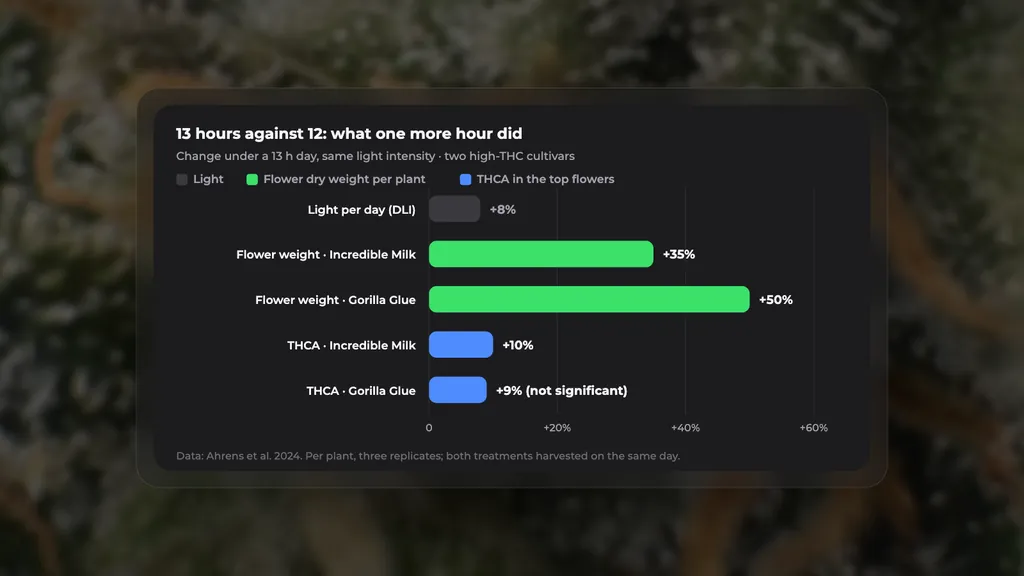
The same Guelph group then grew two cultivars, Incredible Milk and Gorilla Glue, to commercial maturity under 12 or 13 hours at the same intensity, about 540 µmol/m²/s. One more hour gave 8% more light per day. Flower dry weight per plant was 35% higher in Incredible Milk and 50% higher in Gorilla Glue (Ahrens et al., 2024).
Potency did not pay for it. THCA in the top flowers was 31.5% under 13 hours against 28.7% under 12 in Incredible Milk, and 27.3% against 25.1% in Gorilla Glue, a difference that was not statistically significant in the second cultivar. THC per plant rose by at least 38%.
Three details keep the result in proportion:
- Per plant, not per square metre. Each treatment had three replicates of three plants per cultivar, and the authors warn against turning per-plant gains into per-area gains. Bigger plants at commercial density shade each other.
- Same harvest day, different ripeness. Both treatments were cut when the 12-hour plants were ready. Stigma browning and trichome ambering came earlier and moved faster under 12 hours, so the 13-hour plants were harvested less ripe. How many more days they needed was not measured.
- Looser tops in one cultivar. The density of the top inflorescence was 36% lower under 13 hours in Incredible Milk and unchanged in Gorilla Glue.
Fourteen hours: more flower, less THC
An Australian trial went further, with 10, 12 or 14 hours at 700 µmol/m²/s for three cultivars and a harvest after 57 days of flowering. Flower biomass was highest in every cultivar when flowering started under 14 hours. In the two high-THC cultivars, though, staying at 14 hours to the end lowered THC concentration by about two fifths: from 12% to 7% in Northern Lights and from 10% to 6% in Hindu Kush (Peterswald et al., 2023).
In Hindu Kush the two effects cancelled out: 39% more flower with 40% less THC in it, and the same THC per plant. The authors noted visibly fewer trichomes and slower pistil senescence under the static 14-hour day, which reads like a crop cut before it was ripe.
The treatment that worked for Northern Lights was a switch: 14 hours for the first 28 days of flowering, then 12 hours to harvest. THC yield per plant rose by 49%, from extra biomass alone, with no change in concentration. In the high-CBD cultivar Cannatonic, treatments that began at 14 hours raised total CBD yield by 50 to 100%.
Shorter was not better. A 10-hour day delayed the start of flowering in all three cultivars and tended to give the lowest yields.
Is it just more light?
A longer day at the same intensity delivers more photons: 8% more at 13 hours, 17% more at 14. Yield follows the daily light integral, as our guide to PPFD and DLI explains, so part of the gain is simply light. But yield rose more than the DLI did, four to six times more in the Guelph trial, and its authors rejected their own hypothesis that yield would be proportional to light (Ahrens et al., 2024). Their explanation is growth in the first weeks after the flip: under a longer day the plant builds a larger frame and more flower sites before it stops stretching. In hemp, stretch was 47 to 102% greater under 14 hours than under 12 (Zhang et al., 2021), which matters in a room with a fixed ceiling.
None of these trials compared 13 hours with 12 hours at a higher intensity and the same DLI, and none measured electricity. One extra hour is 8% more lamp hours a day, for a crop that may also need more days. Judge the result in grams per kWh and in cost per gram, not in grams per plant.
Light in the dark period
If the plant times the night, light during the night is the real risk. The evidence is thinner than forum threads suggest:
- Dim light every night stops normal flowering. In a CBD hemp cultivar kept on 9-hour days, 1.0 µmol/m²/s from incandescent lamps for six more hours each evening was enough to stop the full transition to flowering. It was the lowest dose tested, so the safe level is below it and still unknown (Park et al., 2023).
- A night break holds plants vegetative. One hour of full light in the middle of a 12-hour night, every night, kept a CBD cultivar from flowering (Grover et al., 2025). Mother rooms use it on purpose.
- Infrared cameras are a small risk. Near-infrared LEDs delayed flowering in hemp by up to 12 days, but only at a flux far above what a camera delivers at working distance; the authors judged the intensities too low to matter in most settings (Kusuma et al., 2021).
- Moonlight is not a leak. A full moon gives 0.002 to 0.005 µmol/m²/s, hundreds of times less than the lowest dose tested.
Two things growers often state as fact have no trial behind them. No published experiment shows that a light leak turns female plants hermaphrodite; the best-known paper on hermaphroditism cites only grower handbooks for it (Punja and Holmes, 2020). And no study has set a safe level of stray light for flowering high-THC cannabis. Until one does, treat the dark period as dark: seal doors and ducts, cover indicator LEDs, and check the room from inside with the lights off.
Autoflowers ignore the clock
Day-neutral cultivars flower by age, whatever the day length. Genetics has found more than one cause. In hemp the trait maps to a recessive locus on chromosome 1, Autoflower1 (Toth et al., 2022), and to a second, independent locus that contains a FLOWERING LOCUS T gene (Dowling et al., 2024). In autoflowering cannabis lines the cause is a splice-site mutation in PRR37, a clock gene that normally holds FT back (Leckie et al., 2024).
For these plants the day length only sets the light dose: 18 or 20 hours give more DLI at the same intensity. Their timing is covered in our guide to autoflower harvest time.
How to test a longer day
- Keep 12/12 as the default. It flowers every photoperiod-sensitive cultivar, and it is the right schedule for genetics you have not run before.
- Test one cultivar at a time. Every cultivar in these trials responded differently. A side-by-side with the same clones, in two rooms or two tents, beats one run compared with memory.
- Change the timer, nothing else. Same intensity, same climate, same feed, or the result cannot be read.
- Consider a switch. Fourteen hours for the first four weeks, then 12, gained biomass without losing THC in one trial. It is the cautious version.
- Plan for the stretch. Longer days mean taller plants. Leave headroom and trellis early.
- Harvest by trichomes, not by day count. Ripening ran slower under longer days. Read the heads, as described in when to harvest, and expect a later date.
- Judge it on the final numbers. Dry weight per square metre, lab THC, days in the room and kWh. A heavier plant that takes ten more days may not be a gain.
A photoperiod checklist
- Write down the light schedule of every room and the date of the flip.
- Check the dark period from inside the room: no leaks at doors, ducts or panels, no indicator lights.
- Run new cultivars at 12/12 first and record the days to the first stigmas and to harvest.
- Trial 13 hours, or 14 hours for four weeks and then 12, on one known cultivar next to a 12-hour control.
- Track stretch every week and trichomes from week six.
- Cut each treatment when it is ripe, not on the same day.
- Compare dry weight, THC, days and electricity before changing the whole room.
References
- Ahrens A, Llewellyn D, Zheng Y (2023). Is twelve hours really the optimum photoperiod for promoting flowering in indoor-grown cultivars of Cannabis sativa? Plants 12(14):2605.
- Ahrens A, Llewellyn D, Zheng Y (2024). Longer photoperiod substantially increases indoor-grown cannabis’ yield and quality: a study of two high-THC cultivars grown under 12 h vs. 13 h days. Plants 13(3):433.
- Dowling CA, Shi J, Toth JA, Quade MA, Smart LB, McCabe PF, Schilling S, Melzer R (2024). A FLOWERING LOCUS T ortholog is associated with photoperiod-insensitive flowering in hemp (Cannabis sativa L.). The Plant Journal 119(1):383–403.
- Grover EF, Haiden SR, Berkowitz GA (2025). Examining the “night break” method in Cannabis sativa horticulture: vegetative daily light integral affects yield of extractable biomass in C. sativa. Plants 14(19):3095.
- Hamner KC, Bonner J (1938). Photoperiodism in relation to hormones as factors in floral initiation and development. Botanical Gazette 100(2):388–431.
- Kusuma P, Westmoreland FM, Zhen S, Bugbee B (2021). Photons from NIR LEDs can delay flowering in short-day soybean and Cannabis: implications for phytochrome activity. PLoS ONE 16(7):e0255232.
- Leckie KM, Sawler J, Kapos P, MacKenzie JO, Giles I, Baynes K, Lo J, Baute GJ, Celedon JM (2024). Loss of daylength sensitivity by splice site mutation in Cannabis pseudo-response regulator. The Plant Journal 118(6):2020–2036.
- Moher M, Jones M, Zheng Y (2021). Photoperiodic response of in vitro Cannabis sativa plants. HortScience 56(1):108–113.
- Park J, Collado CE, Lam VP, Hernández R (2023). Flowering response of Cannabis sativa L. ‘Suver Haze’ under varying daylength-extension light intensities and durations. Horticulturae 9(5):526.
- Peterswald TJ, Mieog JC, Azman Halimi R, Magner NJ, Trebilco A, Kretzschmar T, Purdy SJ (2023). Moving away from 12:12; the effect of different photoperiods on biomass yield and cannabinoids in medicinal cannabis. Plants 12(5):1061.
- Punja ZK, Holmes JE (2020). Hermaphroditism in marijuana (Cannabis sativa L.) inflorescences – impact on floral morphology, seed formation, progeny sex ratios, and genetic variation. Frontiers in Plant Science 11:718.
- Song YH, Shim JS, Kinmonth-Schultz HA, Imaizumi T (2015). Photoperiodic flowering: time measurement mechanisms in leaves. Annual Review of Plant Biology 66:441–464.
- Toth JA, Stack GM, Carlson CH, Smart LB (2022). Identification and mapping of major-effect flowering time loci Autoflower1 and Early1 in Cannabis sativa L. Frontiers in Plant Science 13:991680.
- Zhang M, Anderson SL, Brym ZT, Pearson BJ (2021). Photoperiodic flowering response of essential oil, grain, and fiber hemp (Cannabis sativa L.) cultivars. Frontiers in Plant Science 12:694153.