
Hermaphrodite Cannabis: What Really Causes It, and What It Costs
Light leaks, heat and late harvests are blamed for every hermaphrodite. The controlled studies point mainly to genetics and to ethylene, and show what a pollinated flower loses.
 GrowBotiq Research Team· 6 min read
In this article6
Few things worry a grower more than a yellow banana-shaped anther in the middle of a ripening bud. One hermaphrodite can seed a room, and the usual suspects are named at once: a light leak, a hot week, a feeding mistake, a harvest left too long.
This article looks at what has actually been measured: how sex works in cannabis, which triggers have been tested, what a hermaphrodite flower produces, and what pollen does to a crop. One answer breeders are working on is plants that barely set seed at all, covered in our guide to triploid cannabis.
How sex works in cannabis
Cannabis is normally dioecious: male and female plants. Sex is set by chromosomes, as in humans, with XX females and XY males (Divashuk et al., 2014). A hermaphrodite in a female crop is not a third kind of plant. It is an XX plant that forms some male flowers, usually as anthers among its female flowers.
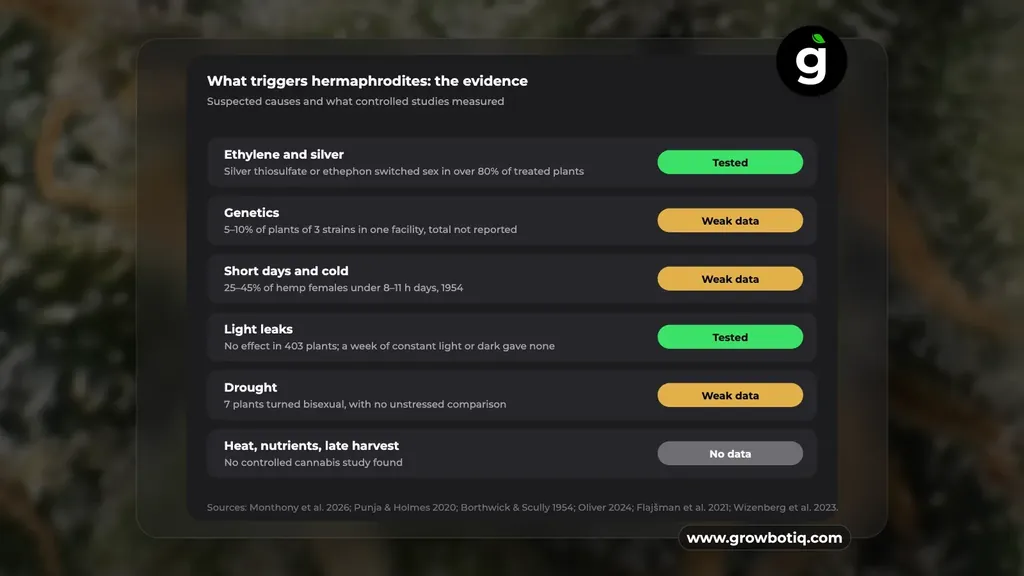
The switch is hormonal. Ethylene keeps female flowers female; block its action and male flowers appear. That is how breeders make feminized seed on purpose: silver thiosulfate or ethephon changed the sex of flowers in more than 80% of treated plants in a recent study, with gene activity changing within 18 hours (Monthony et al., 2026). Our guide to feminized seeds explains the method.
How common it is
The only measured figure for drug-type cannabis comes from one licensed indoor facility: 5 to 10% of plants of three strains formed anthers inside their female flowers, from about week 4 of flowering until harvest (Punja & Holmes, 2020). The authors did not report the total number of plants and note that the true rate in cannabis populations is unknown. In high-CBD breeding lines, untreated control plants averaged about one flower cluster with male flowers per plant (Flajšman et al., 2021).
Because the tendency varies between strains, genetics is the first suspect: a cultivar that hermaphrodites in one room usually does so in others.
Light leaks, stress and late harvests: what was tested
- Light leaks. In a commercial room of 403 plants, plants near the door, where light entered during the dark period, had no more male flowers than the rest (Oliver, 2024). In another study, a full week of constant light or constant darkness before 12/12 produced no male flowers on untreated plants (Flajšman et al., 2021). Neither study rules out every kind of leak, but neither supports the idea that a brief exposure flips plants.
- Day length and cold. The strongest environmental data are from hemp in 1954: 25 to 45% of female plants formed male flowers under 8 to 11 hour days, and cool temperatures before flowering increased the share (Borthwick & Scully, 1954, as summarised by Richards et al., 2026). Those day lengths are far from a normal 12/12 room.
- Drought. In a CBD hemp cultivar, seven plants turned bisexual within two weeks after watering was cut, but the study had no well-watered comparison, so cause and effect are not established (Wizenberg et al., 2023).
- Heat, nutrients, late harvest. A 2026 review found no controlled cannabis study; the evidence usually quoted comes from cucumber and wheat (Richards et al., 2026).
Stress may still play a part, but the data show only one proven lever, ethylene, and a strong genetic component.
What hermaphrodite flowers produce
The anthers are real. Their pollen looked like normal pollen and germinated at 10 to 30% on agar; seeds formed by self-pollination germinated at 90 to 95%, and every seedling tested was genetically female (Punja & Holmes, 2020). Those seeds are, in effect, feminized seeds. Whether the seedlings inherit the tendency to hermaphrodite was not measured.
What pollen costs
A seeded flower puts its resources into seeds. When THC-rich and CBD-rich plants were deliberately pollinated, total cannabinoids fell by 75% and 60%, and monoterpenes in the THC-rich plant by 60 to 80% (Lipson Feder et al., 2021). That was heavy pollination in a shared chamber with three plants per treatment, so a few stray anthers will cost less, but nobody has yet measured how much less. Our article on terpenes puts the loss in context.
Prevention and scouting
- Choose genetics from suppliers who select against hermaphrodites, and drop cultivars that keep producing them.
- Scout every plant weekly from week 3 of flower, looking inside the buds, not just at the tops.
- Remove single anthers with tweezers; remove plants with many, bagging them before moving them.
- Keep the dark period dark and the climate steady: cheap insurance, even if the evidence is thin.
- Log each case by plant, strain and week, so patterns show up across cycles.
- For large operations, hand-held Raman scanners told hermaphrodites from females with 98.7% accuracy in a test (Goff et al., 2022).
Pests and diseases are scouted on the same rounds, as described in our guide to integrated pest management.
References
- Borthwick HA, Scully NJ (1954). Photoperiodic responses of hemp. Botanical Gazette 116(1):14–29. doi:10.1086/335843
- Divashuk MG, Alexandrov OS, Razumova OV, Kirov IV, Karlov GI (2014). Molecular cytogenetic characterization of the dioecious Cannabis sativa with an XY chromosome sex determination system. PLOS ONE 9(1):e85118. doi:10.1371/journal.pone.0085118
- Flajšman M, Slapnik M, Murovec J (2021). Production of feminized seeds of high CBD Cannabis sativa L. by manipulation of sex expression and its application to breeding. Frontiers in Plant Science 12:718092. doi:10.3389/fpls.2021.718092
- Goff NK, Guenther JF, Roberts JK, Adler M, Molle MD, Mathews G, Kurouski D (2022). Non-invasive and confirmatory differentiation of hermaphrodite from both male and female cannabis plants using a hand-held Raman spectrometer. Molecules 27(15):4978. doi:10.3390/molecules27154978
- Lipson Feder C, Cohen O, Shapira A, Katzir I, Peer R, Guberman O, Procaccia S, Berman P, Flaishman M, Meiri D (2021). Fertilization following pollination predominantly decreases phytocannabinoids accumulation and alters the accumulation of terpenoids in cannabis inflorescences. Frontiers in Plant Science 12:753847. doi:10.3389/fpls.2021.753847
- Monthony AS, Roy J, de Ronne M, Carlson O, Murch SJ, Torkamaneh D (2026). Sex-specific ethylene responses drive floral sexual plasticity in Cannabis sativa. The Plant Journal 125(3):e70721. doi:10.1111/tpj.70721
- Oliver W (2024). Investigating the effects of dark period light exposure on sex expression in female Cannabis sativa. SURG Journal 15(1). doi:10.21083/surg.v15i1.7697
- Punja ZK, Holmes JE (2020). Hermaphroditism in marijuana (Cannabis sativa L.) inflorescences – impact on floral morphology, seed formation, progeny sex ratios, and genetic variation. Frontiers in Plant Science 11:718. doi:10.3389/fpls.2020.00718
- Richards CD, Ryu BR, Gim GJ, Park SH (2026). Hermaphroditism in Cannabis sativa L.: impacts, inducers, and industry implications. Plants 15(11):1643. doi:10.3390/plants15111643
- Wizenberg SB, Muir-Guarnaccia J, Campbell LG (2023). Cosexuality reduces pollen production and fitness in Cannabis sativa L. Plants 12(21):3731. doi:10.3390/plants12213731