
Feminized Cannabis Seeds: How They Are Made and How Female They Are
A female plant is pushed to grow male flowers, and its pollen can only pass on X chromosomes. The chemistry is forty years old; the numbers on how well it works are recent.
 GrowBotiq Research Team· 6 min read
In this article7
Most cannabis seed sold today is feminized: every seed should become a female plant, the only kind that produces flowers worth harvesting. The method behind it was published in 1982 and has hardly changed. What has changed is the amount of data on how well it works.
The principle: female pollen
Cannabis females are XX and males XY. If a female plant can be made to grow male flowers, its pollen can only carry an X chromosome, and every seed it fathers on another female, or on itself, is XX. The trick is to override the hormone that keeps female flowers female: ethylene.
Silver ions block ethylene action. In the original study, silver nitrate or silver thiosulfate (STS) applied to the shoot tip of female plants produced fertile male flowers whose pollen set seed; STS worked better, with 100 µg per plant giving the most fully male flowers (Mohan Ram & Sett, 1982). Gibberellins can also induce male flowers, a response abscisic acid blocks (Ram & Jaiswal, 1972). Our article on hermaphrodites describes the same switch when it happens by accident.
Which agent works best
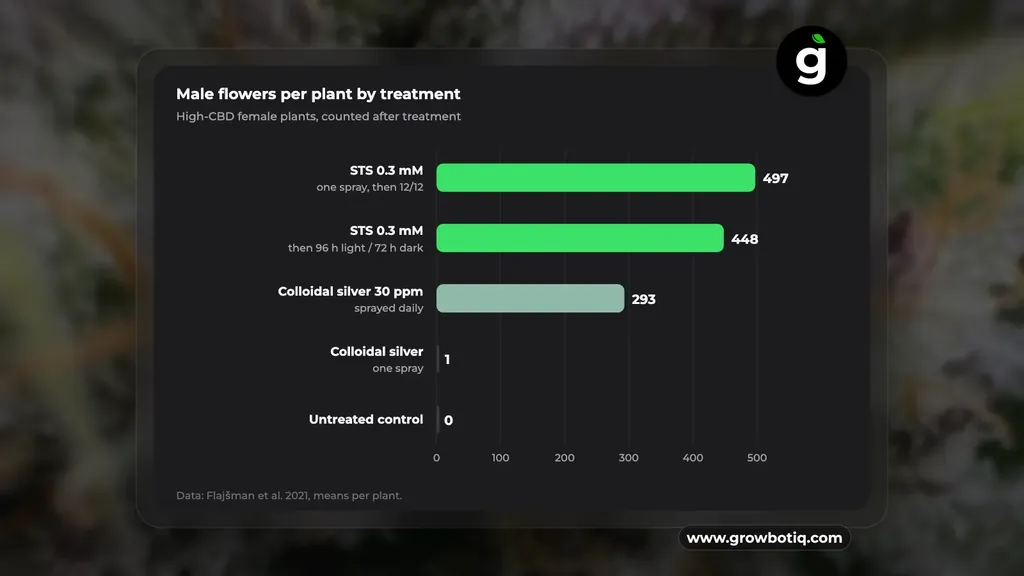
A breeding study on high-CBD cannabis compared the options directly. One spray of 0.3 mM STS produced about 500 male flowers per plant. Colloidal silver at 30 ppm needed daily spraying to reach about 290, and a single colloidal silver spray did almost nothing. Gibberellin sprayed on the whole plant was no better than leaving it untreated (Flajšman et al., 2021).
Other trials agree. A floriculture silver product matched STS, with about 500 male flowers per plant across six accessions (Owen et al., 2023), and a 2025 comparison ranked STS first, with cobalt nitrate and 1-MCP failing (Fitzgerald et al., 2025).
Dose and timing
In four hemp strains, three sprays of STS a week apart gave about half male flowers at 0.3 mM and at least 95% at 3 mM on the top flower clusters (Lubell & Brand, 2018). In three cultivars, a single 1.5 mM spray at the start of flowering was enough, while a single spray later in flowering was not (Kim et al., 2024). A practical guideline review recommends one 3 mM spray to runoff in late vegetative growth, followed by 12-hour days (Timoteo Junior & Oswald, 2024).
Male flowers appear about three weeks after treatment and shed pollen about a week later (Flajšman et al., 2021). Concentrations of 20 mM burned leaves.
Induced pollen is weaker
Masculinized females are not as good at being male as real males. They produced less total pollen (Wizenberg et al., 2023) and more misshapen grains, with only two of five strains germinating as well as a true male (DiMatteo et al., 2020). Germination tests on agar were often in single digits, from 0 to 7% in one study and 2 to 6% for stored pollen in another (Flajšman et al., 2021; Fitzgerald et al., 2025). Pollen is usually applied generously for that reason, and used fresh. Pollen from reversed females is also how breeders tested the seed set of triploid cannabis.
How female are the seeds?
The genetics predict 100%, and most measured lots came close. Seeds from a spontaneous hermaphrodite were all genetically female (Punja & Holmes, 2020); STS at 500 to 750 ppm gave 100% females by DNA markers, but silver nitrate at 250 ppm only 88% (Tariq et al., 2026). In a Thai landrace, self-pollinated colloidal-silver lines were all female, while one cross produced a single hermaphrodite among about 18 plants (Sreewongchai et al., 2026).
Males in a feminized lot point to pollen contamination or a mislabelled parent, not to the method. Whether feminized plants hermaphrodite more often than plants from regular seed is widely claimed, but no published study has compared the two.
Safety
Silver nitrate is corrosive to skin and eyes, an oxidiser and very toxic to aquatic life; occupational exposure limits for soluble silver are 0.01 mg per cubic metre. In practice:
- Mix and spray with gloves, goggles and no mist in the air you breathe.
- Collect leftover solution as chemical waste; do not pour it down the drain.
- Never harvest flower from treated plants for consumption: treat them as pollen donors only.
- Keep treated plants physically isolated so their pollen reaches only the plants meant for seed.
A short protocol
- Select a vigorous female with the chemistry you want, confirmed by a lab test.
- Spray 1.5 to 3 mM STS once, near the switch to 12/12, in an isolated space.
- Collect pollen when the male flowers open, about four weeks later; use it fresh.
- Pollinate the chosen females, ideally by brushing selected branches.
- Grow out a sample of the seed and record the share of females and any hermaphrodites.
References
- DiMatteo J, Kurtz L, Lubell-Brand JD (2020). Pollen appearance and in vitro germination varies for five strains of female hemp masculinized using silver thiosulfate. HortScience 55(4):547–549. doi:10.21273/HORTSCI14842-20
- Fitzgerald TM, Brown JW, Steinmaus S, Prince J, Bhandari R, Da Cunha Leme Filho JF (2025). Chemical masculinization of female Cannabis sativa L.: impacts on pollen viability and feminized seed production. Horticulturae 11(11):1286. doi:10.3390/horticulturae11111286
- Flajšman M, Slapnik M, Murovec J (2021). Production of feminized seeds of high CBD Cannabis sativa L. by manipulation of sex expression and its application to breeding. Frontiers in Plant Science 12:718092. doi:10.3389/fpls.2021.718092
- Kim J, Kim DG, Kim WJ, Lee YJ, Lee SH, Ryu J, Kim JH, Kim SH (2024). Characterization of male flower induction by silver thiosulfate foliar spray in female cannabis at the middle reproductive stage for breeding. Plants 13(17):2429. doi:10.3390/plants13172429
- Lubell JD, Brand MH (2018). Foliar sprays of silver thiosulfate produce male flowers on female hemp plants. HortTechnology 28(6):743–747. doi:10.21273/HORTTECH04188-18
- Mohan Ram HY, Sett R (1982). Induction of fertile male flowers in genetically female Cannabis sativa plants by silver nitrate and silver thiosulphate anionic complex. Theoretical and Applied Genetics 62(4):369–375. doi:10.1007/BF00275107
- Owen LC, Suchoff DH, Chen H (2023). A novel method for stimulating Cannabis sativa L. male flowers from female plants. Plants 12(19):3371. doi:10.3390/plants12193371
- Punja ZK, Holmes JE (2020). Hermaphroditism in marijuana (Cannabis sativa L.) inflorescences – impact on floral morphology, seed formation, progeny sex ratios, and genetic variation. Frontiers in Plant Science 11:718. doi:10.3389/fpls.2020.00718
- Ram HYM, Jaiswal VS (1972). Induction of male flowers on female plants of Cannabis sativa by gibberellins and its inhibition by abscisic acid. Planta 105(3):263–266. doi:10.1007/BF00385397
- Sreewongchai T, Srikul P, Mayong A, Matthayatthaworn W (2026). Comparison of self-pollination and intercrossing for feminized seed production in Thai Hang Kra Rok cannabis (Cannabis sativa L.) landrace. Agriculture and Natural Resources 60(5):600512. doi:10.34044/j.anres.2026.60.5.12
- Tariq R, Habib U, Khan MA, Rana RM, Kamran M (2026). Optimized chemical masculinization and SCAR marker-assisted screening for feminized seed production in hemp. Plant Breeding. doi:10.1111/pbr.70111
- Timoteo Junior AA, Oswald IWH (2024). Optimized guidelines for feminized seed production in high-THC cannabis cultivars. Frontiers in Plant Science 15:1384286. doi:10.3389/fpls.2024.1384286
- Wizenberg SB, Muir-Guarnaccia J, Campbell LG (2023). Cosexuality reduces pollen production and fitness in Cannabis sativa L. Plants 12(21):3731. doi:10.3390/plants12213731