
Triploid Cannabis: What Seedless Genetics Really Deliver
In field trials with pollen, triploids set 77 to 87% fewer seeds. The promises of bigger yields and higher potency rest on much thinner evidence.
 GrowBotiq Research Team· 11 min read
In this article9
Seedless watermelons and bananas have been in shops for decades. The same idea has now reached cannabis: triploid plants, sold as "seedless" genetics that shrug off stray pollen and, according to some catalogues, grow bigger and stronger flowers too.
Part of that is well supported. Triploids really do set far fewer seeds. The rest is less clear, and one careful study found triploids with less THCA and fewer terpenes than the plants they came from. This guide goes through what has been measured.
What triploid means
Normal cannabis is diploid: every cell carries two sets of chromosomes, 20 in total. A triploid carries three sets, 30 chromosomes (Suchoff et al., 2024). A tetraploid carries four.
An odd number of sets is what causes the sterility. When the plant tries to make seed, three sets cannot be divided evenly, and most seeds fail. Plant breeders use this on purpose: one of the most effective ways to develop a seedless crop is to create triploids by crossing a diploid with an artificially induced tetraploid (Touchell et al., 2020).
How breeders make one
The first step is a tetraploid. Growing tips or small cuttings in tissue culture are treated with a chemical that stops dividing cells from separating their chromosomes, usually colchicine or oryzalin (Touchell et al., 2020). In one study, a 36-hour colchicine treatment on twenty plantlets gave five tetraploid clones, and three stayed stable through three rounds of cloning (Crawford et al., 2021). With oryzalin, 20 to 40 micromolar for 24 hours gave the most tetraploids in one drug-type strain (Parsons et al., 2019), and an optimized protocol reached 93.75% tetraploids, the rest being mixed plants (Jafari et al., 2025).
These are toxic laboratory chemicals, and each new plant has to be checked with flow cytometry, a lab test that measures the amount of DNA per cell. This is breeding work, not something to try in a grow room.
The second step is the cross, and its direction matters. Tetraploid mothers pollinated by diploids gave filled seed, but 78% less of it than a normal cross. The reverse cross, a diploid mother with tetraploid pollen, gave no filled seed at all, only about 233 empty shells per plant (Crawford et al., 2021). Triploid seed is therefore more expensive to produce, and the authors say so. In that study the pollen came from females treated with silver thiosulfate, so the triploid seed was feminized as well.
How seedless is seedless?
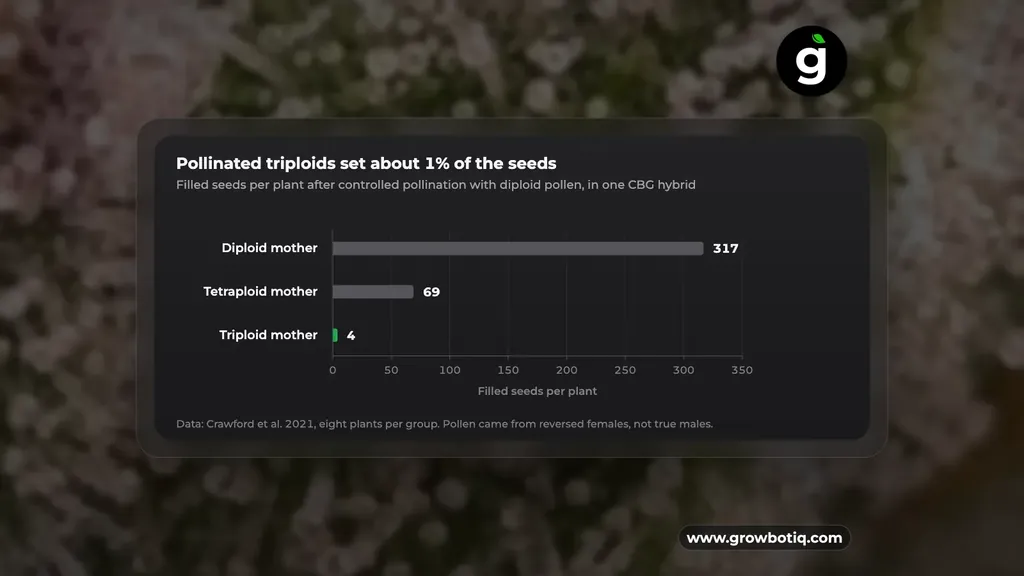
In controlled pollination of a CBG hybrid, diploid mothers gave 317 filled seeds per plant. Triploid mothers gave about 4 with diploid pollen and about 6 with tetraploid pollen, 1.3% and 1.8% of the normal count. More than half of the few seeds that formed on triploids were empty (Crawford et al., 2021).
The authors add a caution of their own. The pollen came from reversed females, which is often less viable than pollen from true males, so real field pollen might do more (Crawford et al., 2021).
That test has since been run. Diploid and triploid versions of the CBD variety Lifter and the variety White CBG were grown in open fields in Kentucky, New York and North Carolina over two seasons, with and without pollen. Where pollen was present, triploid Lifter set 87% fewer seeds than its diploid and triploid White CBG 77% fewer. The diploids, loaded with seed, lost seed-free biomass and cannabinoid concentration compared with the triploids (Suchoff et al., 2024).
The authors' wording is the fair summary: triploids are not completely insensitive to pollen, but triploidy is an effective way to reduce seed and protect yield and quality when pollen is around (Suchoff et al., 2024).
Why this matters depends on where you grow. Cannabis is wind-pollinated, and pollen from hemp grain fields, wild plants or a single hermaphrodite can reach a flower crop. Earlier work cited by Crawford and colleagues found that pollination cut essential oil yield by more than 55% (Crawford et al., 2021).
Do triploids yield more?
Sometimes. In one field season in Oregon, triploids of a CBG hybrid averaged 3,311 g of dry plant against 2,097 g for the diploids, 57% more by the authors' figure. Flower clusters weighed 1,212 g against 1,068 g per plant, a difference that only passed a weaker statistical test. Indoors, the same triploids gave 30.7 g of flower per plant against 24.3 g for the diploids, and plant weight did not differ (Crawford et al., 2021).
The larger field study did not see it. Triploids were taller and wider than diploids, but in the fields without pollen this did not turn into more seed-free biomass, across six site-years (Suchoff et al., 2024).
So the yield advantage of a triploid shows up mainly where the diploid would have been pollinated. In a clean room with no pollen, the published trials do not promise more flower.
Potency and terpenes
Here the evidence cuts against the marketing. In the CBG hybrid grown indoors, CBG concentration rose from 7.78% in diploids to 9.19% in triploids, but the difference was not statistically significant, and THC stayed the same at about 0.14% (Crawford et al., 2021). In the open-field trials without pollen, cannabinoid concentrations did not differ between triploids and diploids (Suchoff et al., 2024).
The only study on high-THC drug cultivars found a loss. Across three THCA-dominant cultivars, THCA averaged 21.0% in diploids and 18.8% in triploids, a significant drop. Tetraploids, at 19.5%, were not significantly different from either. In a CBD cultivar, CBDA fell from 17.59% in diploids to 15.02% in triploids and 12.14% in tetraploids (Fernandes et al., 2023).
Aroma compounds went the same way. Total volatiles decreased in the triploids, and limonene was about 47% lower in triploids across the four cultivars. The authors note that this has relevant implications for the commercial use of triploids (Fernandes et al., 2023). If you sell on terpenes, test the triploid version before you plant a room with it.
The same study shows why averages are not the whole story. Responses differed between cultivars, and among the tetraploids of one cultivar a single plant reached 26.84% total cannabinoids, the best in the trial (Fernandes et al., 2023). Polyploid breeding creates variation. Someone still has to select the good plants.
Tetraploids and beyond
Tetraploids are the parents of triploids, and they have been studied on their own. In clones of a balanced THC/CBD strain, tetraploids had larger fan leaves, stomata about 30% larger and about half as dense, about 40% more trichomes on sugar leaves and 9% more CBD in the buds. Dried bud yield and THC did not change significantly (Parsons et al., 2019).
There was a cost in propagation. After four weeks only 60% of tetraploid cuttings had rooted, against 100% of the diploid ones (Parsons et al., 2019).
One recent paper went further and produced hexaploids, plants with six sets. Its authors report about 65% more total cannabinoids than diploids and 2.7 times the flower dry weight (Ha et al., 2026). All those plants descended from one treated plant, so this is a first result that needs repeating.
Triploids also happen on their own
Not every triploid comes out of a laboratory. Researchers screened seedlings from 13 seed populations with flow cytometry and found natural triploids in 10 of them, at an average of about 0.5%, or 1 plant in 200. The highest rate, 2.3%, was in a self-pollinated population. The same paper notes that some elite clones, Mac1 among them, are triploid with no sign of having been made artificially (Philbrook et al., 2023).
For a grower hunting through seed, this means a few plants in a large run may be triploid without anyone knowing. For a breeder, it means a favourite clone that never gives good seed is worth a ploidy test.
Limits of the evidence
- Few cultivars have been tested: one CBG hybrid, two hemp varieties and four drug-type cultivars carry most of the conclusions.
- The controlled seed counts used pollen from reversed females and eight plants per group. The open-field trials confirm the direction, not those exact numbers.
- The field weights in Oregon come from 15 plants per group in one season, and the flower samples for cannabinoid testing from that field were lost.
- Only one of these studies measured terpenes in triploids, and we found no published trial of triploids in commercial indoor production.
- Seed cost, germination and the stability of triploid clones over many cuttings are not covered in the studies cited here.
What to do with this
- Start from your pollen risk. Outdoors or in a greenhouse near hemp fields, or with cultivars that throw male flowers, a triploid can save a crop. In a sealed room, the case is much weaker.
- Do not expect zero seeds. Triploids cut seed set by 77 to 99% in the trials. Keep scouting for male flowers.
- Ask the breeder for proof of ploidy, such as a flow cytometry result, and for trial data on that exact cultivar.
- Trial a small batch next to your current cultivar before switching. Measure flower weight, cannabinoids and terpenes, not only plant size.
- Remember that a triploid is a dead end for breeding. You can clone it, but you cannot make reliable seed from it.
- Check rooting and vigour of cuttings early. Polyploid clones do not always propagate as easily as their diploids.
- Keep the numbers for every batch, so the decision rests on your own rooms and not on a catalogue.
References
- Crawford S, Rojas BM, Crawford E, Otten M, Schoenenberger TA, Garfinkel AR, Chen H (2021). Characteristics of the diploid, triploid, and tetraploid versions of a cannabigerol-dominant F1 hybrid industrial hemp cultivar, Cannabis sativa ‘Stem Cell CBG’. Genes 12(6):923. doi:10.3390/genes12060923
- Fernandes HP, Choi YH, Vrieling K, de Bresser M, Sewalt B, Tonolo F (2023). Cultivar-dependent phenotypic and chemotypic responses of drug-type Cannabis sativa L. to polyploidization. Frontiers in Plant Science 14:1233191. doi:10.3389/fpls.2023.1233191
- Ha TH, Kim DG, Kim J, Kim WJ, Kang SY, Kim SH (2026). Induction of polyploidy and its effect on cannabinoid content in Cannabis sativa L. Industrial Crops and Products 239:122423. doi:10.1016/j.indcrop.2025.122423
- Jafari M, Paul N, Hesami M, Jones AMP (2025). Machine learning-aided optimization of in vitro tetraploid induction in cannabis. International Journal of Molecular Sciences 26(4):1746. doi:10.3390/ijms26041746
- Parsons JL, Martin SL, James T, Golenia G, Boudko EA, Hepworth SR (2019). Polyploidization for the genetic improvement of Cannabis sativa. Frontiers in Plant Science 10:476. doi:10.3389/fpls.2019.00476
- Philbrook R, Jafari M, Gerstenberg S, Say KL, Warren J, Jones AMP (2023). Naturally occurring triploidy in cannabis. Plants 12(23):3927. doi:10.3390/plants12233927
- Suchoff DH, Inoa SH, Stack GM, Wares AJ, Snyder SI, Murdock MJ, et al. (2024). Characterization of agronomic performance and sterility in triploid and diploid cannabinoid hemp. Agronomy Journal 116(5):2470–2482. doi:10.1002/agj2.21618
- Touchell DH, Palmer IE, Ranney TG (2020). In vitro ploidy manipulation for crop improvement. Frontiers in Plant Science 11:722. doi:10.3389/fpls.2020.00722