
Thrips and Aphids on Indoor Cannabis: Damage, Viruses and Control
Thrips scar leaves and aphids coat flowers in honeydew. Cannabis-specific studies are few, but they have measured a yield loss, tested virus transmission and found that resin limits some predators.
 GrowBotiq Research Team· 5 min read
In this article5
Silvery scars and black specks on leaves mean thrips; sticky honeydew, white cast skins and clusters on young tips mean aphids. Both are common in indoor cannabis, and both have been studied far less than in vegetable or flower crops. A review counted only about six peer-reviewed papers on insect pests of indoor cannabis (Lemay et al., 2022). This article covers what those few studies measured.
Thrips
In Colorado hemp, the onion thrips, Thrips tabaci, was the only thrips commonly found on foliage; the western flower thrips was mostly associated with flowers and pollen (Cranshaw et al., 2019). Indoors, onion thrips can seriously damage leaves.
The only yield trial put zero, one or five thrips on young plants of one cultivar and grew them for eight weeks. Plants started with five thrips yielded 90 g of fresh flower against 130 g for clean plants, about 31% less (McCune et al., 2021). An earlier version of the study suggested lower THC as well, but that claim was dropped from the published paper.
The cannabis aphid
The cannabis aphid, Phorodon cannabis, feeds only on cannabis. It reproduced at every temperature from 20 to 30 °C, best at 25 °C, producing about 7.5 nymphs a day over 15 reproductive days (Durak et al., 2021). Outdoors it overwinters as eggs; indoors it can reproduce all year. It feeds deep in the plant’s sap, unlike the green peach and cotton aphids, which failed to build populations on hemp (Leede & Davis, 2025). Its effect on yield has not been measured, but it fouls flowers with honeydew, cast skins and eggs (Cranshaw et al., 2019).
Aphids did worse on a high-cannabinoid cultivar, but CBD itself did not protect plants: adding CBD to the aphids’ diet increased their reproduction (MacWilliams et al., 2023).
Viruses and viroids
The cannabis aphid is a confirmed vector of potato virus Y: groups of aphids transmitted it to hemp in 96% of tests, single aphids in 63% (Pitt et al., 2022). Cannabis aphids feeding on plants infected with hop latent viroid picked it up in 4 of 8 groups, rice root aphids in 1 of 8, but transmission to healthy plants was not detected (Ong et al., 2025). Rice root aphids are covered in our article on fungus gnats and root aphids.
What controls them
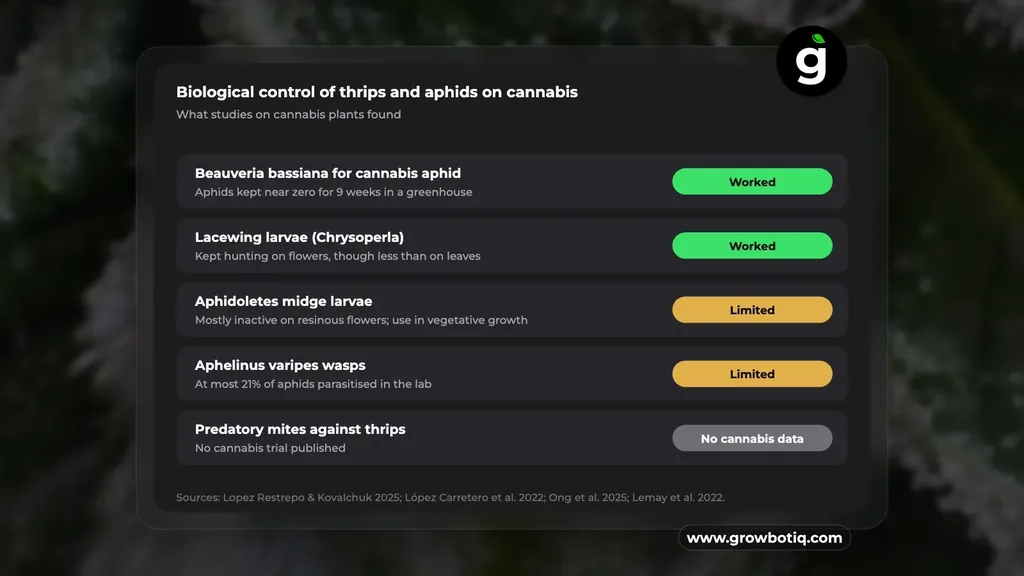
Biological control often works less well on cannabis than in other greenhouse crops, possibly because of sticky glandular trichomes, plant chemistry and short-day lighting (Lemay et al., 2022). The trials so far:
- Insect-killing fungi. Beauveria bassiana and Metarhizium killed all aphids in the lab by day 10, and in a greenhouse Beauveria kept aphids near zero for nine weeks, as well as an insecticide, while insecticide-treated plants had lower cannabinoids and terpenes (Lopez Restrepo & Kovalchuk, 2025).
- Predators on flowers. On resinous flowers, Aphidoletes midge larvae were mostly inactive, while lacewing larvae kept moving and feeding, though less than on leaves. Use Aphidoletes in vegetative growth and lacewings into flowering (López Carretero et al., 2022).
- Parasitoid wasps. Aphelinus varipes parasitised at most 21% of cannabis and rice root aphids in the lab, a candidate rather than a proven solution (Ong et al., 2025).
- Thrips predators. Predatory mites such as Neoseiulus cucumeris and Amblyseius swirskii are widely used, but no published trial has measured their effect on thrips in cannabis.
A thrips and aphid plan
- Inspect new plants and cuttings; keep them apart for a week.
- Hang blue or yellow sticky cards and check leaf undersides and young tips weekly.
- Use Beauveria preventively where allowed, and release lacewings and predatory mites early.
- Use Aphidoletes in vegetative growth, not in late flower.
- Remove heavily infested plants before flowers form.
- Log every sighting by room, as part of the same routine used for spider mites.
References
- Cranshaw W, Schreiner M, Britt K, Kuhar TP, McPartland J, Grant J (2019). Developing insect pest management systems for hemp in the United States: a work in progress. Journal of Integrated Pest Management 10(1):26. doi:10.1093/jipm/pmz023
- Durak R, Jedryczka M, Czajka B, Dampc J, Wielgusz K, Borowiak-Sobkowiak B (2021). Mild abiotic stress affects development and stimulates hormesis of hemp aphid Phorodon cannabis. Insects 12(5):420. doi:10.3390/insects12050420
- Lemay J, Zheng Y, Scott-Dupree C (2022). Factors influencing the efficacy of biological control agents used to manage insect pests in indoor cannabis (Cannabis sativa) cultivation. Frontiers in Agronomy 4:795989. doi:10.3389/fagro.2022.795989
- Leede AE, Davis JA (2025). Life table analyses and feeding behaviors of cannabis aphid, cotton aphid, and green peach aphid (Hemiptera: Aphididae) on industrial hemp. Journal of Economic Entomology 118(2):707–712. doi:10.1093/jee/toaf004
- López Carretero P, Pekas A, Stubsgaard L, Sancho Blanco G, Lütken H, Sigsgaard L (2022). Glandular trichomes affect mobility and predatory behavior of two aphid predators on medicinal cannabis. Biological Control 170:104932. doi:10.1016/j.biocontrol.2022.104932
- Lopez Restrepo D, Kovalchuk I (2025). Entomopathogenic fungi effectively control Phorodon cannabis aphid population in Cannabis sativa plants. Plants 14(6):931. doi:10.3390/plants14060931
- MacWilliams J, Peirce E, Pitt WJ, Schreiner M, Matthews T, Yao L, Broeckling C, Nachappa P (2023). Assessing the adaptive role of cannabidiol (CBD) in Cannabis sativa defense against cannabis aphids. Frontiers in Plant Science 14:1223894. doi:10.3389/fpls.2023.1223894
- McCune F, Morphy C, Eaves J, Fournier V (2021). Onion thrips, Thrips tabaci (Thysanoptera: Thripidae), reduces yields in indoor-grown cannabis. Phytoprotection 101(1):14. doi:10.7202/1076365ar
- Ong M, Munz J, Feng A, Yaqub S, Buirs L, Gries G (2025). Acquisition of hop latent viroid from viroid-infected cannabis plants by rice root aphids and cannabis aphids. Archives of Virology 170(11):221. doi:10.1007/s00705-025-06422-2
- Ong M, Su C, Yaqub S, Feng A, Buirs L, Gries G (2025). Rice root aphids, Rhopalosiphum rufiabdominale, and cannabis aphids, Phorodon cannabis (Hemiptera: Aphididae), are parasitised by Aphelinus varipes (Hymenoptera: Aphelinidae). The Canadian Entomologist 157:e39. doi:10.4039/tce.2025.10024
- Pitt WJ, Kairy L, Villa E, Nalam VJ, Nachappa P (2022). Virus infection and host plant suitability affect feeding behaviors of cannabis aphid (Hemiptera: Aphididae), a newly described vector of potato virus Y. Environmental Entomology 51(2):322–331. doi:10.1093/ee/nvac001