
Plant chemistry · Post-harvest
Cannabis Decarboxylation: Temperature, Time and What Studies Measured
Cannabis makes THCA, and heat turns it into THC. Kinetic studies show how fast that happens, why flower is slower than the textbook numbers, and what every extra degree costs.
 GrowBotiq Research Team· 11 min read
In this article9
A living cannabis flower contains almost no THC. What its trichomes make is THCA, an acid that only becomes THC when it is heated. A flame does that in an instant, which is why the question never came up for smokers. It comes up for everyone else: for extracts, oils, edibles and medical preparations, and for anyone reading the two THC lines on a lab certificate.
Online the step is called "decarbing", and one recipe is repeated everywhere: 240 °F, about 115 °C, for 40 minutes. The reaction has in fact been measured many times, in extracts, in ground flower, in vaporizers, in tea and in thousands of pharmacy-made oils. This guide sums up what those measurements say about temperature, time, and what is lost along the way.
What decarboxylation is
THCA is THC with a carboxyl group attached. Heat splits the group off as carbon dioxide, and the molecule gets lighter: THCA weighs 358.5 g/mol and THC 314.5, so one gram of THCA can give at most 0.877 g of THC. That is the factor behind "total THC" on a lab report, as our article on potency testing explains. The same holds for CBDA and CBD.
The step matters because the acid does little at the receptor that THC acts on. In binding tests, THCA attached to the human CB1 receptor 62 times more weakly than THC, and since the THCA sample itself contained 2% THC, the authors suspect the true figure is weaker still (McPartland et al., 2017).
The plant does not do the job itself. In freshly harvested hemp, and in hemp dried at room temperature, the neutral forms were "hardly detected" (Baek et al., 2025), and resin taken straight from the trichome heads held CBD and CBDA in a ratio of about 1 to 99 (Kim et al., 2024). How the plant builds the acids is covered in our guide to cannabinoid biosynthesis.
Temperature sets the speed
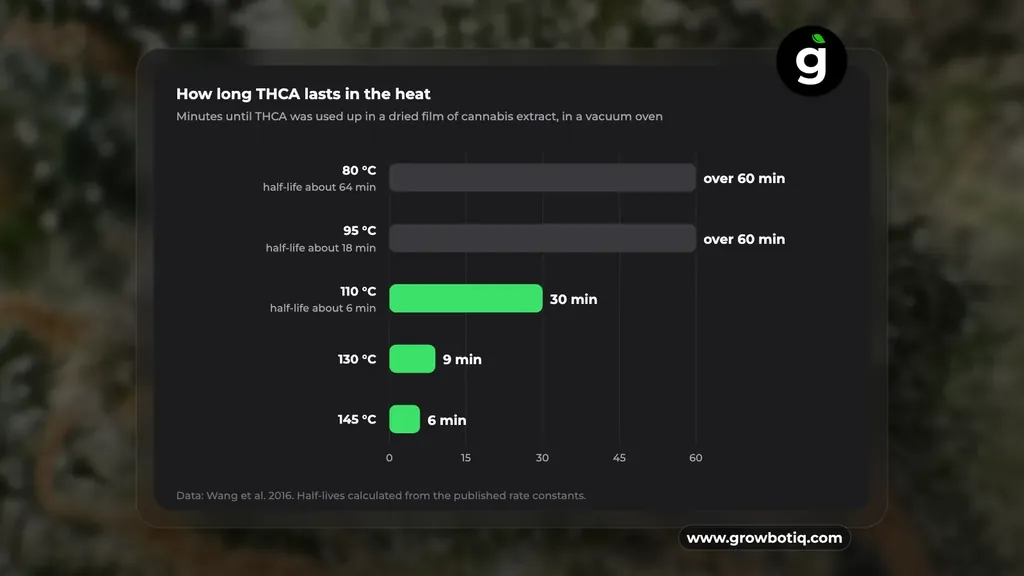
The reference study heated a dried film of flower extract in a vacuum oven and followed the THCA minute by minute. The reaction was first order: a fixed share of what is left disappears every minute, and that share rises steeply with temperature. Going by the published rate constants, half the THCA was gone after about 64 minutes at 80 °C, 18 minutes at 95 °C and 6 minutes at 110 °C. THCA was used up after 30 minutes at 110 °C, 9 minutes at 130 °C and 6 minutes at 145 °C; below 100 °C an hour was not enough (Wang et al., 2016).
CBDA and CBGA reacted at about half the speed of THCA or less (Wang et al., 2016), and a comparison of the acids in hemp also found THCA the fastest (Moreno et al., 2020). A setting tuned for THC therefore leaves CBD behind.
Flower is slower than the lab film
Those minutes belong to a few milligrams of extract spread in a vial. Plant material heats through more slowly. In ground hemp flower in a closed oven, half the THCA had reacted only after 39 minutes at 105 °C, 27 minutes at 120 °C and 21 minutes at 135 °C, and at 90 °C not even half was gone in an hour (Ryu et al., 2021).
The amount changes the answer again. In 500 mg of hemp kief, CBDA was not fully converted after three hours at 100 to 120 °C; it took 140 minutes at 130 °C and 60 minutes at 140 °C (Fućak et al., 2023). In 100 mg of finely ground flower spread thin, CBDA was close to complete in 60 minutes at 120 °C and 97% converted in 12 minutes at 150 °C. The authors put the difference down to the small, thin sample and recall that in an earlier trial four times more material in the same vessel slowed the reaction by about 38% (Carrera et al., 2026).
The one study that optimised the step for commercial flower arrived at 137 °C for 57 minutes for THC and 149 °C for 41 minutes for CBD when time mattered, or 131 °C for both, for 65 and 102 minutes, when it did not. Sample mass affected the kinetics most at the higher temperatures (Reason et al., 2022). There is no single correct setting, only one that fits a given amount, layer and oven.
What heat costs
Conversion is never free. Even under vacuum, the sum of acid and neutral form had fallen by 8% for THC, 18% for CBD and 53% for CBG by the time the reaction was finished at 110 °C (Wang et al., 2016). In hemp flower heated for two hours, total CBD was down 18% at 120 °C and 31% at 150 °C (Carrera et al., 2026). Losses of the neutral cannabinoids rose with temperature and time in every case tested, and were smaller without oxygen (Moreno et al., 2020).
Part of the loss is evaporation and part is breakdown. In THC-rich material up to 3% CBN formed (Carrera et al., 2026). In kief, CBD declined again after its peak, and the authors named 140 °C for 30 minutes as the best compromise between conversion and loss (Fućak et al., 2023).
Terpenes go first. When flowers were decarboxylated at 120 °C for 30 minutes in a laboratory reactor that trapped the vapours in olive oil, about 58% of their terpenes, mainly monoterpenes, ended up in the trap (Boffa et al., 2024). In an open oven that share is simply gone. Our guide to terpenes explains why the lightest ones leave first.
Smoking, vaping and the lab instrument
A flame or a vaporizer does the conversion in seconds. Four electric vaporizers converted 97.3 to 99.8% of the THCA and a gas-flame device 87.7 to 93.3%; between 55 and 83% of the THC reached the vapour, the rest staying in the device or the residue (Lanz et al., 2016). In a laboratory smoking study, decarboxylation was complete both when flower was smoked and when extract was dabbed, but only 19 to 27% of the flower's total THC was available in the smoke, against 75.5% for dabbing (Hädener et al., 2019). What limits the dose is delivery, not conversion.
The same reaction complicates testing. A gas chromatograph heats the sample, so it reports THCA as THC. Early work found at most about 70% conversion in the instrument (Dussy et al., 2005), and a recent comparison about 50 to 60% without a chemical pre-treatment (Franzin et al., 2025). A study with isotope-labelled standards disagrees: it found the conversion complete and traced the shortfall to THCA sticking to surfaces in the instrument (Mulloor et al., 2025). Either way, laboratories that measure THCA and THC separately by liquid chromatography avoid the problem.
Tea, oil and the kitchen
Boiling water is not hot enough for long enough. In tea made the way Dutch patients are instructed, one gram in a litre of water simmered for 15 minutes, the cup held about four times more THCA than THC, and when pure THCA was boiled for 15 minutes only 6.6% of it turned into THC (Hazekamp et al., 2007). Little of either dissolves: plain water took up 0.4 to 1.9% of the THC in the plant, and 53 to 64% once cream was added (Maly et al., 2024).
Oil is the best documented preparation. Among 4,774 olive-oil preparations made by Italian pharmacies, those infused without a prior oven step, at 98 °C for an hour or 110 °C for two, still held 50 to 90% of their cannabinoids as acids, in a highly variable ratio. When the flower was first heated at 115 °C for 40 minutes, 93% of the THC but only 79% of the CBD was in the neutral form; after 145 °C for 30 minutes, 99% and 96.5% (Dei Cas et al., 2020). An independent test of the 145 °C step also found the conversion complete (Pacifici et al., 2017).
That makes the popular 115 °C for 40 minutes a reasonable setting for THC and a weak one for CBD. For butter, baked goods, sous-vide baths and household microwaves we found no peer-reviewed measurements at all.
Curing and storage
Curing is not a slow decarboxylation. Hemp dried at room temperature and then cured for three weeks in sealed containers had under 2% of its cannabinoids converted; hot-air drying at 75 °C converted about 9% (Baek et al., 2025). Curing changes moisture and aroma, as our guide to drying and curing describes, but it does not activate anything.
Storage does, slowly. In flower kept for a year at 25 °C, THCA fell by about a third (Milay et al., 2020), and in cannabis resin at room temperature its half-life was about 462 days in the dark and 330 in daylight (Lindholst, 2010). Because THC breaks down in its turn, old flower is not pre-activated flower; our guide to storing cannabis has the numbers.
Limits of the evidence
- The detailed THCA kinetics come from one extract, heated under vacuum. For flower, the best open data are on CBDA in hemp.
- No study isolates the effect of the moisture in the flower, or compares an open tray with a sealed container for terpene retention.
- Butter, edibles, sous-vide and household microwaves have not been measured in peer-reviewed work.
- We found no human study of THCA taken by mouth on its own.
What follows in practice
- Read "total THC" as a ceiling: THC plus 0.877 times THCA assumes a complete conversion with nothing lost.
- For THC flower, stay in the range the trials support, 110 to 145 °C, in a thin layer, for a time that fits the amount. About 130 °C for an hour was the commercial optimum.
- Give CBD flower more: around 145 to 150 °C, or a longer time.
- Do not go hotter or longer than needed. Every extra step costs cannabinoids, and terpenes before them.
- Do not count on tea, or on an oil infusion alone, to convert the acids.
- Where the dose matters, have THCA and THC measured separately before and after.
- Keep cured flower cool and dark: time converts THCA slowly and destroys THC after it.
References
- Baek Y, Grab H, Chen C (2025). Postharvest drying and curing affect cannabinoid contents and microbial levels in industrial hemp (Cannabis sativa L.). Plants 14(3):414. doi:10.3390/plants14030414
- Boffa L, Binello A, Cravotto G (2024). Efficient capture of cannabis terpenes in olive oil during microwave-assisted cannabinoid decarboxylation. Molecules 29(4):899. doi:10.3390/molecules29040899
- Carrera DÁ, Mazurov AA, Latino DARS, George GM, Katsir L (2026). Thermal conversion of cannabinoids in hemp flower: decarboxylation kinetics and potential accumulation of Δ9-tetrahydrocannabinol. ACS Omega 11(41):62490–62500. doi:10.1021/acsomega.6c01681
- Dei Cas M, Casagni E, Casiraghi A, Minghetti P, Fornasari DMM, Ferri F, Arnoldi S, Gambaro V, Roda G (2020). Phytocannabinoids profile in medicinal cannabis oils: the impact of plant varieties and preparation methods. Frontiers in Pharmacology 11:570616. doi:10.3389/fphar.2020.570616
- Dussy FE, Hamberg C, Luginbühl M, Schwerzmann T, Briellmann TA (2005). Isolation of Δ9-THCA-A from hemp and analytical aspects concerning the determination of Δ9-THC in cannabis products. Forensic Science International 149(1):3–10. doi:10.1016/j.forsciint.2004.05.015
- Franzin M, Di Lenardo R, Ruoso R, Addobbati R (2025). Incomplete decarboxylation of acidic cannabinoids in GC-MS leads to underestimation of the total cannabinoid content in cannabis oils without derivatization. Pharmaceutics 17(3):334. doi:10.3390/pharmaceutics17030334
- Fućak T, Kreft S, Svedružić ŽM, Tavčar E (2023). Mechanism and kinetics of CBDA decarboxylation into CBD in hemp. Journal of Plant Biochemistry and Biotechnology 32(3):608–621. doi:10.1007/s13562-023-00847-z
- Hädener M, Vieten S, Weinmann W, Mahler H (2019). A preliminary investigation of lung availability of cannabinoids by smoking marijuana or dabbing BHO and decarboxylation rate of THC- and CBD-acids. Forensic Science International 295:207–212. doi:10.1016/j.forsciint.2018.12.021
- Hazekamp A, Bastola K, Rashidi H, Bender J, Verpoorte R (2007). Cannabis tea revisited: a systematic evaluation of the cannabinoid composition of cannabis tea. Journal of Ethnopharmacology 113(1):85–90. doi:10.1016/j.jep.2007.05.019
- Kim E-S, Park S-H, Kinney CA, Olejar KJ, Corredor-Perilla IC (2024). Comparison of decarboxylation rates of acidic cannabinoids between secretory cavity contents and air-dried inflorescence extracts in Cannabis sativa cv. ‘Cherry Wine’. Scientific Reports 14:16411. doi:10.1038/s41598-024-66420-3
- Lanz C, Mattsson J, Soydaner U, Brenneisen R (2016). Medicinal cannabis: in vitro validation of vaporizers for the smoke-free inhalation of cannabis. PLOS ONE 11(1):e0147286. doi:10.1371/journal.pone.0147286
- Lindholst C (2010). Long term stability of cannabis resin and cannabis extracts. Australian Journal of Forensic Sciences 42(3):181–190. doi:10.1080/00450610903258144
- Maly M, Benes F, Binova Z, Hajslova J (2024). Tea prepared from dried cannabis: what do we drink? Journal of Agricultural and Food Chemistry 72(38):21254–21265. doi:10.1021/acs.jafc.4c05940
- McPartland JM, MacDonald C, Young M, Grant PS, Furkert DP, Glass M (2017). Affinity and efficacy studies of tetrahydrocannabinolic acid A at cannabinoid receptor types one and two. Cannabis and Cannabinoid Research 2(1):87–95. doi:10.1089/can.2016.0032
- Milay L, Berman P, Shapira A, Guberman O, Meiri D (2020). Metabolic profiling of cannabis secondary metabolites for evaluation of optimal postharvest storage conditions. Frontiers in Plant Science 11:583605. doi:10.3389/fpls.2020.583605
- Moreno T, Dyer P, Tallon S (2020). Cannabinoid decarboxylation: a comparative kinetic study. Industrial & Engineering Chemistry Research 59(46):20307–20315. doi:10.1021/acs.iecr.0c03791
- Mulloor J, Wilson WB, Sander LC (2025). New perspectives on THCA decarboxylation and accurate GC–MS quantitation of total THC in cannabis using analyte protectants. Forensic Chemistry 44:100668. doi:10.1016/j.forc.2025.100668
- Pacifici R, Marchei E, Salvatore F, Guandalini L, Busardò FP, Pichini S (2017). Evaluation of cannabinoids concentration and stability in standardized preparations of cannabis tea and cannabis oil by ultra-high performance liquid chromatography tandem mass spectrometry. Clinical Chemistry and Laboratory Medicine 55(10):1555–1563. doi:10.1515/cclm-2016-1060
- Reason DA, Grainger MNC, Lane JR (2022). Optimization of the decarboxylation of cannabis for commercial applications. Industrial & Engineering Chemistry Research 61(23):7823–7832. doi:10.1021/acs.iecr.2c00826
- Ryu BR, Islam MJ, Azad MOK, Go E-J, Rahman MH, Rana MS, Lim Y-S, Lim J-D (2021). Conversion characteristics of some major cannabinoids from hemp (Cannabis sativa L.) raw materials by new rapid simultaneous analysis method. Molecules 26(14):4113. doi:10.3390/molecules26144113
- Wang M, Wang Y-H, Avula B, Radwan MM, Wanas AS, van Antwerp J, Parcher JF, ElSohly MA, Khan IA (2016). Decarboxylation study of acidic cannabinoids: a novel approach using ultra-high-performance supercritical fluid chromatography/photodiode array-mass spectrometry. Cannabis and Cannabinoid Research 1(1):262–271. doi:10.1089/can.2016.0020