

Post-Harvest · Storage
How to Store Cannabis: THC Loss, Terpenes, Temperature and Light
Dried flower is not stable. Studies that followed it for up to four years show what temperature, light, air and grinding cost, and why terpenes go long before THC.
10 min read
The work of a whole cycle ends in a jar, a bag or a vault, and it does not stop changing there. THC breaks down, terpenes evaporate, and the flower that tested at 24% in October is a different product in March. How different depends on four things you control: temperature, light, air and whether the flower is still whole.
Forensic and analytical laboratories have followed stored cannabis for up to four years, because they need to know how old a seized sample is or how long a reference material stays valid. Their numbers are the best guide a grower has. This article sums them up and turns them into storage rules.
What happens to THC in the jar
Fresh flower holds almost all of its THC as the acid form, THCA. In storage two reactions run side by side. THCA slowly loses its carboxyl group and becomes THC, the same decarboxylation that heat does in seconds. THC in turn oxidises to cannabinol (CBN) and to other products.
That is why the two numbers on a lab report move in opposite directions. In whole flower kept for a year at 25 °C, THCA fell by about 33% while neutral THC went up (Milay et al., 2020). What counts is total THC, the sum of the two, and it only goes down.
CBN is not where most of the THC ends up. It is absent from fresh, carefully dried flower, and in a four-year study about three molecules of THC disappeared for every molecule of CBN that formed (Zamengo et al., 2019). After four years at room temperature, CBN was still only about 14% of the THC that remained (Ross and ElSohly, 1997). Our article on amber trichomes and CBN covers what that means for the effect. One more rumour can go: no Δ8-THC formed in dried flower stored in the dark between −20 and 40 °C for up to a year (Meija et al., 2022).
How fast: four years of data
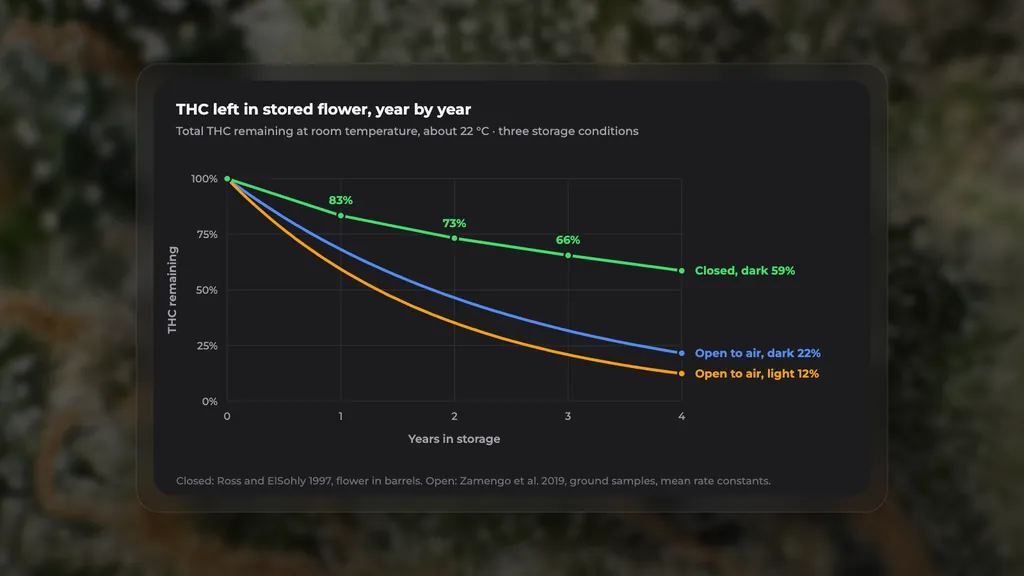
The longest data set on flower comes from the University of Mississippi. Plant material kept in closed barrels in the dark at 20 to 22 °C lost on average 16.6% of its THC after one year, 26.8% after two, 34.5% after three and 41.4% after four. The loss was fastest in the first year and then settled at about seven points a year (Ross and ElSohly, 1997).
An Italian forensic laboratory tested the other extreme: seized cannabis and hashish, ground to a fine powder and kept in containers closed only with gauze, in light or in the dark at 22 °C. The first 100 days cost about 13% of the THC in light and 11% in the dark. The average rates they measured correspond to about 41% lost after one year in light and 32% in the dark, and after four years most of the THC was gone (Zamengo et al., 2019).
Between those two sits the case most growers care about. In ground flower sealed in the dark at 20 °C, total THC fell by about 2% a month (Meija et al., 2022). In ground flower sealed in single-dose cartridges at 25 °C, total THC was down 21% after two years, with THCA down 44% and CBN up 28-fold (Aviram et al., 2022).
There is no single yearly figure. First-year losses in these studies run from about 17% to about 40%, and the conditions explain the gap.
Temperature: cupboard, fridge or freezer
Temperature is the strongest lever. In the Italian study, samples kept at 4 °C changed less than those at 22 °C, and at −20 °C neither THC nor CBN changed significantly in four years (Zamengo et al., 2019). A two-year study on commercial flower concluded that THC flower should be refrigerated to keep its cannabinoid content consistent, while CBD was more stable, so room temperature may be enough for CBD flower (Reason et al., 2022).
A kinetic study at Canada’s National Research Council stored ground flower at six temperatures from −20 to 40 °C and fitted one model to all of it. Its rule is easy to remember: the time THCA takes to fall to 85% of its starting value doubles with every 5 °C of cooling (Meija et al., 2022).
Read the other way, THCA in a store room at 30 °C goes four times faster than at 20 °C. The same authors add that a fridge is not a stop button: for reference materials, even 4 °C fell short of long-term stability.
Light
The first systematic study, in 1976, named light as the greatest single factor in the loss of cannabinoids, ahead of temperature and air (Fairbairn et al., 1976). The Italian data put a number on it: the rate of THC loss was about 36% higher in light than in the dark at the same temperature. Light did not speed up the formation of CBN, so the extra THC went somewhere else (Zamengo et al., 2019). Ultraviolet light accelerates the loss further (Reason et al., 2022).
Clear glass on a shelf is the worst container in the house. Brown glass, a tin or a closed cupboard solves it for free.
Air, grinding and the container
Trichome heads are the plant’s own packaging. Fairbairn described the glands as “well filled, well closed containers” and found that losses fell when they were left undamaged. Grinding breaks them: ground flower formed more CBN than whole flower and held fewer terpenes at every temperature (Milay et al., 2020). Keep flower whole until the day it is used.
For containers, a six-month comparison at 18 °C kept hemp flower in a tight brown glass bottle, in an airtight HDPE plastic box or on an open tray. Glass kept the volatile profile best. The plastic box behaved like the open tray, which the authors put down to the permeability of the plastic to water and oxygen (Spadafora et al., 2024).
Removing oxygen sounds like the obvious next step, but the trials so far do not show much. Flower canned under nitrogen with about 4% residual oxygen was no different from flower canned in air after 74 days, for total cannabinoids and for total terpenes (MacLaughlin and MacDonald, 2024), and an argon headspace did not reduce terpene loss in glass jars (Bueno et al., 2020). Under vacuum at 4 °C, two sesquiterpenes that declined by 15 to 22% in air-filled bags held steady over four months (Birenboim et al., 2024). The evidence is short-term and thin in both directions: a full, airtight jar matters more than the gas inside it.
Terpenes go first
Aroma is lost on a different clock. In a classic experiment, buds lost 31% of their volatile oil in one week of drying at room temperature. After one more month in a paper bag the loss was 45%, and after three months 55%, all measured against the fresh bud (Ross and ElSohly, 1996). Monoterpenes such as myrcene and limonene went faster than the heavier sesquiterpenes: their share of the oil fell from 92% to 62%.
Closed containers slow this down but do not stop it. In cured flower kept in closed bottles in the dark, the average terpene concentration had fallen by more than half after four months, with significant losses at every temperature from 25 °C down to −80 °C, while the cannabinoids made by the plant had lost 26% on average after a whole year (Milay et al., 2020). The deep freezer was the worst condition for terpenes in that study. Its authors recommend whole flower at 4 °C as the best compromise for both.
Over weeks the picture is better: intact flower in airtight glass jars lost about 12% of its terpenes on average over two to six weeks (Bueno et al., 2020). The practical reading is that potency keeps for many months and aroma for a few. Flower sold or smoked within three months of the cure is a different product from the same flower at nine.
Humidity: dry first, then hold
Storage starts with the right dryness. The ASTM standard for dry cannabis flower sets a water activity of 0.55 to 0.65: above it mould can grow, below it the flower turns brittle and breaks in handling (ASTM D8197-22). The standard is about mould and breakage, not about potency. We found no peer-reviewed trial showing that two-way humidity packs preserve terpenes or cannabinoids; what they do is hold the jar inside the range, which is reason enough. Getting there is the subject of our guide to drying and curing.
How to store it
- Whole, not ground. Trim, but leave the flower intact and handle it as little as possible.
- Airtight glass, filled. Brown glass or clear glass kept in the dark, sized so that little air is left above the flower. Plastic bags and boxes let water and oxygen through.
- Dark. A cupboard, a tin or an opaque outer box. No display jars in daylight.
- Cool. Below 20 °C for weeks, a fridge at about 4 °C for months. Every 5 °C counts.
- Cold jars stay closed. Let a jar from the fridge or freezer reach room temperature before opening it, or moisture from the air condenses on the flower.
- Freezer for potency, not for aroma. At −20 °C cannabinoids barely move for years, but terpenes did worst in flower kept below −20 °C. Use it for material that will be extracted or tested, not for jars you open often.
- Dated. Harvest date, jar date and, for a business, the test date on every container. Sell and use the oldest first.
A storage checklist
- Dry and cure to a water activity of 0.55 to 0.65 before long storage.
- Pack whole flower in airtight glass and fill the container.
- Keep it in the dark, away from heat sources, below 20 °C.
- Move anything meant to last more than three months to a fridge at about 4 °C.
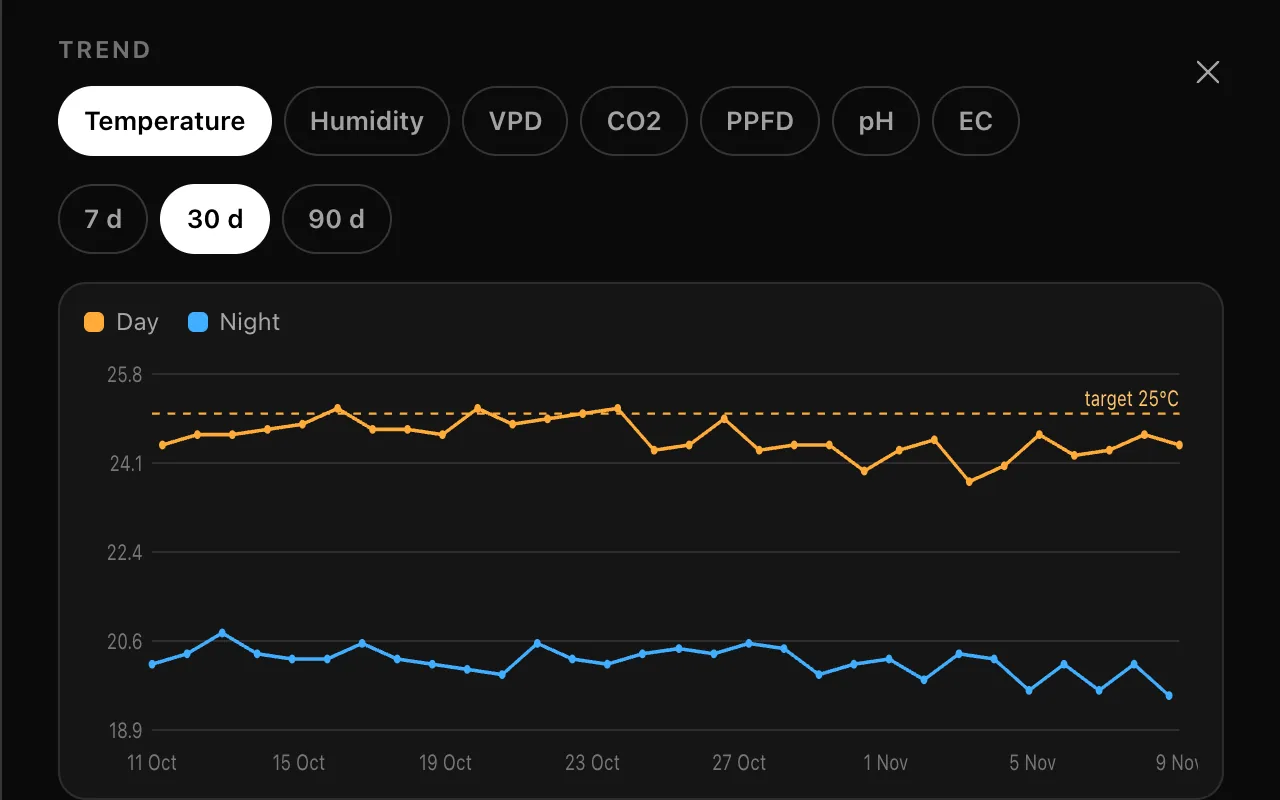
- Log the temperature and humidity of the store room like any other room.
- Label every container with harvest and packing dates.
- Retest potency before selling flower that is more than six months old.
References
- ASTM International (2022). ASTM D8197-22: Standard Specification for Maintaining Acceptable Water Activity (aw) Range (0.55 to 0.65) for Dry Cannabis Flower Intended for Human/Animal Use. West Conshohocken, PA.
- Aviram J, Atzmony D, Frenklakh A, Kroll A, Zaks I, Hazekamp A (2022). THC degradation does not impair the accuracy of THC doses aerosolized by the metered-dose SyqeAir inhaler: a 24-month stability trial. Journal of Cannabis Research 4:55.
- Birenboim M, Chalupowicz D, Kenigsbuch D, Shimshoni JA (2024). Improved long-term preservation of cannabis inflorescence by utilizing integrated pre-harvest hexanoic acid treatment and optimal post-harvest storage conditions. Plants 13(7):992.
- Bueno J, Leuer E, Kearney M, Green EH, Greenbaum EA (2020). The preservation and augmentation of volatile terpenes in cannabis inflorescence. Journal of Cannabis Research 2:27.
- Fairbairn JW, Liebmann JA, Rowan MG (1976). The stability of cannabis and its preparations on storage. Journal of Pharmacy and Pharmacology 28(1):1–7.
- MacLaughlin LL, MacDonald MT (2024). Is nitrogen-modified atmosphere packaging a tool for retention of volatile terpenes and cannabinoids in stored Cannabis sativa inflorescence? Journal of Cannabis Research 6:42.
- Meija J, McRae G, Miles CO, Melanson JE (2022). Thermal stability of cannabinoids in dried cannabis: a kinetic study. Analytical and Bioanalytical Chemistry 414(1):377–384.
- Milay L, Berman P, Shapira A, Guberman O, Meiri D (2020). Metabolic profiling of cannabis secondary metabolites for evaluation of optimal postharvest storage conditions. Frontiers in Plant Science 11:583605.
- Reason DA, Grainger MNC, Lane JR (2022). Optimal storage conditions of commercial cannabis crops. Industrial & Engineering Chemistry Research 61(39):14691–14701.
- Ross SA, ElSohly MA (1996). The volatile oil composition of fresh and air-dried buds of Cannabis sativa. Journal of Natural Products 59(1):49–51.
- Ross SA, ElSohly MA (1997). CBN and Δ9-THC concentration ratio as an indicator of the age of stored marijuana samples. Bulletin on Narcotics 49–50(1–2):139–147.
- Spadafora ND, Felletti S, Chenet T, Sirangelo TM, Cescon M, Catani M, De Luca C, Stevanin C, Cavazzini A, Pasti L (2024). The influence of drying and storage conditions on the volatilome and cannabinoid content of Cannabis sativa L. inflorescences. Analytical and Bioanalytical Chemistry 416(16):3797–3809.
- Zamengo L, Bettin C, Badocco D, Di Marco V, Miolo G, Frison G (2019). The role of time and storage conditions on the composition of hashish and marijuana samples: a four-year study. Forensic Science International 298:131–137.